First, I apologise for the vague title. I couldn't think of a short way to represent the problem. Also, I am aware that a similar question exists, but I have a little bit more insight.
The problem is:
A man is known to speak the truth three out of four times. He throws a die and reports that it is a six. Find the probability that it actually is a six.
The answer in the book is $ \frac{3}{8} $, which sounds completely off to me, given the numbers, on first glance. I decided to try it on my own. After some contemplation, it indeed is true that $ \frac{3}{8} $ is correct. But, the question's vagueness makes it interesting. It's sort of a naive answer!
First, here's the book's solution:
Let $ E $ be the event that the man reports that a six occurs, $ S_1 $ be the event that six occurs and $ S_2 $ be the event that six does not occur.
$ P(S_1) $ = Probability that six occurs = $ \frac{1}{6} $
$ P(S_2) $ = Probability that six does not occur = $ \frac{5}{6} $
$ P(E~|S_1) $ = Probability that the man reports that a six occurred when it has actually occurred (truth) = $ \frac{3}{4} $
$ P(E~|S_2) $ = Probability that the man reports that a six occurred when it hasn't actually occurred = $ \frac{1}{4} $
$ P(S_1|E) $ = Probability that a six has actually occurred when the man claims so =
$$ \frac{P(S_1)~P(E~|S1)}{P(S_1)~P(E~|S_1)+P(S_2)~P(E~|S_2)} = \frac{3}{8} $$
Link to original: Page 25 of this (link updated 22/11/2015; tends to break often).
Here's the first of my two solutions:

The question is a little vague and it doesn't tell us what the man says when he doesn't get a six. Assuming he lies every time he doesn't get a six (which is not quite what the question says), would bring up $ P(E~|S_2) $ to $ 1 $, which skyrockets $ P(lie) $ to $ \frac{1}{6} + \frac{1}{6} + \frac{1}{6} + \frac{1}{6} + \frac{1}{6} + \frac{1}{6}.\frac{1}{4} = \frac{7}{8} $.
Also, $ P(E~|S_1) = \frac{3}{4} $ and $ P(E) = \frac{5}{6} + \frac{1}{6}.\frac{3}{4} = \frac{23}{24} $.
This brings us to, $$ P(S_1|E) = \frac{P(S_1)P(E~|S_1)}{P(E)} = \frac{3}{23} = 13.04\% $$
Please note that I don't care about the sixes rolled when he lies about it being a six, because that condition is not applicable to the question.
I'm very skeptical about my calculations! I decided to whip up a simple program and see what the probability distribution is for $$ \frac{Number~of~sixes~rolled~while ~saying~it's~a~six}{Number~of~dice~rolls} $$
Here's the result:
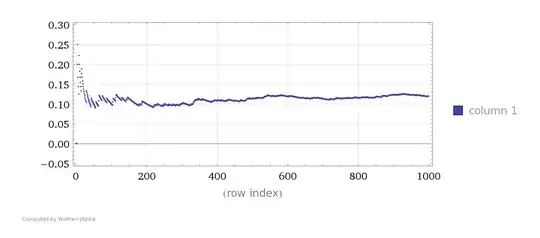
Considering the book says $ P(E~|S_2) = \frac{1}{4} $, which is in essence is contradictory to the question, let's also consider the other possibility:

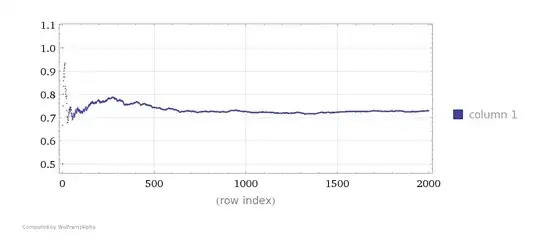
It's even more vague in this scenario! If the man lies after any given roll, there is a $ \frac{1}{5} $ probability that he will lie about it being any other number. This creates a new branch at each lie, which splits into five. In this case,
$$ P(E) = \frac{1}{6}.\frac{1}{4}.\frac{1}{5}.\frac{5}{1}+\frac{1}{6}.\frac{3}{4} = \frac{1}{6} $$
$ P(E~|S_1) $ still remains $ \frac{3}{4} $, but $ P(E~|S_2) = \frac{1}{4}.\frac{1}{5} = \frac{1}{20} $.
$$ P(S_1|E) = \frac{P(S_1)P(E~|S_1)}{P(E)} = \frac{3}{4} = 75\% $$
This seems like the more intuitive answer, and it is why I doubted the original answer in the first place. Given a truth probability of $ \frac{3}{4} $, there was no way that the probability of a six was $ 37.5\% $!
The ambiguity of the question is what makes $ \frac{3}{8} $ wrong to me. Entirely out of curiosity, which answer fits best with the question and are these calculations correct or baloney?


