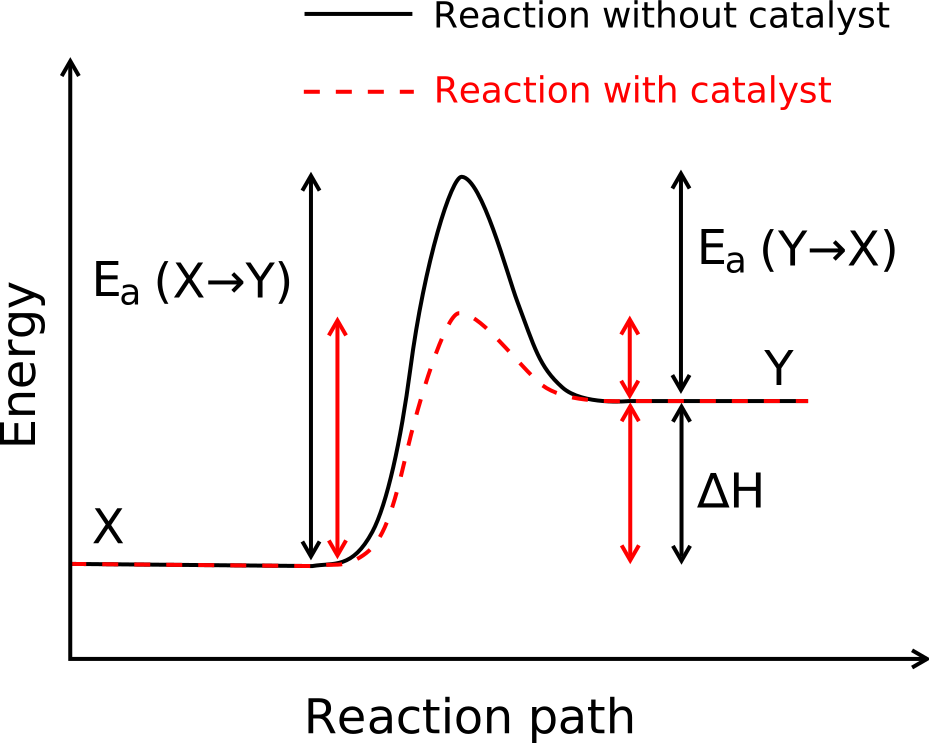
Without a kinetic model, there isn't much that can really be done here that is guaranteed to make physical sense. In terms of getting a reasonable picture, the problem with just taking a quadratic that passes through the three points is that the peak is not in the middle of the reaction coordinate. Even if it were, the energy graph is not symmetric about the peak, whereas a quadratic function is symmetric about the vertex. So if you're going to use a polynomial, you need a higher degree polynomial to make it work.
If I had to plot $(0,0),(1,E_1),(2,E_2)$ in a context like this one, I would probably use Hermite interpolation. This is a lot like the polynomial interpolation you're familiar with except that it also allows you to enforce the values of the derivative at the points. Here I would require
$$g(0)=0 \\
g'(0)=0 \\
g(1)=E_1 \\
g'(1)=0 \\
g(2)=E_2 \\
g'(2)=0.$$
This makes the graph flat at each of the points being interpolated. These are six conditions which means I would need a polynomial of degree $5$.
This problem can be solved by writing
$$g(x)=a x^5 + b x^4 + \dots + f$$
and then solving the six equations in six unknowns. A better way to solve it is to use a variant of Newton interpolation. Here we would write the function in the form
$$g(x)=a+bx+cx^2+dx^2(x-1)+ex^2(x-1)^2+fx^2(x-1)^2(x-2).$$
I will omit an explanation of how I came up with this form; if you look up Newton divided differences you will find plenty of material on the subject. This approach is better because it makes the system triangular. This means we can solve it entirely by back-substitution, as follows:
$$g(0)=a=0 \\
g'(0)=b=0 \\
g(1)=c=E_1 \\
g'(1)=2E_1+d=0 \Rightarrow d=-2 E_1$$
and so forth, with each new equation giving us a coefficient. Examples of final solutions:
$$E_1=2,E_2=1: \: g(x)=2x^2-4x^2(x-1)+2.25x^2(x-1)^2-0.75x^2(x-1)^2(x-2) \\
E_1=2,E_2=-1: \: g(x)=2x^2-4x^2(x-1)+1.75x^2(x-1)^2+0.75x^2(x-1)^2(x-2)$$
The first one is endothermic ($\Delta E=1$); the second is exothermic ($\Delta E=-1$); both have activation energy $2$. You can check to see if these have the shape that you want.