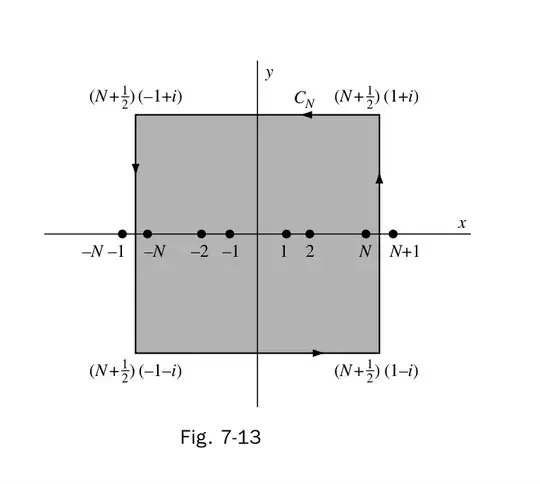
Here is an unorthodox answer that needs some more work to make it rigorous.
Consider $$f(z) = \frac{\psi(-z)}{(z+1)(z+2)^3}.$$
We can certainly integrate around a circular contour as ML gives $2\pi R\times \log R/R^4.$
Now we have
$$\mathrm{Res}_{z=0} f(z) = \frac{1}{8},$$
$$\mathrm{Res}_{z=-1} f(z) = -\gamma,$$
$$\mathrm{Res}_{z=-2} f(z) = \frac{\pi^2}{6} +\zeta(3) - 3 +\gamma,$$
and finally
$$\mathrm{Res}_{z=n} f(z) = \frac{1}{(n+1)(n+2)^3},$$
This means that the sum is
$$\frac{23}{8} - \frac{\pi^2}{6} -\zeta(3).$$
Addendum.
To see how to calculate the residue of $f(z)$ at $z=-2$ use the Cauchy
Integral Formula for the series coefficients which is
$$\frac{1}{2\pi i}
\int_{|z+2|=\epsilon}
\frac{\psi(-z)}{(z+2)^{n+1}} \; dz.$$
Put $z+2 = -w$ to get
$$- \frac{(-1)^{n+1}}{2\pi i}
\int_{|w|=\epsilon}
\frac{\psi(w+2)}{w^{n+1}} \; dw$$
which is
$$\frac{(-1)^n}{2\pi i}
\int_{|w|=\epsilon}
\frac{1}{w^{n+1}}
\left(\frac{1}{w+1} + \psi(w+1)\right) \; dw$$
The first component can be evaluated to give the series
$$1+(z+2)+(z+2)^2+(z+2)^3+\cdots$$
(remember that the CIF integral gives the coefficient on $(z+2)^n.$)
The second component is
$$\frac{(-1)^n}{2\pi i}
\int_{|w|=\epsilon}
\frac{1}{w^{n+1}}
\psi(w+1) \; dw$$
The rational zeta series for the digamma function is
$$\psi(z+1) = -\gamma - \sum_{k\ge 1} \zeta(k+1) (-z)^k$$
for $|z|<1.$
It follows that the second component gives the series
$$-\gamma - \sum_{k\ge 1} \zeta(k+1) (z+2)^k.$$
This finally yields
$$\psi(-z)
= 1-\gamma + \sum_{k\ge 1} (1-\zeta(k+1)) (z+2)^k.$$
Now since
$$\frac{1}{z+1} = \frac{1}{-1+z+2}
= -\frac{1}{1-(z+2)}
= -1 - (z+2) - (z+2)^2 - (z+2)^3 -\cdots$$
The desired residue is
$$-(1-\zeta(3)) - (1-\zeta(2)) - (1-\gamma)
= -3 + \gamma + \frac{\pi^2}{6} + \zeta(3).$$