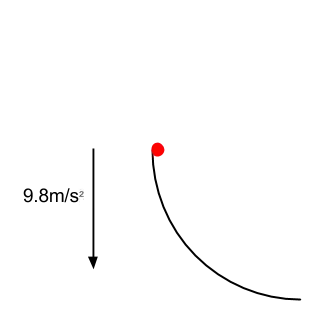
Let $g=9.8\,\mathrm{m}/\mathrm{s}^2$ be the acceleration due to gravity, $r$ the radius of the circular arc, $s$ the distance the object has traveled from the start, and $\theta$ the angle of declination of the object from the center of the circular arc.
Then at angle $\theta$ the acceleration in the direction of the path would be $g\cos\theta$. Therefore,
$$\frac{d^2s}{dt}=g\cos\theta$$
Substituting $\theta=\dfrac sr$,
$$\frac{d^2s}{dt^2}=g\cos\left(\frac sr\right)$$
We have the initial conditions $\theta(0)=0$ and $\frac{d\theta}{dt}=0$. So we just have an initial value problem to solve to find $s$. Differentiate that to get your desired speed.
This is similar to the formula for a pendulum. In fact, If you replace $s$ with $\dfrac{{\pi}r}2-s$ (which is the distance to the bottom of the arc), then divide that by $r$ to change the unit, you get a the "Arbitrary-amplitude period" pendulum formula with special initial values. See the linked Wikipedia article for the solution to that--the solution involves elliptic integrals, which are beyond me.