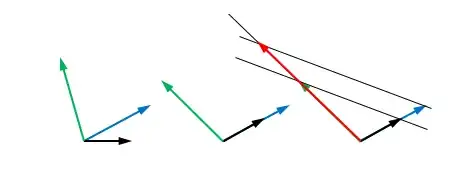
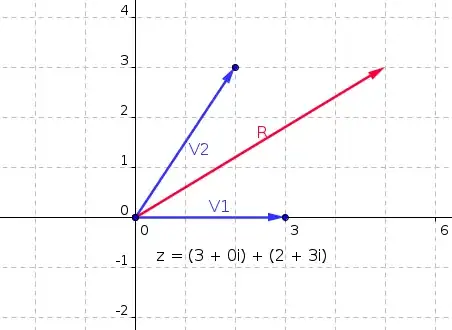
When dealing with complex numbers they can be presented as vectors, at least that is stated in my textbook. And the addition operation defined for complex numbers:
$$z_1 + z_2 = x_1 + x_2 + i(y_1 + y_2)$$
fully corresponds with the rules for vector addition.
But why the multiplication operation does not have a geometric (vector) representation? I wonder, because my textbook states that $\sqrt{i} = e^{\frac{i\pi}{4}}, e^{\frac{i5\pi}{4}}$, that is:
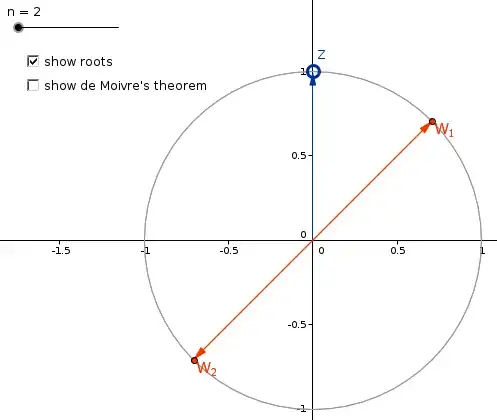
But if I try to multiply $W_1 \times W_2$ I will get a zero vector. And even if $W_1$ and $W_2$ were not collinear I would have get a vector which lies in another plane.
So, could anyone give me an answer about whether I'm correct at all and if I am whether any explanation of this situation exists, or may be I just have to live with it?
Thank you.