0

I have been having trouble understanding the translation of a graph. I understand the 'rule in the sense that the '$+$' shifts to the left and the '$-$' to the right when dealing with something like e.g. $f(x + 2) = f(x)$.

In the book I am using it has written that if $g(x) = f(x-c)$, where $c > 0$ then the value of $g$ at $x$ is the same as the value of $f$ at $x-c$.

So ...if $c = 2$ and my function for $g$ was $g(x) = x^2$ and I put in $x=3$ I'd get $9$. For $f(x-c)$ I don't quite understand this part. Am I wanting to put in the same $x$ (i.e. $x = 3$) which would give me $f(3-1) = f(1) = g(3) = 9$. When I do this it seems to work against how I thought it would go. To me this implies that in $g(x)$ when I input $3$ for $x$ I'd get a $y$ value of $9$. Then when I input $x=3$ in the function for '$f$' I'd end up with $f(1)$ provides me with $9$. It seems $g(1)$ is going back $2$ spaces to the left when compared to $f(3)$ in order to get the answer $9$ (based on $3-1 =2 $, from within the functions respective brackets)

Clearly I misunderstand something here.....

N. F. Taussig
  • 76,571

3 Answers3

1

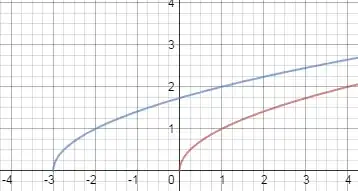
I personally think of it like this. Let's use the graphs of $f(x) = \sqrt{x}$ and $g(x) = \sqrt{x - 3}$.

enter image description here

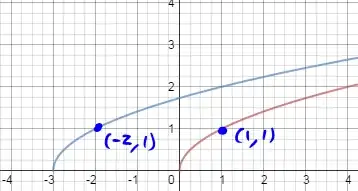
In this picture, $f(x) = \sqrt{x}$ is in red. Now, when we look at $g(x) = \sqrt{x+3} = f(x+3)$, it's getting a head start, so it hits all the same $y$-values, but earlier than regular $\sqrt{x}$.

So, while $\sqrt{x} = 1$ when $x = 1$, the function $\sqrt{x+3} = 1$ when $x = -2$, which is $3$ units earlier than $f(x)$.

enter image description here

And this keeps happening! The function $f(x)$ is always $3$ units behind $g(x) = f(x + 3)$, if you think of the $x$-axis as time; the further to the left $g(x)$ is, the more of a head start it's got. So while $f(x) = 1$ when $x = 1$, the function $g(x)$ has already raced ahead, and $g(x) = 2$ when $x = 1$. It takes $f(x)$ an extra $3$ units to hit $f(x) = 2$, when $x = 4$.

That's what helps me understand the counter-intuitive horizontal shifts, anyway: it's going to take $f(x)$ longer than $f(x + 3)$ to reach the same spot in their journey. Being to the right on the $x$-axis means its taking longer (higher $x$-values) to get to the same spot.

pjs36
  • 17,979
0

You are correct in supposing that if you had some function $f(x)$, then if you let $c > 0$ and tried to plot $f(x-c)$, you would get the graph of $f(x)$ shifted $c$ to the right. So if $g(x) = f(x-c)$, then $g$ is the graph that results from shifting $f$ $c$ to the right.

The part where your confusion is forgivable is where you have a $g$ that is fixed, but you're trying to recover the original $f$. If as you suggest you fix $g(x) = x^2$, fix $c=2$ to get a handle on things, and define $f$ to be such that $g(x)=f(x-2)$, then $f$ must be the $x^2$-looking parabola whose vertex is at $(-2,0)$. (This is so because when you shift such a graph $2$ to the right, you get the $x^2$-looking parabola whose vertex is at $(0,0)$, i.e., $g$.)

Let's see this by plotting a few points:

$f(-5) = f(-3 - 2) = g(-3) = 9$

$f(-4) = f(-2 - 2) = g(-2) = 4$

$f(-3) = f(-1 - 2) = g(-1) = 1$

$f(-2) = f(0 - 2) = g(0) = 0$

$f(-1) = f(1 - 2) = g(1) = 1$

$f(0) = f(2 - 2) = g(2) = 4$

$f(1) = f(3 - 2) = g(3) = 9$

$f(2) = f(4-2) = g(4) = 16$

$f(3) = f(5 - 2) = g(5) = 25$

Notice how if you have to calculate values for $f$ in this scenario, you have to massage the input to $f$ a little bit to get it of the form into something that you do know to compute. The general description for this $f$ would be $f(x) = f((x+2)-2) = g(x+2) = (x+2)^2 = x^2 + 4x + 4$.

Usually, one starts with an $f$, and then shifts it around to obtain new graphs that obey the properties that they're interested in.

Ken
  • 3,751
-2

Original function: $g(x)= F(x-h)$ -used for horizontal translations only

If a positive number were used or plugged in for "$h$", then essentially it would become negative thus "$+$" equals left, to the negatives side or left. Similarly, if a negative number was used, then the two negatives would become a positive, so the graph would move to the positive side or right. This is why horizontal translations are counteractive.

tarit goswami
  • 3,009
  • 1
  • 12
  • 27