Why is
$$\sum_{k=1}^n \log k \ge \int_1^n \log x \, dx$$
is there an intuitive or graphical way to think about it?
Why is
$$\sum_{k=1}^n \log k \ge \int_1^n \log x \, dx$$
is there an intuitive or graphical way to think about it?
Hint 1: $\int_1^n \log x \, dx =\sum_{k=2}^n \int_{k-1}^k \log x \, dx $
Hint 2: If $x \in [k-1,k]$ then $\log(x) \leq \log(k)$.

Consider that $\log(x)$ is an increasing function and that $\log(1)=0$, then look at the following plot:
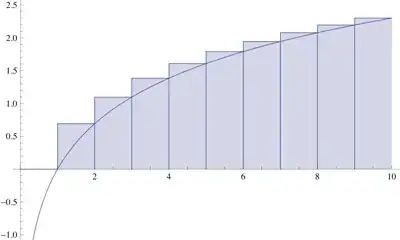
Normally, if $f(x)$ is an increasing function, then, for $a,b\in\mathbb{Z}$, $$ \sum_{k=a+1}^bf(k)\ge\int_a^bf(x)\,\mathrm{d}x $$ but since $f(a)=\log(1)=0$, we can include $1$ in the summation.

Draw a picture of $\log x$ and the left and right Riemann sums corresponding to the integral with interval width $1$. Which one matches the sum on the left hand side?


