the exercise says: If $a_1,\ldots,a_n\ge0$ then the A-M is $A_n=\frac{a_1+\cdots+a_n}{n}$ and G-M is $G_n=\sqrt[n]{a_1a_2\cdots a_n}$ we would like to show that $G_n\le A_n$
(1) suppose that $a_1<A_n$ then some $a_i>A_n$, for convenience say $a_2>A_n$ Let $\overline{a}_1=A_n$ and $\overline{a}_2=a_1+a_2-\overline{a}_1$ show that $$\overline{a}_1\overline{a}_2\ge a_1a_2$$
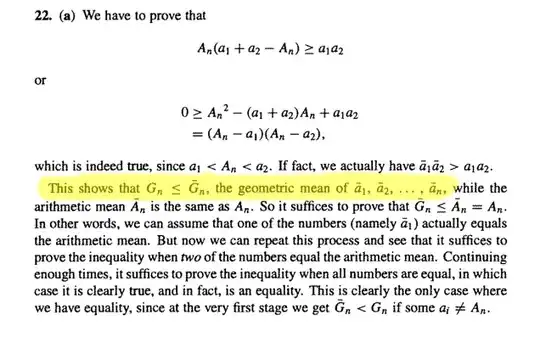
I can't understand how he concludes $G_n\le \overline{G}_n$, maybe he says suppose that $a_3<A_n$ then for convenience say $a_4>A_n$, and so $$\overline{a}_1\overline{a}_2\ge a_1a_2\\ \overline{a}_3\overline{a}_4\ge a_3a_4\\ \vdots \\ \overline{a}_{n-1}\overline{a}_n\ge a_{n-1}a_n$$ and multiply each to get the result but what if $a_3=A_n$? is there a more rigorous proof? also i can't understand the rest of what he says if anyone can clarify it
thanks in advance
