5

There is a result which I think is true but it's not written anywhere. Since I just began studying algebraic geometry, it's hard to figure out this by myself.

Let $K$ be a field, $X\subset\mathbb{A}^n_k$ and $Y\subset\mathbb{A}^m_k$ be affine varieties. Then consider a morphism $f:X\to Y$, such that $f(p) = (f_1(p),\ldots, f_m(p))$, with $f_i\in K[x_1,\ldots, x_n]$ for $i=1\ldots m$.

This morphism induces a homomorphism $\phi: K[Y]\to K[X]$ between the coordinate rings $K[X] = K[x_1,\ldots, x_n]/I(X)$ and $K[Y] = K[x_1,\ldots,x_m]/I(Y)$. It is defined by $\phi(y_i+I(Y)) = f_i+I(X)$. We can also go the reverse way and induce a morphism from this kind of homomorphism, in fact there is a bijection between these morphisms and homomorphisms.

It is possible to go a step further and define a map (which is also called a morphism) $\phi^*:Spec(K[X])\to Spec(K[Y])$ given by $\phi^*(P) = \phi^{-1}(P)$. We say that $\phi^*$ is induced by $\phi$.

From my reading, looks like $f$ is a isomorphism $\iff\phi$ is a isomorphism $\iff\phi^*$ is a isomorphism. I want to know if this is true. Also, it's said that obtaining $\phi^*$ from $\phi$ is a generalization of obtaining $\phi$ from $f$, how is that so?

ADD: some important definitions below.
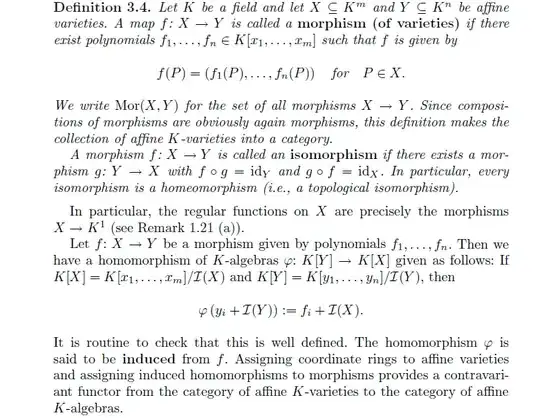
mor

Sorry if the doubts are dumb, I'm still trying to get the big picture. I feel a little lost, so I would appreciate simple explanations. Thank you.

Integral
  • 6,554
  • What is the difference between Spec$(K[X])$ and $X$? – Theo Douvropoulos Apr 12 '15 at 19:09
  • @Theo The first one are polyomials, the second one are points.I don't know how to treat them as the same. Probably I'm missing something there. – Integral Apr 12 '15 at 19:13
  • My previous comment was wrong, because I misunderstood your question. The answer depends on what you call isomorphism. – user40276 Apr 12 '15 at 19:13
  • The category of reduced finitely generated $k$-algebras is anti-equivalent to the category of affine varieties. But the isomorphism, in the category of affine varieties, is a sheaf isomorphism. If you just mean homeomorphism, then it's not true. – user40276 Apr 12 '15 at 19:15
  • To understand how $\phi^{*}$ is a generalization of $f$, you must know the Nullstellensatz. – user40276 Apr 12 '15 at 19:17
  • $K[X]$ is the polynomials, I thought Spec$(K[X])$ is again a topological space with points for each of the prime ideals... Is the only difference between $X$ and Spec$(K[X])$ as topological spaces, the extra points that Spec$(K[X])$ has because of the prime but not maximal ideals? – Theo Douvropoulos Apr 12 '15 at 19:18
  • 1
    @Theo The difference between $X$ and $\text{Spec}(K[X])$ is by a very dense inclusion by adding the prime ideals ($X \hookrightarrow \text{Spec} (K[X])$). By very dense, I mean that the lattices of open sets are isomorphic. – user40276 Apr 12 '15 at 19:20
  • The morphism $f$ and isomorphism is defined in the image I just added, the last morphism $\phi^*$ is defined in the same way. But the isomorphism from $\phi$ is a ring isomorphism (if I understand correctly). – Integral Apr 12 '15 at 19:21
  • I'm gonna read the comments now. – Integral Apr 12 '15 at 19:21
  • @user40276 I know the Nullstellensatz, I guess I just don't know how to use it to conclude this generalization. I would be very pleased with an answer explaining the reasoning behind this. Also I need to know which of my implications are correct. – Integral Apr 12 '15 at 19:28
  • $f: X \rightarrow Y$ induces a morphism $f^{#} : K[Y] \rightarrow K[X]$ given by composition. You must conclude that $(f^{#})^{*} = f$ where you consider, instead of $\text{Spec}$, the maximal spectrum. – user40276 Apr 12 '15 at 19:32
  • I'll have to spend some time checking this, it's still not clear. Probably I'll comment more later. But thanks for the help for now. – Integral Apr 12 '15 at 19:42
  • If you have difficult in proving these stuff, I think that in Wedhorn and Görtz's book this is all proven. – user40276 Apr 12 '15 at 19:53

1 Answers1

4

It's true that an algebraic map of Zariski-closed subsets of $K^n$ (this is not what "affine variety over $K$" means unless $K$ is algebraically closed) is an isomorphism iff the induced map on rings of functions is an isomorphism. The point is that an inverse map on rings of functions provides the components of an algebraic map which inverts the original map.

Depending on what you mean by $\text{Spec }$, though, the last part of the equivalence does not hold. Let me assume for simplicity that $K$ is algebraically closed. Consider the map

$$\mathbb{A}^1 \ni t \mapsto (t^2, t^3) \in \mathbb{A}^2.$$

The image of this map is the variety $\{ y^2 = x^3 \}$, with ring of functions $K[x, y]/(y^2 - x^3)$. The induced map

$$K[x, y]/(y^2 - x^3) \ni f(x, y) \mapsto f(t^2, t^3) \in K[t]$$

on rings of functions is not an isomorphism because its image does not contain $t$. But the induced induced map on prime ideals is an isomorphism (of sets).

From a differential-geometric point of view, the problem is that the map $t \mapsto (t^2, t^3)$ does not induce an isomorphism on Zariski tangent spaces at the origin; that is, it is neither an immersion nor a submersion at the origin. This discrepancy cannot be detected at the level of prime ideals, but it can be detected using a non-prime ideal, namely the ideal $(t^2)$.

If you haven't already, it would be good at this point to spend some time studying the Nullstellensatz.

Qiaochu Yuan
  • 419,620