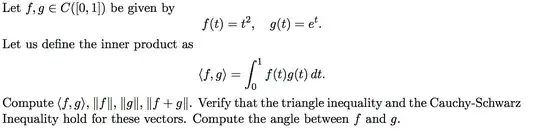
An inner product $V$ on a real vector space $E$ is a form which is symmetric positive definite. This means that:
- form: $V:E\times E\mapsto\mathbb{R}$,
- symmetric: for all $x,y\in E$, we have that $V(x,y)=V(y,x)$,
- positive: for all $x\in E$, we have that $V(x,x)\ge0$,
- definite: if for some $x\in E$, we have that $V(x,x)=0$, then $x=0$.
If $E=\mathbb{R}^n$, it is easy to see that $V(x,y)=x^Ty$ satisfies all those properties.
We can also see that if we take $E=\ell^2(\mathbb{R})$ which is the space of all $\mathbb{R}$-valued infinite sequences $(x_0,x_1,\ldots)$ such that $\sum_{i=0}^\infty x_i^2<\infty$, then the form $$V(x,y):=\sum_{i=0}^\infty x_iy_i$$ is also an inner-product on $E$.
Now, consider $E=C([0,1],\mathbb{R})$ which is the space of continuous functions from $[0,1]$ to $\mathbb{R}$. Recall also that an integral is also a sum, that is we have that
$$\int_0^1f(t)dt=\lim_{n\to\infty}\dfrac{1}{n}\sum_{i=0}^\infty f(t_i),\ t_i=i/n$$
which comes from the definition of a Riemann integral. So, the integral can be seen as averaged infinite sum.
Therefore, one can see that
$$\langle f,g\rangle=\lim_{n\to\infty}\dfrac{1}{n}\sum_{i=0}^\infty f(t_i)g(t_i),\ t_i=i/n$$
which as a very similar structure as the inner-product on $\ell^2$ where $x_i=f(t_i)$ and $y_i=g(t_i)$; the only difference being the factor $1/n$.
One can easily prove that this is indeed an inner product as it verifies all the conditions stated earlier.
So, in the end, an integral is nothing else but a continuous sum that acts on spaces of functions with continuous domain. Those functions can then be seen as vectors with infinitely many (a continuum) of indices.