Given three iid random variables, $X,Y,Z$ following a Uniform $(0,1)$ distribution. Then, how to find $\Pr(X>YZ)$?
Recently, I was asked this question in an interview, but I chocked there. Any hint will be appreciated.
Given three iid random variables, $X,Y,Z$ following a Uniform $(0,1)$ distribution. Then, how to find $\Pr(X>YZ)$?
Recently, I was asked this question in an interview, but I chocked there. Any hint will be appreciated.

The problem amounts to finding the right range over which to integrate the joint density function to satisfy the inequality $x\gt yz$. Firstly, $x$ can range from $0$ to $1$. Then for a given $x$, the $y,z$ satisfying $yz\lt x$ is shown by the shaded region of the diagram.
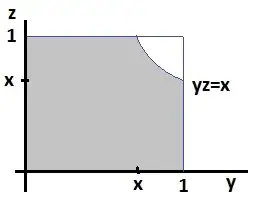
So we need to integrate in two pieces:
\begin{eqnarray*} P(X\gt YZ) &=& \int_{x=0}^1 \int_{y=0}^x \int_{z=0}^1 1\;dz\;dy\;dx + \int_{x=0}^1 \int_{y=x}^1 \int_{z=0}^{x/y} 1\;dz\;dy\;dx \\ &=& \int_{x=0}^1 \int_{y=0}^x 1\;dy\;dx + \int_{x=0}^1 \int_{y=x}^1 \dfrac{x}{y}\;dy\;dx \\ &=& \int_{x=0}^1 x\;dx + \int_{x=0}^1 \left[ x\ln{y} \right]_x^1\;dx \\ &=& \int_{x=0}^1 x\;dx - \int_{x=0}^1 x\ln{x} \;dx \\ &=& \left[\dfrac{1}{4}x^2(3-2\ln{x})\right]_0^1 \\ &=& \dfrac{3}{4}.\end{eqnarray*}
