I had originally written this up for another question but it seems fitting here as well. Maybe this can help someone.
Depending on how you introduced $e$, you might be able to use the fact that there are two sequences $(a_n)_{n \in \mathbb{N}}$, $(b_n)_{n \in \mathbb{N}}$ with
$$\begin{align}
a_n ~~~&:=~~~ \left ( 1 + \frac{1}{n} \right ) ^n \\ ~ \\
b_n ~~~&:=~~~ \left ( 1 - \frac{1}{n} \right ) ^{-n}
\end{align}$$
and
$$\underset{n \rightarrow \infty}{\lim} a_n ~~~=~~~ \underset{n \rightarrow \infty}{\lim} b_n ~~~=~~~ e \\ ~ \\$$
While both sequences converge to the same limit, $a_n$ approaches from the bottom and $b_n$ approaches from the top:
import numpy as np
import matplotlib.pyplot as plt
from matplotlib import rcParams
rcParams.update({'figure.autolayout': True})

pts = np.arange(0, 20, 1)
a_n = lambda n: (1+1/n)**n
b_n = lambda n: (1-1/n)**(-n)

plt.errorbar(x = pts, xerr = None, y = a_n(pts), yerr = None, fmt = "bx", markersize = "5", markeredgewidth = "2", label = "$a_n$")
plt.errorbar(x = pts, xerr = None, y = b_n(pts), yerr = None, fmt = "rx", markersize = "5", markeredgewidth = "2", label = "$b_n$")
plt.plot(pts, [np.exp(1)]*len(pts), color = "black", linewidth = 2, label = "$e$")
plt.xlim(1.5, 14.5)
plt.ylim(2.0, 3.5)
plt.legend(loc = "best")
plt.setp(plt.gca().get_legend().get_texts(), fontsize = "22")
plt.show()
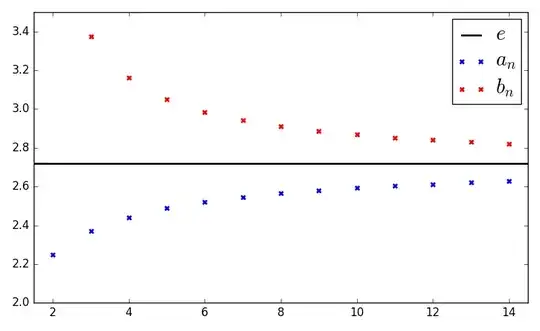
So we're going to use the following inequality:
$$\forall n \in \mathbb{N} ~ : ~~~~~ \left ( 1 + \frac{1}{n} \right ) ^n ~~~~<~~~~ e ~~~~<~~~~ \left ( 1 - \frac{1}{n} \right ) ^{-n} \tag*{$\circledast$} \\ ~ \\$$
Thesis
$$\forall n \in \mathbb{N}, ~ n \geq 2 ~ : ~~~~~ e \cdot \left ( \frac{n}{e} \right )^n ~~~~<~~~~ n! ~~~~<~~~~ n \cdot e \cdot \left ( \frac{n}{e} \right )^n \\ ~ \\$$
Proof By Induction
Base Case
We begin with $n = 2$ and get
$$\begin{align}
& ~ && e \cdot \left ( \frac{2}{e} \right )^2 ~~~~&&<~~~~ 2! ~~~~&&<~~~~ 2 \cdot e \cdot \left ( \frac{2}{e} \right )^2 \\ ~ \\
& \Leftrightarrow && e \cdot \frac{4}{e^2} ~~~~&&<~~~~ 1 \cdot 2 ~~~~&&<~~~~ 2 \cdot e \cdot \frac{4}{e^2} \\ ~ \\
& \Leftrightarrow && \frac{4}{e} ~~~~&&<~~~~ 2 ~~~~&&<~~~~ \frac{8}{e} \\ ~ \\
&\Leftrightarrow && 2 ~~~~&&<~~~~ e ~~~~&&<~~~~ 4 ~~~~ \\
\end{align}
$$
Which is a true statement.
Inductive Hypothesis
Therefore the statement holds for some $n$. $\tag*{$\text{I.H.}$}$
Inductive Step
$$\begin{align}
& ~ && e \cdot \left ( \frac{n+1}{e} \right )^{n+1} \\ ~ \\
& = && (n+1) \cdot \frac{1}{e} \cdot e \cdot \left ( \frac{n+1}{e} \right )^n\\ ~ \\
& = && (n+1) \cdot \left ( \frac{n}{e} \right )^n \cdot \left ( \frac{n+1}{n} \right )^n\\ ~ \\
& = && (n+1) \cdot \left ( \frac{n}{e} \right )^n \cdot \left ( 1 + \frac{1}{n} \right )^n\\ ~ \\
& \overset{\circledast}{<} && (n+1) \cdot \left ( \frac{n}{e} \right )^n \cdot e\\ ~ \\
& \overset{\text{I.H.}}{<} && (n+1) \cdot n!\\ ~ \\
& = && (n+1)!\\ ~ \\
& = && (n+1) \cdot n!\\ ~ \\
& \overset{\text{I.H.}}{<} && (n+1) \cdot n \cdot e \cdot \left ( \frac{n}{e} \right )^n\\ ~ \\
& = && (n+1) \cdot e \cdot \left ( \frac{n}{e} \right )^{n+1} \cdot e \\ ~ \\
& = && (n+1) \cdot e \cdot \left ( \frac{n+1}{e} \right )^{n+1} \cdot \left ( \frac{n}{n+1} \right )^{n+1} \cdot e \\ ~ \\
& = && (n+1) \cdot e \cdot \left ( \frac{n+1}{e} \right )^{n+1} \cdot \left ( 1 - \frac{1}{n+1} \right )^{n+1} \cdot e \\ ~ \\
& \overset{\circledast}{<} && (n+1) \cdot e \cdot \left ( \frac{n+1}{e} \right )^{n+1} \cdot \left ( 1 - \frac{1}{n+1} \right )^{n+1} \cdot \left ( 1 - \frac{1}{n+1} \right )^{-(n+1)} \\ ~ \\
& = && (n+1) \cdot e \cdot \left ( \frac{n+1}{e} \right )^{n+1} \\ ~ \\
\end{align}
$$
Conclusion
Therefore the statement holds $\forall n \in \mathbb{N}, ~ n \geq 2$.
$$\tag*{$\square$}$$


