I just read about the First and Second Isomorphism Theorems in the book Abstract Algebra by Dummit and Foote. After proving the Second Isomorphism Theorem, they said:
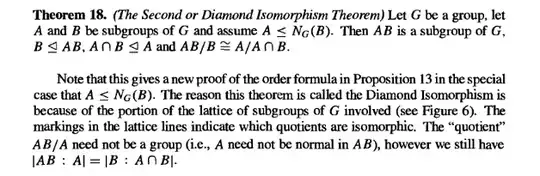
Proposition 13 isn't really important for my question (I guess) but anyway it is the one that states that if $H$ and $K$ are two finite subgroups of $G$ then $|HK|=\dfrac{|H||K|}{|H\cap K|}$.
I didn't understand why $|AB:A|=|B:A\cap B|$. It is obvious if $AB$ is finite because using the Second Isomorphism theorem we have $|AB:B|=|A:A\cap B|$ because $AB/ B \cong A/ A\cap B$. Then $$ |AB:B|=\dfrac{|AB|}{|B|}\quad\textsf{and}\quad|A:A\cap B|=\dfrac{|A|}{|A\cap B|}\\[0.3in] \implies\dfrac{|AB|}{|B|}=\dfrac{|A|}{|A\cap B|}\\[0.3in] \implies\dfrac{|AB|}{|A|}=\dfrac{|B|}{|A\cap B|} $$ which proves that $|AB:A|=|B:A\cap B|$, but this doesn't prove it if $A$ or $B$ is infinite and I believe there's a simple general proof that under the asssumptions in Theorem 18 we get $|AB:A|=|B:A\cap B|$. Could anyone please help me? If the proof is easy (and I guess so because they stated the relation in the book like if it was obvious) then could you give me hints?
Thank you in advance!

