8

Can anybody please show me the main branches and subbranches of mathematics and the statistical sciences in a hierarchical form? I am not a mathematician and often in my research I see a lot of new mathematical terms and theories. I need a way to find a proper path to learn those specific terms (so I first study their prerequisites and focus on just the necessary parts).

Examples of branches include, but are not limited to, algebra, linear algebra, calculus, arithmetic and analysis.

J W
  • 2,184
  • 5
    The thing looks more like a tangled web than a neat-looking tree... – J. M. ain't a mathematician May 10 '12 at 14:40
  • 7
    Asking for a hierarchial list of the main branches of math seems like an overly broad request. Why not tell us why you need such a list in the first place. Wanting one to be able to find a specific subject doesn't seem realistic. If you come across a new area of math in your research and you want to find out roughly what it is about, you can just Google it. – KCd May 10 '12 at 14:41
  • You could look through the tags on this site, which are described under the tags tab. That should give you some idea of the scope of mathematics, its subdivisions, and how some of the tangled web is linked together. – Mark Bennet May 10 '12 at 14:46
  • 2
    possible duplicate of this closed question: http://math.stackexchange.com/q/82660/1543 The closest thing to some sort of hierarchical classification is http://www.ams.org/mathscinet/msc/msc2010.html – Willie Wong May 10 '12 at 14:47
  • @KCd So when I see a new math term I can find out how much of its requirement I know. As you better know, math is so wide and unfortunately its subject are coupled with each other, Grasp in new math study area usually need extensive study in its prerequisites. – Real Dreams May 10 '12 at 14:48
  • @ J. M. So please explain just the parts that is like a tree and show me other relations in other way – Real Dreams May 10 '12 at 14:49
  • 2
    Have you even looked at Wikipedia? http://en.wikipedia.org/wiki/Areas_of_mathematics – Neal May 10 '12 at 15:01
  • 3
    There is no such thing. – AD - Stop Putin - May 10 '12 at 15:01
  • 2
    Maybe the Princeton Companion would be a good investment. – Neal May 12 '12 at 05:39
  • Here's a way to look at it, but there are many ways of looking at how the different branches of math are related. https://www.flickr.com/photos/95869671@N08/32264483720/in/dateposted-public/. Here's the accompanying video https://www.youtube.com/watch?v=OmJ-4B-mS-Y – sk8asd123 Jul 04 '20 at 02:41
  • There's also this representation by Quanta https://www.quantamagazine.org/the-map-of-mathematics-20200213/ – sk8asd123 Dec 05 '21 at 05:27
  • @sk8asd123 thanks for sharing it. It's incredible. – Real Dreams Dec 07 '21 at 09:10

3 Answers3

13

The Mathematical Atlas might be useful. Quote from the front page:

Welcome! This is a collection of short articles designed to provide an introduction to the areas of modern mathematics and pointers to further information, as well as answers to some common (or not!) questions. The material is arranged in a hierarchy of disciplines, each with its own index page ("blue pages").

EDIT: It seems that the website no longer available. However, you can still browse it through the internet archive: link.

5

A somewhat flawed but possibly useful classification can be found at here. This is the American Mathematical Society's mathematics subject classification.

  • Thanks, it is so detailed, I need just main relations between main branch and a short explanation of the special view port of the branches that make it another segment, I mean pure math no applied math – Real Dreams May 10 '12 at 14:56
  • The AMS classification includes probability and stochastic process and statistics as categories. I think I can say that probability and stochastic processes could be considered a branch of mathematics. But like many statisticians I do not see the field of statistics as a branch of methematics. While mathematics is used in statistical theory to for example determine properties of estimators, get asymptotic distributions and derive distributions for functions of a random variable it is methodology for data analysis – Michael R. Chernick May 10 '12 at 15:10
  • As such it has principles of inference that are used to evaluate patterns in data that can be separated from random noise. That activity is different from mathematics I think. – Michael R. Chernick May 10 '12 at 15:12
4

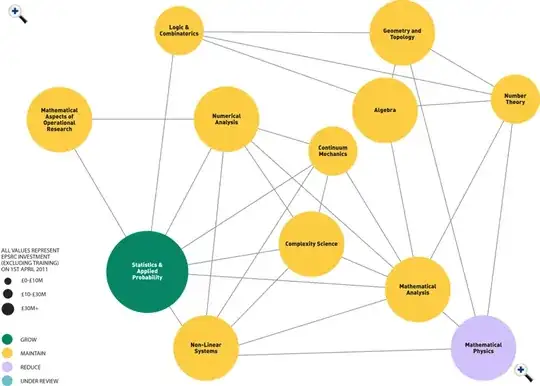
enter image description here

Source: EPRS, where it is available an A-Z list of all research areas within the EPSRC portfolio and all research areas within this theme.