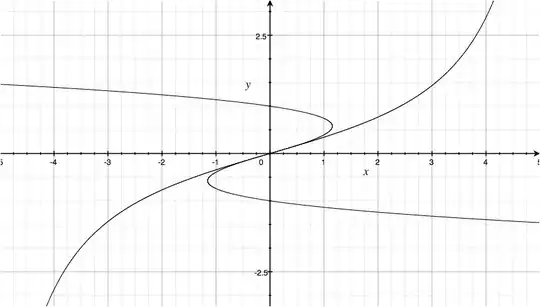
I only see numerical approaches to solve this equation. Is there an analytical solution to solve $x$ as a function of $y$ for the range $(0,2 \pi)$? If there is no solution, is it possible to proof it?
Asked
Active
Viewed 204 times
5

-
What do you mean by 'solve'? Are you trying to find zeroes? – J126 Jun 07 '12 at 18:15
-
2I would be extremely surprised if there were. – Harald Hanche-Olsen Jun 07 '12 at 18:15
-
1@JoeJohnson126: My guess is that he wants to solve for $x$ as a function of $y$. – Harald Hanche-Olsen Jun 07 '12 at 18:16
-
@ Harald Hanche-Olsen: thats right – varantir Jun 07 '12 at 18:24
-
Probably no solution in elementary functions. See, for example, Kepler's equation which is known to have no solution in elementary functions: http://en.wikipedia.org/wiki/Kepler's_equation – GEdgar Jun 07 '12 at 18:39
-
out of curiosity, what is it for? Is it Newton's method or something? I'm only asking because there are contexts (like Newton's method) where you don't need one to solve the problem. – Robert Mastragostino Jun 07 '12 at 18:40
-
It can be reduced to $y-\tan^{-1}(y)=w-\sqrt{y^2+1}\sin(w),w=x-\tan^{-1}(y)$ using the harmonic addition theorem, a Kepler equation, but it is out of the convergence conditions of its classic series solutions – Тyma Gaidash Jan 01 '24 at 18:04
1 Answers
2
For a full and complete answer you might want to look into inversion of the power series, although I have not checked the inverse function theorem conditions for this one thoroughly. Nevertheless here's my $O(y^5)$-worth take on it: $$y=\frac{\frac{x^{3}}{6}+O\left(x^{5}\right)}{\frac{x^{2}}{2}+O\left(x^{4}\right)}=\frac{2}{x^{2}}\frac{\frac{x^{3}}{6}+O\left(x^{5}\right)}{1+O\left(x^{2}\right)}=\frac{2}{x^{2}}\left(\frac{x^{3}}{6}+O\left(x^{5}\right)\right)\left(1+O\left(x^{2}\right)\right)=\frac{2}{x^{2}}\left(\frac{x^{3}}{6}+O\left(x^{5}\right)\right)=\frac{x}{3}+O\left(x^{3}\right)$$ $$x=3y+O\left(y^{3}\right)$$ $$x=\left(1-\cos x\right)y+\sin x=\frac{3y^{3}}{2}+O\left(y^{5}\right)+3y+O\left(y^{3}\right)-\frac{1}{6}\left(27y^{3}+O\left(y^{5}\right)\right)=3y-3y^{3}+O\left(y^{5}\right)$$
I am not entirely (neither meromorphically) confident about the last term at $\frac{1}{6}$ in brackets in the last line, however Grapher tells me I am not too far from truth