6

This question seems tricky and I frankly don't know how to start. I will be grateful if someone can provide a solution.

We have a triangle $ABC$ and there is a point $F$ on $BC$ such that $AF$ intersects the median $BD$ at $E$. If $AE=BC$ how do we prove that triangle $BEF$ is isosceles?

I think this has to do with ratios of sides, but I'm not getting any where. I drew a graph as accurately as I could and I am pretty confident that the objective of the problem is to somehow show that $EF$ equals $BF$, but I have no clue. Thanks!

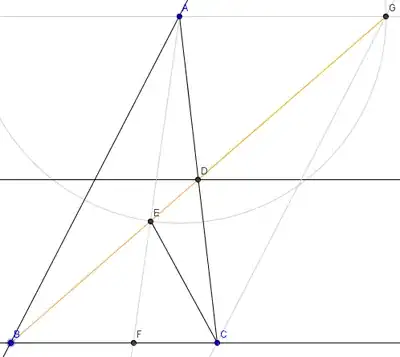
http://postimage.org/image/gpcz69zxz/

Nitesh
  • 215
  • A drawing would be helpful. – Raskolnikov Aug 28 '12 at 16:07
  • If you have a drawing in front of you, @Nitesh, you'll see that it is impossible, without more data, that $,EF=BF,$ ,as this would render the triangles $,\Delta AED,,,,\Delta CBD,$ congruent, and then $,BD=ED,$ , which is absurd as the latter segment is a subsegment of the former. – DonAntonio Aug 28 '12 at 16:17
  • I added a diagram, but I don't see how AED and CBD have to be congruent if EF=BF? – Nitesh Aug 28 '12 at 16:22
  • $$EF=FB\Longrightarrow \angle EBF=\angle BEF,,,,,\angle BEF=\angle AED,,(\text{vertex angles})$$ and since $,AE=BC,,,,,AD=DC,$ we get congruency – DonAntonio Aug 28 '12 at 17:10
  • Oops, wrong! We have side-side-angle, not side-angle-side! The above doesn't render those triangles congruent, indeed...unless $,AD=DC,$ is the longest side in each respective triangle. – DonAntonio Aug 28 '12 at 17:13

1 Answers1

4

enter image description here

ABCG - parallelogram. BD is median $\Rightarrow$ B,D,E,G - collinear. We have $\angle AGE=\angle EBF$ and $\angle BEF=\angle AEG$

$\Delta ABC= \Delta ACG \Rightarrow AG=AE \Rightarrow $ $\angle AGE= \angle AEG \Rightarrow \angle EBF = \angle BEF$.

PS. F inside BC if only $BC\geq AC/2$

Mike
  • 1,346