While thinking about the Lambert $W$ function I had to consider
Solving $(x+y) \exp(x+y) = x \exp(x)$ for $y$.
This is what I arrived at:
(for $x$ and $y$ not zero)
$(x+y) \exp(x+y) = x \exp(x)$
$x\exp(x+y) + y \exp(x+y) = x \exp(x)$
$\exp(y) + y/x \exp(y) = 1$
$y/x \exp(y) = 1 - \exp(y)$
$y/x = (1-\exp(y))/\exp(y)$
$x/y = \exp(y)/(1-\exp(y))$
$x = y\exp(y)/(1-\exp(y))$
$1/x = 1/y\exp(y) -1/y$
And then I got stuck.
Can we solve for $y$ by using Lambert $W$ function?
Or how about an expression with integrals?


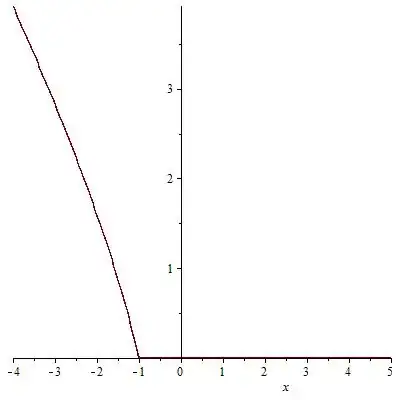
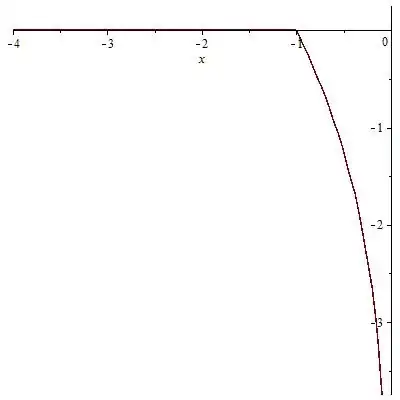


$f_1(a) = ln(-exp(a))$
Then $f_1(f_1(a)) = a + 2 \pi i $ which is a good answer.
Likewise let $f(a) = W(-a e^a)$ , then $f(f(a)) = a + b$ wich is probably a solution to $(a+b) e^{a+b} = a e^a$ for $a$ and $b$ not $0$.
Maybe I should post this as the answer. However I still do not know if $f(f(a))$ can be simplified or written as an integral ?
– mick Sep 20 '12 at 21:24