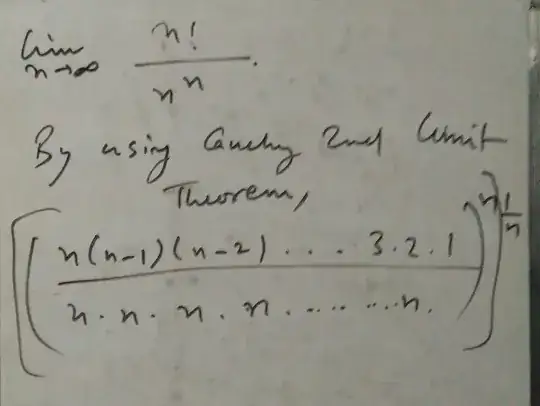
Cauchy's second theorem on limits says that for a sequence $\{a_n\}$ of positive values, if $$\lim_{n\rightarrow \infty} \frac{a_{n+1}}{a_n} = \ell,$$ then $$\lim_{n\rightarrow \infty} (a_n)^{1/n} = \ell.$$
You are wanting the limit $\displaystyle \lim_{n\rightarrow \infty} (a_n)^{1/n}$ with $a_n = \left(\frac{n!}{n^n}\right)^n$. What happens when we simplify the ratio $\frac{a_{n+1}}{a_n}$?
\begin{eqnarray}
\frac{a_{n+1}}{a_n} &=& \frac{\left(\frac{(n+1)!}{(n+1)^{(n+1)}}\right)^{n+1}}{\left(\frac{n!}{n^n}\right)^n}\\
&=& \frac{\left(\frac{n!}{(n+1)^{n}}\right)^{n+1}}{\left(\frac{n!}{n^n}\right)^n}\\
&=& \left(\frac{n!}{(n+1)^{n}}\right)\cdot \left[\frac{\left(\frac{n!}{(n+1)^{n}}\right)}{\left(\frac{n!}{n^n}\right)} \right]^n\\
&=& \left(\frac{n!}{(n+1)^{n}}\right)\cdot \left[\left(\frac{n}{n+1}\right)^n \right]^n.\\
\end{eqnarray}
The first factor in the product, $\left(\frac{n!}{(n+1)^{n}}\right)$, is bounded above by $1$. The second factor, $\left(\frac{n}{n+1}\right)^{n^2}$, approaches $0$ in the limit (hint: use L'Hôpital's rule to show $n^2\log(n/(n+1)) \rightarrow -\infty$). Therefore, $$\lim_{n\rightarrow \infty} \frac{a_{n+1}}{a_n} = 0.$$