(see figure 1 below)
Let us rewrite the 3 line equations under the equivalent form :
$$(L_1) \ \left\{ \begin{array}[ccc] .(2-z)y &=& zx \\ \ \ z& =& 0 \end{array} \right. , \ \ \ \ \ (L_2) \ \left\{ \begin{array}[rcc] .(2-z)y &= &zx \\ \ \ z& =& 1 \end{array} \right., \
\ \ \ \ (L_3) \ \left\{ \begin{array}[rcc] .(2-z)y& =& zx \\ \ \ z &=& 2 \end{array} \right.$$
Let $(S)$ be the 2nd degree surface with equation:
$$\tag{1}(2-z)y = zx$$
For all $k, \ \ (L_k) \ \subset \ (S) $ (see Remark 1). Thus (1) is a solution to your question (it would remain to show that it's unique, but the way your question is formulated, you have to find the existence of a solution but not prove its unicity ; about unicity, see Remark 2).
Equation (1) can be written under the equivalent form $2y = (x+y)z$, or $Z = XY$ with the bijective linear change of variable $$\left\{ \begin{array}[l] .X= x& + &y&\\ Y=& && z \\ Z= & &2y & \end{array} \right.$$ Thus, it is a hyperbolic paraboloid (https://tex.stackexchange.com/q/19921).
Remark 1 : Let us explain the fact that (for example) $(L_2) \subset (S)$ ; it is equivalent to show that the defining properties of $(L_2)$ imply the defining property of $(S)$.
Indeed, $(2-z)y=zx$ and $z=1$ imply that $(2-z)y=zx$... just because $(p \& q) \implies p.$
Remark 2 : There is a general result by Hilbert [that can be found in his book with Cohn-Vossen : "Mathematics and the imagination"] saying that, being given 3 "skew" lines in general position in $\mathbb{R^3}$, there is a unique (ruled) quadric that contains these lines ; it is in general an hyperboloid with one sheet ; exceptionally (as is the case here), it is a hyperbolic paraboloid. See (Equation of a regulus) and as well (Hyperboloids of one sheet, hyperbolic paraboloids, and Hilbert's famous "three skew lines").
Remark 3 : There is a helicoidal surface $(H)$ (https://en.wikipedia.org/wiki/Helicoid) i.e., a spiraling staircase represented in figure 2 containing straight lines $(L_1),(L_2)$ and $(L_3)$. It is very different from surface (S): it's not a second degree surface : for example, a vertical line passing through $(H)$ intersects it an infinite number of times instead of at most twice for $(S)$. The visible difference between $(S)$ and $(H)$ is that the rotation pace is not uniform for lines on $(S)$: it is maximum for $z=1$ and slows down and tends to zero when $z \to \infty$.
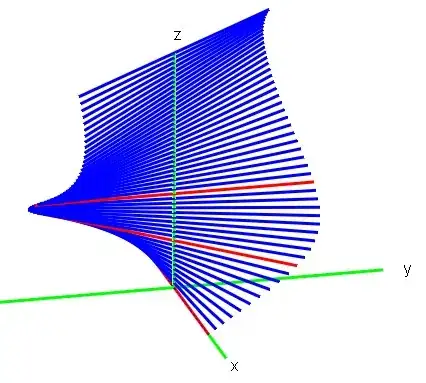
Fig. 1 : Hyperbolic paraboloid (S). $z$ varies from $0$ to $5$. In red: the given lines $(L_k)$.
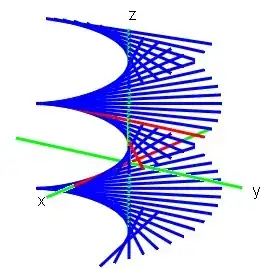
Fig. 2 : Helicoid $(H)$ that is a ruled surface containing the $(L_k)$ but is not a solution to the question because it is not a quadric surface (with second degree equation).


