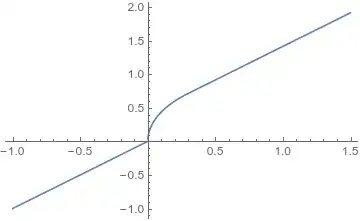
 $$f(x) = \begin{cases}
x &, x<0 \\
\sqrt{2x - x^2} &, 0 \leq x < \frac{1}{2}(2-\sqrt{2}) \\
x - 1 + \sqrt{2}&, \frac{1}{2}(2-\sqrt{2}) \leq x
\end{cases}$$
is continuous everywhere, strictly monotonically increasing everywhere, and (two-sided) differentiable on $\mathbb{R} \smallsetminus\{0\}$. At $x = 0$, the left derivative is $1$ and the right derivative is undefined.
$$f(x) = \begin{cases}
x &, x<0 \\
\sqrt{2x - x^2} &, 0 \leq x < \frac{1}{2}(2-\sqrt{2}) \\
x - 1 + \sqrt{2}&, \frac{1}{2}(2-\sqrt{2}) \leq x
\end{cases}$$
is continuous everywhere, strictly monotonically increasing everywhere, and (two-sided) differentiable on $\mathbb{R} \smallsetminus\{0\}$. At $x = 0$, the left derivative is $1$ and the right derivative is undefined.
What kinds of discontinuities (in $f'$) are there? Removable, infinite, jump,
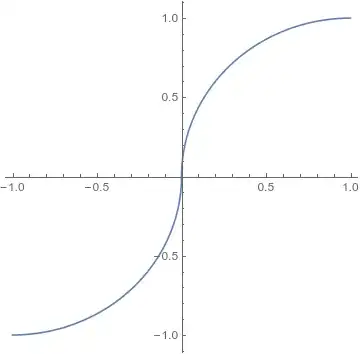
endpoint, essential, and mixed (like $\mathrm{e}^{1/x}$). Which of these can we make work? Yves Daoust makes an infinite endpoint discontinuity with $\sqrt{x}$. I made a mixed discontinuity above. Essential singularities can be made to work. (Glue $\int_{-1}^x 1+\sin(1/u) \, \mathrm{d}u$ on $(-\infty,0)$ to $2 - \int_{x}^1 1+\sin(1/u) \, \mathrm{d}u$ on $(0,\infty)$ along $\left( 0,\frac{1}{2} \right)$.) Infinite discontinuity is easy: glue two quarter circles together (or any other endpoint-like discontinuities).
Jump isn't strong enough, since you only need a one-sided derivative. Removable isn't strong enough either. (What would a Calculus student do with $\frac{\mathrm{d}}{\mathrm{d}x} \frac{x^2}{x}$, starting with either the quotient rule or the definition of the derivative? We allow cancellation under the limit sign that extends the domain of the resulting expressions. Of course, we remember that the derivative is undefined when the function is undefined...)


