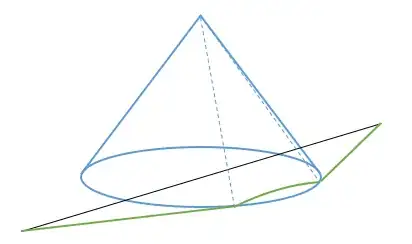
Let us consider the path from $(0,-2, 0)$, straight to some point of the basis of the cone, let $(\cos\alpha,-\sin\alpha, 0)$, then following the geodesic to the symmetrical point $(\cos\alpha,\sin\alpha, 0)$ and then straight to $(0,2,0)$.
Following this answer (https://math.stackexchange.com/a/2061892/65203), when you flatten the cone, the geodesic is simply a chord of the circumference of radius $a:=\sqrt{1+h^2}$. As the arc along that circumference has length $2\alpha$, this corresponds to an aperture angle of $\dfrac{2\alpha}a$, and the chord length is given by $2a\sin\dfrac\alpha a$.
Hence the total path length is
$$2\sqrt{\cos^2\alpha+(2-\sin\alpha)^2}+2a\sin\frac\alpha a$$ which you need to minimize for $\alpha\in[\frac\pi6,\frac\pi2]$.
As this function is increasing in the given range, the minimum is always achieved for $\alpha=\frac\pi6$, giving the minimum length
$$2\sqrt3+2a\sin\frac{\pi}{6a}.$$
Update:
I wrongly stated that the function is increasing. This is not true for small values of $a$. Then the problem requires the resolution of a nasty nonlinear equation.


