To ask about complete (three linear factor) reducibility over the complexes, we take the Hessian matrix of second partials. The entries are linear in the named variables. Next, let $\Delta$ be the determinant of the Hessian. This $\Delta$ is once again a cubic form. The original cubic (homogeneous) ternary form factors completely if and only if $\Delta $ is a constant multiple of it. I have finished this first test, your cubic does not factor completely.
More difficult if the cubic might be a linear times an irreducible quadratic. In that case, there is still a conclusive test:
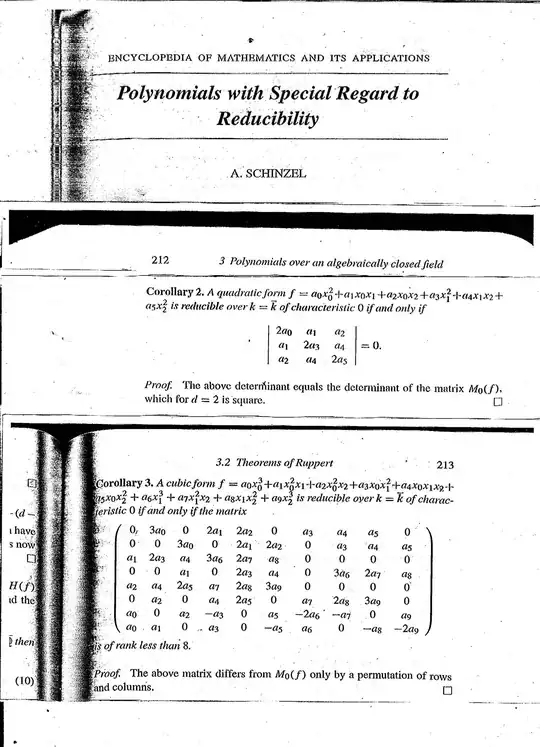
For your problem, the coefficients in order from $0$ to $9$ are
$$ 1,-3,-3,-3,-5,-3,1,-3,-3,1 $$
where the best looking diagram is a triangle as in bowling. The $-5$ refers to $-5abc \; ,$ the $1$s refer to $a^3,b^3,c^3 \; .$
Alright, I wote a little program to correctly type the 8 by ten matrix, then put that into gp-Pari. The original polynomial is irreducible over the complex numbers.
?
?  sch = [ 0, 3, 0, -6, -6, 0, -3, -5, -3, 0; 0, 0, 3, 0, -6, -6, 0, -3, -5, -3; -3, -6, -5, 3, -6, -3, 0, 0, 0, 0; 0, 0, -3, 0, -6, -5, 0, 3, -6, -3; -3, -5, -6, -3, -6, 3, 0, 0, 0, 0; 0, -3, 0, -5, -6, 0, -3, -6, 3, 0; 1, 0, -3, 3, 0, -3, -2, 3, 0, 1; 1, -3, 0, -3, 0, 3, 1, 0, 3, -2]
%25 =
[ 0  3  0 -6 -6  0 -3 -5 -3  0]

[ 0  0  3  0 -6 -6  0 -3 -5 -3]

[-3 -6 -5  3 -6 -3  0  0  0  0]

[ 0  0 -3  0 -6 -5  0  3 -6 -3]

[-3 -5 -6 -3 -6  3  0  0  0  0]

[ 0 -3  0 -5 -6  0 -3 -6  3  0]

[ 1  0 -3  3  0 -3 -2  3  0  1]

[ 1 -3  0 -3  0  3  1  0  3 -2]

? matrank(sch)
%26 = 8
?
?
?


