3

I'm trying to find the Stirling number $S(n, n-3)$ for $n$ $\ge$ $0$.

(the number of ways to place $n$ distinct objects, into $n-3$ identical boxes)

Obviously the first option is choosing the first box to contain a set of $4$ elements while the rest are singletons.

Giving : ${n \choose4}$

But after this I'm stuck.

The other options of picking are:

  1. 3 elements in the first box, 2 in the second while the rest are singletons
  2. 2 elements in the first box, 2 in the second and, 2 in the third, rest singletons.

For the second one, my best guess would be $\frac{1}{6}{n\choose2}{n-2\choose2}{n-4\choose2}$.

Any help on 1. and 2.?

Mike Spivey
  • 55,550
MITjanitor
  • 2,690
  • 2
    I'd say that your best guess for 2 is correct. What is your best guess for 1? – Calvin Lin Jan 23 '13 at 06:17
  • possibly ${5\choose 3}{n\choose 5} \frac{1}{2}$ – MITjanitor Jan 23 '13 at 06:19
  • Try and make it in a form similar to your other best guess. This will make it easier for you to count slightly more complicated options like having 3 elements in first 2 boxes, and 2 elements in the next 4 boxes. – Calvin Lin Jan 23 '13 at 06:21
  • To compute Stirling number, you may use the following recurrence relation: $S(n,k)=S(n-1,k-1)+kS(n-1,k)$. – Shane Jan 23 '13 at 06:24
  • 3
    well then ${n\choose 3}{n-3\choose 2}$ – MITjanitor Jan 23 '13 at 06:25
  • @user59273: That's correct -- please consider writing it as an answer to your question and accepting it so that the question can be marked as answered. – joriki Jan 23 '13 at 07:45
  • 1
    When you say "stirling number" you mean "...of the second kind", no? And when you say "number of ways to place n distinct objects..." you mean to imply " ... with no empty box", right? – leonbloy Jan 23 '13 at 12:35
  • @leonbloy: yes! – MITjanitor Jan 23 '13 at 16:30

3 Answers3

4

Combining the three possible outcomes of choices we get :

$$S(n,n-3)={n\choose 4} + \frac{1}{6}{n\choose 2}{n-2\choose 2}{n-4\choose 2} + \frac{1}{2}{n\choose 3}{n-3\choose 2}$$

Arch-Inst
  • 3
  • 2
MITjanitor
  • 2,690
  • 2
    Wait why the 1/2 before the last term? I thought you said in your comment it was just $\binom{n}{3}\binom{n-3}{2}$... and that makes more sense to me. – Murey Tasroc Jun 24 '19 at 03:04
4

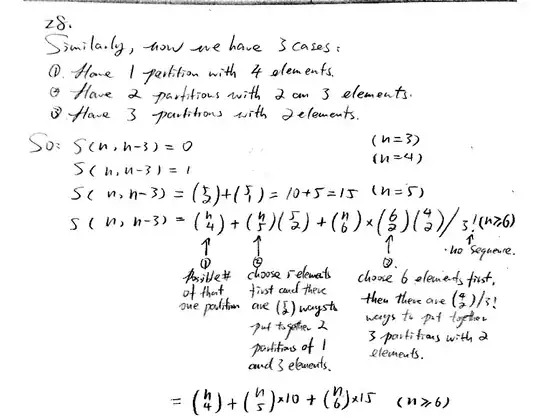
enter image description here

You can verify my answer with the table of S(n,k) values on Wikipedia. It works.

Not sure if an answer without discrete cases (like n = 3, 4, 5) can be derived, but at very least this answer is absolutely correct..

Sullivan
  • 171
0

Sulivan's answer and MITjanitor's answer (without the $\frac12$) can also be written: $$S(n,n-3)=\left\{{n\atop n-3}\right\}= \frac{n(n-1)(n-2)^2(n-3)^2}{48} = {n \choose 4}{n-2 \choose 2} $$

Henry
  • 157,058