In order to obtain your parametrization I would first show that one-sheet hyperboloid is a rational variety, which means that it is birationally equivalent to $\mathbb{P}^2$. Then in the 2nd step we modify the rational map $\psi:\mathbb{P}^2\dashrightarrow\mathbf{V}(P_{h})$ to become our desired parametrization.
Homogenize the polynomial function. Note that you'll be obtaining a projective variety in $\mathbb{P}^3$ represented by the zero of the following polynomial:
$$P_{h} := -{\frac {4\,{w}^{2}b-4\,{x}^{2}-{y}^{2}+{z}^{2}}{4\,b}}$$
Then consider the map
$$\phi: U\subset \mathbf{V}\left(P_{h}\right) \dashrightarrow \mathbb{P}^2\\
(x:y:z:w) \mapsto (x:y-z:w)
$$
where $U = \mathbf{V}(P_{h})\setminus\{\left( 0:1:1:0 \right)\}$. This gives a rational map from our quadric to $\mathbb{P}^2$ (geometrically this is very similar to the idea of parametrization of a circle using a pencil of lines).
Now, by naming
$$
X = x\\
Y = y-z\\
W = w
$$
and solving the above equations for $x$, $y$ and $w$ and substituting them in $P_h$ we obtain $z$. Consequently, this gives the rational map:
$$
\psi : U^{\prime}\subset \mathbb{P}^2 \dashrightarrow \mathbf{V}\left(P_{h}\right)\\
(X:Y:W) \mapsto \left( X : -{\frac {4\,{X}^{2}-{Y}^{2}-4\,W^2\,b}{2\,Y}}:-{\frac {4\,{X}^{2}+{Y}^{2}-4\,W^2\,b}{2\,Y}}:W\right)
$$
where $U^{\prime} = \mathbb{P}^2\setminus\mathbf{V}(Y)$. The rest is easy to check that $\psi$ and $\phi$ give the birational equivalency of $\mathbf{V}(P_{h})$ and $\mathbb{P}^2$. Finally a good way to obtain our rational parametrization that we are looking for is to put $W = 1$. Hence the final parametrization could be written as:
$$
x = X\\
y = -{\frac {4\,{X}^{2}-{Y}^{2}-4\,b}{2\,Y}}\\
z = -{\frac {4\,{X}^{2}+{Y}^{2}-4\,b}{2\,Y}}
$$
Note that for such a parametrization one is allowed to take all but the $Y = 0$.
Finally, it could be helpful to take a look at the visual result of our parametrization. Here I provided the picture for $b = 1/2$. The blue hologram of hyperboloid is created using its implicit function while the "more accurate" portions of it are produced using our rational parametrization for $X \in [-2,2]$ and $Y \in [-18, -0.8] \cup [0.8, 18]$.
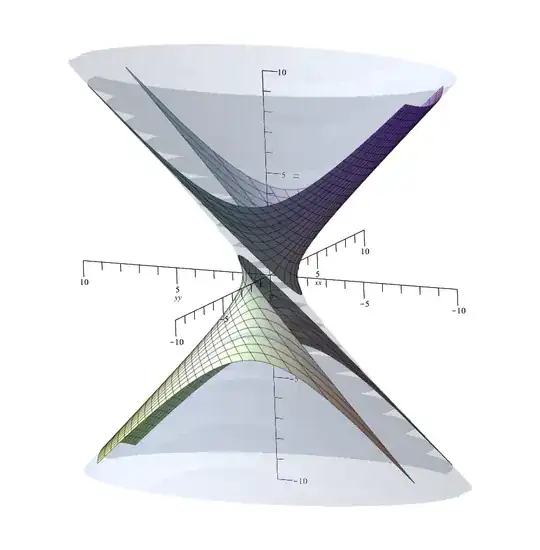
(for a non-rational parameterization of one-sheet hyperboloids see Hyperboloid-Wikipedia).


