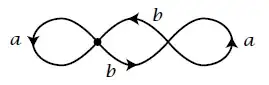
Suppose $\pi : \widetilde X \to X$ is a finite, connected covering, and suppose that there exists a continuous map $f: \widetilde X \to \mathbf R^2$ which is injective on each fibre of $\pi$. Is $\pi$ necessarily a homeomorphism?
In my answer to this question, I proved that it is so if $\mathbf R^2$ is replaced by $\mathbf R$. The reason is that we can continuously single out an element of any finite subset of $\mathbf R$ (for example, the maximum, or the minimum). It appears that the order of $\mathbf R$ plays a significant role in the solution to this question, but that something a little weaker than it is actually involved. Since there is no order on $\mathbf R^2$, I think that the answer to the question with $\mathbf R^2$ is no, but I haven't been able to come up with $\pi, f$ which do not possess this property.