Two different methods of solution :
First (analytical) method :
First of all, in this kind of volume calculation,
a) either you work with a triple integral as @StubbornAtom as done in his answer
b) or (often preferable if it is possible) express your volume as the volume over a certain domain $D$ under a certain surface with equation $z=f(x,y)$, as a double integral :
$$\int\int_D f(x,y)dxdy$$
This is what we are going to do here with $f(x,y)=z=2-x-y$:
$$\int_{y=0}^{y=2}\left(\int_{x=0}^{x=2-y}(2-x-y)dx\right)dy$$
(please note the parentheses ; bounds of integration can be understood when looking at Fig. 1).
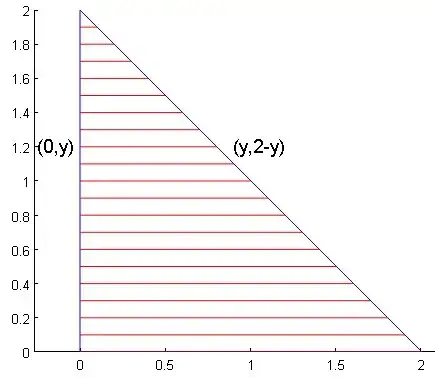
Fig. 1 : The way the domain of integration $D$ (in plane $xOy$) is swept, for a given $y$, from $x=0$ to $x=2-y$.
The integrand $(2-y)-x$ of the internal integral has an antiderivative (with respect to variable $x$) :
$$(2-y)x-\frac{x^2}{2} \ \text{to be taken between} \ x=0 \ \text{and} \ x=2-y$$
giving for the final value of the internal integral
$$\frac{(2-y)^2}{2}$$
It now remains to compute : $\int_{y=0}^2 \frac{(2-y)^2}{2}dy$ ; its value is
$$\frac{-(2-y)^3}{6} \ \text{to be taken between} \ y=0 \ \text{and} \ y=2$$
which finally gives the result $\frac43$
Second (geometrical) method :
This volume is a tetrahedron $OABC$ that can be considered as well as a three-sided pyramid (lying on one of its sides), with equilateral triangle $ABC$ (with sidelength $2\sqrt{2}$) as its base. The centroid of this base equilateral base has coordinates the mean of coordinates of $A,B,C$:
$$I=\tfrac13((2,0,0)+(0,2,0)+(0,0,2))=(\tfrac23,\tfrac23,\tfrac23).$$
The height of this pyramid is distance $h=OI=2/\sqrt{3}$.
It remains to apply the formula giving the volume of a pyramid knowing the area $S$ of its base and its height $h$ :
$$V=\tfrac13 \times S \times h = \tfrac13 \times 2 \sqrt{3} \times \tfrac{2}{\sqrt{3}}=\tfrac43.$$
as in the first solution.


