0

The chapter is about complex series and the question is to determine the radius of convergence using the root test:

Root test: the series $\sum_{n=1}^{\infty} a_{n}$ converges if $$\lim_{n \to \infty} (|a_{n}|)^{\frac{1}{n}}=r<1$$

The series to be determined is $$\sum_{n=1}^{\infty} \frac{n!z^{n}}{n^{n}}$$

Using the root test one obtains $$\lim_{n \to \infty} \frac{(n!)^{\frac{1}{n}}|z|}{n}$$

Now from problem 13 of chapter 22 the following result is obtained $$\lim_{n \to \infty} \frac{(n!)^{\frac{1}{n}}}{n}=\frac{1}{e}$$

It seems to me then that series converges for $\frac{|z|}{e}<1$ so the radius of convergence is $e$

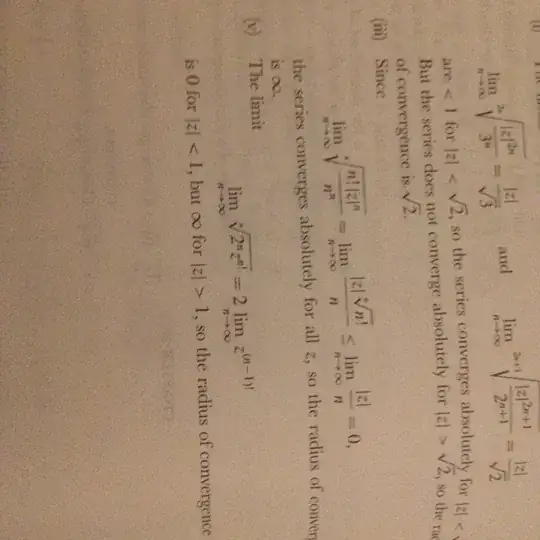
However it is stated in "Answers to selected problems" that the radius of convergence is $\infty$ which is why I wonder if there is something wrong to my approach or if the "solution manual" is wrong?

Ps. It is the 3:rd edition the answer from the book
  • 2
    I think you're right and solution manual wrong. Though you also needed the version of root test saying if limit is $> 1$, then the series diverges (so that your computation shows radius of convergence is no more than $e$). – mathworker21 Jul 24 '19 at 21:34
  • The answer book has radius of convergence e. Also it is revised in the 4th edition; however, the 4th edition introduces a new typo in the selected answers. – Dunham Jul 24 '19 at 21:35
  • @dunham it is wierd because in the book this problem is labeled 3.(ii) however in the answers it is labeled 3.(iii). I have double checked to make sure they are talking about the same sum . I will add a picture of the solution in the book for reference –  Jul 24 '19 at 21:56
  • @mathworker21 thanks! I did somewhat hastily write it down here and forgot that part. –  Jul 24 '19 at 21:58
  • See also https://math.stackexchange.com/questions/177538/finding-the-convergence-interval-of-sum-limits-n-0-infty-fracnxnnn – Arnaud D. Apr 16 '20 at 20:44

2 Answers2

1

An other method. If

$$\lim_{n\to+\infty}|\frac{a_n}{a_{n+1}}|=R$$ then it is the radius.

in your case, the limit is

$$\lim_{n\to+\infty}(1+\frac 1n)^n=e=R$$

0

These are the revisions in the 4th edition:

Problem in the 4th edition:

enter image description here

Selected solutions in the 4th edition:

enter image description here

Answer book solution to 3rd and 4th editions:

enter image description here

Dunham
  • 3,297