0

In Apostol exercise set 6.22, question 15, the following derivative is offered to evaluate:

$$f(x) = \arcsin(\sin(x))$$

I solve it using this: $\sin^{-1}(\sin(x)) = x$. Then the derivative is simply $1$. And it makes a lot of sense. However, the answer in Apostol is

$$\frac{\cos(x)}{|\cos(x)|}\,,\quad x \neq (k + \frac{1}{2})\pi, k \in \mathbb{Z}$$

I understand how he got it: he used the direct definition of the derivative as such: $$f'(x) = \frac{1}{\sqrt{1 - \sin^2(x)}} \times \cos(x) = \frac{\cos(x)}{\sqrt{\cos^2(x)}} = \frac{\cos(x)}{|\cos(x)|}$$ but I think this is wrong.

In Apostol, the $\arcsin$ is clearly defined on $x \in [-1, 1]$ and its range is $f(x) \in [-\frac{\pi}{2}, \frac{\pi}{2}]$. Here is a picture which depicts it exactly as in Apostol:

$\hskip2in$ enter image description here
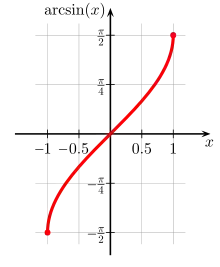
Thus, whatever value the sine takes in $[-1, 1]$, the corresponding range has to be from $-\pi/2$ and $\pi/2$, where $\cos(x) > 0$, so the identity makes no sense in terms of writing it: the derivative is simply $f'(x) = x' = 1$. The reference answer in Apostol seems to violate the inverse assumption, because the comparison of the simplified expression and Apostol answer do not match:

$$f'(x) = \frac{d}{dx}\arcsin(\sin(x)) = \frac{d}{dx}x = 1 \neq \frac{\cos(x)}{|\cos(x)|}$$

Is it the correct reasoning and Apostol solution is wrong, or I am wrong about domains here?

John
  • 1,313
  • 1
    It is $$-i \sinh ^{-1}\left(\frac{1}{2} e^{-i x} \left(-1+e^{2 i x}\right)\right)$$ – Dr. Sonnhard Graubner Aug 02 '19 at 16:37
  • 1
    $\arcsin(\sin x)$ is not $x$ for any $x\in\mathbb{R}$, but it is a periodic, continuous function, piecewise-linear. – Jack D'Aurizio Aug 02 '19 at 16:39
  • @JackD'Aurizio, how can it be periodic, if the domain of $arcsin$ is from $-1$ to $1$? Also, the arcsin is supposed to be an inverse of sin, so sin is cut to make it possible to invert it? – John Aug 02 '19 at 16:41
  • 1
    @John https://www.desmos.com/calculator/tg1st1dlbs – 19aksh Aug 02 '19 at 16:43
  • 1
    You keep talking about the domain of $\arcsin$, but the domain of $f$ is $\mathbb{R}$ – saulspatz Aug 02 '19 at 16:46
  • @saulspatz, but the function $sin$ can be inverted only if it is defined on $-\pi/2, \pi/2$, or other similar interval! The result of this inversion is $arcsin$. As such, $arcsin$ cannot return any $x$ beyond $\pm \frac{\pi}{2}$. By evaluating $arcsin$ for $sin(x)$ where $x$ is outside this interval, we assume that the inverse of $sin^{-1} = arcsin$ exists for multiple-valued function (since it would be define for both $x = 0$ and say $x = \pi$). – John Aug 02 '19 at 16:52
  • So, my concern is that the domain of $arcsin$ is limited to $\pm \pi/2$, and the domain of $arcsin(sin(x))$ cannot be wider than that, since the outer function cannot be inverted properly for the x outside of $\pm \pi/2$ – John Aug 02 '19 at 16:54
  • 1
    No, that's not right. As long as the range of $g$ is as subset of the domain of $f$ we can define $h=f\circ g$ and the domain of $h$ is the same as the domain of $g$. – saulspatz Aug 02 '19 at 16:58
  • @saulspatz, but if the domain of $h$ is all $x$, then it means $arcsin(sin(\pi)) = 0$ and not $\pi$. Thus, $arcsin$ is not an inverse of $sin$, which was the way we defined it in the first place. – John Aug 02 '19 at 17:21
  • @Ak19, i think this plotter simply inserts the values of $sin(x)$ into $arcsin$ and plots them, so the graph unfortunately does not ensure that the plotter understand anything about inverses or what its doing. Unfortunate state of the AI nowadays :) – John Aug 02 '19 at 17:24
  • No, John, it's you that doesn't understand about functions, unfortunately. Inserting the values of $\sin(x)$ in the function $\arcsin$ is exactly what the plotter should do. That what function composition means. – saulspatz Aug 02 '19 at 17:31
  • @saulspatz, I'm not arguing if the plotter is wrong, I state that the plotter does not explain the cause of my concern, which i managed to formulate here: if $arcsin(sin(x))$ is defined for all $x \in \mathbb{R}$, then the arcsin is not an inverse of $sin$, since $arcsin(sin(\pi)) = 0 \neq \pi$, which it should be. Since $arcsin$ is defined as an inverse of $sin$, we arrive at a contradiction. Thus, $arcsin(sin(\pi))$ does not exist. What is incorrect here? – John Aug 02 '19 at 17:42
  • The statement $\arcsin(sin{\pi})$ is false, as everyone keeps telling you. I don't know what to advise, except that you go back and read your book more carefully. I have nothing more to say. – saulspatz Aug 02 '19 at 17:56
  • @saulspatz, thx for help. I found the answer to my confusion in another question. – John Aug 02 '19 at 18:04
  • Glad to hear it. – saulspatz Aug 02 '19 at 18:28
  • I am posting my 2 cents as a mere comment, but what strikes me is that nobody mentioned the possibility of graphing $arcsin(sinx)$. The first thing you notice is that the domain is all real numbers. The second thing is that it zigzags up and down. Now what does that mean for the derivative? It can't be plain $1$. – imranfat Aug 03 '19 at 05:33

1 Answers1

5

I found an answer to my confusion in another question. I will leave this question here in case someone is looking for this set of Apostol exercises.

The problem with the statement $\bf{arcsin(sin(x))}$ is that the function $\bf{arcsin}$ is actually not an inverse of the function $\bf{sin}$, but it is an inverse of another function, which is $\bf{sin}$ restricted to $[-\frac{\pi}{2}, \frac{\pi}{2}]$. Thus, when working with $x$ outside the range $[-\frac{\pi}{2}, \frac{\pi}{2}]$, $\bf{arcsin}$ is not obliged to return the same value as supplied to $\bf{sin(x)}$ in $\bf{arcsin(sin(x))}$.

Here is the original question: Why aren't the graphs of $\sin(\arcsin x)$ and $\arcsin(\sin x)$ the same?.

and here is the relevant answer: https://math.stackexchange.com/a/148700/75829

John
  • 1,313