2

In a recent paper Dan Romik proved the following alternating infinite series representation for Riemann xi function: enter image description here
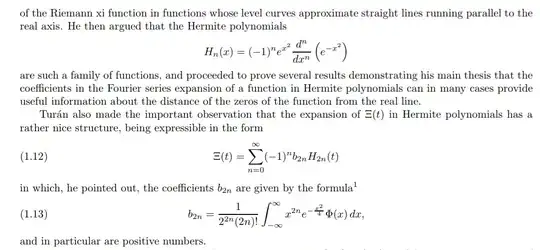
I may be wondering if we can transform this infinite alternating sum into Abel Plana alternate Summation Formula as :

$$\sum_{k=0}^∞ (-1)^nf(k) = (1/2)f(0) + i\int_0^∞\frac{f(iy)−f(−iy)}{2\sinh(πy))} dy$$ ?

(Coefficients seems to follow the growth condition for Abel Plana)

bambi
  • 916

1 Answers1

1

Your formula has nothing special. The Hermite functions $h_n(t)=e^{-x^2/2} H_n(t),H_n(t)=e^{t^2}\frac{d^n}{dt^n} e^{-t^2}$ are an orthogonal basis of $L^2$ thus $$e^{-x^2/2}\Xi(t)=\sum_n \frac{c_n}{\|h_n\|_2^2} h_n(t), \qquad c_n= \int_{-\infty}^\infty e^{-t^2/2}\Xi(t) h_n(t)dt$$ Since $e^{-t^2/2} \Xi(t)$ is even and $H_{2n+1}$ is odd then $c_{2n+1}=0$.

$\Xi(t)$ is the Fourier transform of $\Phi$ and the Fourier transform of $\frac{d^{2n}}{dt^{2n}} e^{-t^2}$ is $\sqrt{\pi}(ix)^{2n}e^{-x^2/4}$ thus $$c_{2n}=\int_{-\infty}^\infty \Xi(t)\frac{d^{2n}}{dt^{2n}} e^{-t^2}dt=\sqrt{\pi}\int_{-\infty}^\infty \Phi(x) \sqrt{\pi}(ix)^{2n}e^{-x^2/4}dx$$ No it can't be turned into an Abel-Plana sum.

reuns
  • 77,999