4

I'm having a difficult time evaluating the integral

$$\mathcal{J} = \int_0^{\sqrt{2}/2} \frac{\arctan \sqrt{1-2t^2}}{1+t^2} \, \mathrm{d}t$$

This is integral arose after simplifying the integral $\displaystyle \int_{0}^{\pi/4 } \arctan \sqrt{\frac{1-\tan^2 x}{2}} \, \mathrm{d}x$;

\begin{align*} \require{cancel.js} \int_{0}^{\pi/4} \arctan \sqrt{\frac{1-\tan^2 t}{2}}\, \mathrm{d}t &\overset{1-\tan^2 t \mapsto 2t^2}{=\! =\! =\! =\! =\! =\!=\!=\!} \int_{0}^{\sqrt{2}/2} \frac{t \arctan t}{\sqrt{1-2t^2} \left ( 1-t^2 \right )} \, \mathrm{d}t \\ &=\cancelto{0}{\left [ - \arctan \sqrt{1-2t^2} \arctan t \right ]_0^{\sqrt{2}/2}} + \int_{0}^{\sqrt{2}/2} \frac{\arctan \sqrt{1-2t^2}}{1+t^2} \, \mathrm{d}t \end{align*}

My main guess is that differentiation under the integral sign is the way to go here. Any ideas?

Tolaso
  • 6,656

5 Answers5

5

\begin{align}J&=\int_0^{\frac{1}{\sqrt{2}}} \frac{\arctan\left(\sqrt{1-2x^2}\right)}{1+x^2}\,dx\\ &\overset{x=\frac{1}{\sqrt{2}}\sin u}=\frac{1}{\sqrt{2}}\int_0^{\frac{\pi}{2}}\frac{\cos u\arctan(\cos u)}{1+\frac{1}{2}\sin^2 u}\,du\\ &=\sqrt{2}\int_0^{\frac{\pi}{2}}\frac{\cos u\arctan(\cos u)}{2+\sin^2 u}\,du\\ &=\left[\arctan\left(\frac{1}{\sqrt{2}}\sin u\right)\arctan(\cos u)\right]_0^{\frac{\pi}{2}}+\int_0^{\frac{\pi}{2}}\frac{\arctan\left(\frac{1}{\sqrt{2}}\sin u\right)\sin u}{1+\cos^2 u}\,du\\ &=\int_0^{\frac{\pi}{2}}\frac{\arctan\left(\frac{1}{\sqrt{2}}\sin u\right)\sin u}{1+\cos^2 u}\,du\\ &=\int_0^{\frac{\pi}{2}}\int_0^{\frac{1}{\sqrt{2}}}\left(\frac{\sin^2 u}{(1+\cos^2 u)(1+a^2\sin^2 u)}\,da\right)\,du\\ &=\int_0^{\frac{1}{\sqrt{2}}}\left[\frac{\sqrt{2}\arctan\left(\frac{1}{\sqrt{2}}\tan u\right)}{2a^2+1}-\frac{\arctan\left(\sqrt{1+a^2}\tan u\right)}{(2a^2+1)\sqrt{1+a^2}}\right]_{u=0}^{u=\frac{\pi}{2}}\,da\\ &=\frac{\pi}{2}\int_0^{\frac{1}{\sqrt{2}}}\frac{\sqrt{2}}{2a^2+1}\,da-\frac{\pi}{2}\int_0^{\frac{1}{\sqrt{2}}}\frac{1}{(2a^2+1)\sqrt{1+a^2}}\,da\\ &=\frac{\pi}{2}\Big[\arctan\left(\sqrt{2}a\right)\Big]_0^{\frac{1}{\sqrt{2}}}-\frac{\pi}{2}\left[\arctan\left(\frac{a}{\sqrt{1+a^2}}\right)\right]_0^{\frac{1}{\sqrt{2}}}\\ &=\frac{\pi}{2}\times \frac{\pi}{4}-\frac{\pi}{2}\times \frac{\pi}{6}\\ &=\boxed{\frac{\pi^2}{24}} \end{align}

FDP
  • 13,647
3

This answer is based on Feynman's trick. Put \begin{equation*} I(a) = \int_{0}^{\pi/4}\arctan\left(a\sqrt{\dfrac{1-\tan^2 x}{2}}\right)\, dx . \end{equation*} Then \begin{gather*} I'(a) = \int_{0}^{\pi/4}\dfrac{1}{1+a^2\dfrac{1-\tan^2 x}{2}}\cdot \sqrt{\dfrac{1-\tan^2 x}{2}} \, dx = \\[2ex]\int_{0}^{\pi/4}\dfrac{1}{1+a^2\dfrac{\cos 2x}{1+\cos 2x}}\cdot \sqrt{\dfrac{\cos 2x}{1+\cos 2x}} \, dx = [y=\cos 2x]\\[2ex] = \dfrac{1}{2}\int_{0}^{1}\dfrac{1}{1+(a^2+1)y}\cdot\sqrt{\dfrac{y}{1-y}}\,dy= \left[z=\sqrt{\dfrac{y}{1-y}}\right] =\\[2ex] \dfrac{1}{2}\int_{-\infty}^{\infty}\dfrac{z^2}{(1+(a^2+2)z^2)(z^2+1)}\, dz = [\mbox{ residue calculus }]=\\[2ex] \dfrac{\pi}{2}\left(\dfrac{1}{a^2+1}-\dfrac{1}{(a^2+1)\sqrt{a^2+2}}\right) \end{gather*} Finally we get \begin{gather*} I(1)=I(1)-I(0)=\int_{0}^{1}I'(a)\, da =\dfrac{\pi}{2}\left[\arctan a -\arctan\dfrac{a}{\sqrt{a^2+2}}\right]_{0}^{1} =\dfrac{\pi^2}{24}. \end{gather*}

JanG
  • 4,577
  • No need residue calculus, integrand has an antiderivative $\displaystyle\frac{\operatorname{atan}(z)}{{{a}^{2}}+1}-\frac{\operatorname{atan}\left( \frac{\left( 2 {{a}^{2}}+4\right) z}{2 \sqrt{{{a}^{2}}+2}}\right) }{\left( {{a}^{2}}+1\right) , \sqrt{{{a}^{2}}+2}}$ – FDP Mar 27 '20 at 05:23
  • $@$FDP You are right. I could have used partial fraction decomposition. \begin{equation} \dfrac{z^2}{(1+(a^2+2)z^2)(z^2+1)}=\dfrac{1}{a^2+1}\left(\dfrac{1}{1+z^2}-\dfrac{1}{1+(a^2+2)z^2}\right). \end{equation} – JanG Mar 27 '20 at 07:14
2

Following/Copying the answer over there we have that:

\begin{align*} \int_{0}^{\sqrt{2}/2} \frac{\arctan \sqrt{1-2t^2}}{1+t^2} \, \mathrm{d}t &= \int_{0}^{1} \frac{1}{1+x^2} \arctan \sqrt{\frac{1-x^2}{2}} \, \mathrm{d}x \\ &=-\sqrt{2} \int_{0}^{1} \frac{x \arctan x}{\sqrt{1-x^2} \left ( 3-x^2 \right )} \, \mathrm{d}x\\ &=-\sqrt{2} \int_{0}^{1}\frac{x}{\sqrt{1-x^2}\left ( 3-x^2 \right )} \int_{0}^{1} \frac{x}{1+x^2t^2} \, \mathrm{d}t \, \mathrm{d}x \\ &= -\sqrt{2} \int_{0}^{1} \int_{0}^{1} \frac{x^2}{\sqrt{1-x^2}\left ( 3-x^2 \right ) \left ( x^2+ \frac{1}{t^2} \right )} \frac{1}{t^2} \, \mathrm{d}x \, \mathrm{d}t\\ &\!\!\!\!\!\overset{x=\cos \theta}{=\! =\! =\! =\!} \sqrt{2} \int_{0}^{1} \int_{0}^{\pi/2} \frac{\cos^2 \theta}{\left ( 3 - \cos^2 \theta \right )\left ( \cos^2 \theta + \frac{1}{t^2} \right )} \, \mathrm{d}\theta \; \frac{\mathrm{d}t}{t^2} \\ &= \frac{\sqrt{2}}{3} \int_{0}^{1} \int_{0}^{\pi/2} \frac{\sec^2 \theta}{\left ( \sec^2 \theta - \frac{1}{3} \right ) \left ( t^2 + \sec^2 \theta \right )} \, \mathrm{d} \theta \, \mathrm{d}t \\ &=\frac{\sqrt{2}}{3} \int_{0}^{1} \int_{0}^{\pi/2} \frac{\sec^2 \theta}{\left ( \tan^2 \theta + \frac{2}{3} \right )\left ( \tan^2 \theta + 1 + t^2 \right )} \, \mathrm{d}\theta \, \mathrm{d}t \\ &=\frac{\sqrt{2}}{3} \int_{0}^{1} \left ( \int_{0}^{\pi/2} \frac{\sec^2 \theta}{\tan^2 \theta + \frac{2}{3}} \, \mathrm{d} \theta - \int_{0}^{\pi/2} \frac{\sec^2 \theta}{\tan^2 \theta + 1 + t^2} \, \mathrm{d}\theta \right ) \frac{\mathrm{d}t}{t^2+\frac{1}{3}} \end{align*}

For the remaining integrals we have:

\begin{align*} \int_{0}^{\pi/2} \frac{\sec^2 \theta}{\tan^2 \theta + \frac{2}{3}} \, \mathrm{d}\theta &\overset{u =\tan \theta}{=\! =\! =\! =\!} \int_{0}^{\infty} \frac{\mathrm{d}u}{u^2 + \frac{2}{3}} \\ &=\left [ \frac{\sqrt{3}}{2} \arctan \sqrt{\frac{3}{2}}u \right ]_0^\infty \\ &= \frac{\sqrt{3}\pi}{2\sqrt{2}} \\ &= \frac{\pi \sqrt{6}}{4} \end{align*}

and similarly

$$\int_{0}^{\pi/2} \frac{\sec^2 \theta}{\tan^2 \theta + 1 + t^2} \, \mathrm{d}\theta = \frac{\pi}{2 \sqrt{1+t^2}}$$

Thus,

\begin{align*} \int_{0}^{1} \left ( \int_{0}^{\pi/2} \frac{\sec^2 \theta}{\tan^2 \theta + \frac{2}{3}} \, \mathrm{d} \theta - \int_{0}^{\pi/2} \frac{\sec^2 \theta}{\tan^2 \theta + 1 + t^2} \, \mathrm{d}\theta \right ) \frac{\mathrm{d}t}{t^2+\frac{1}{3}} &= \frac{\pi \sqrt{6}}{4}\int_{0}^{1} \frac{\mathrm{d}t}{t^2 + \frac{1}{3}} - \frac{\pi}{2}\int_{0}^{1} \frac{\mathrm{d}t}{\sqrt{1+t^2} \left ( t^2 + \frac{1}{3} \right )} \\ &\!\!\!\!\!\overset{t \mapsto 1/t}{=\! =\! =\! =\! =\!}\frac{\pi \sqrt{6}}{4} \frac{\pi}{\sqrt{3}} - \frac{3 \pi}{2} \int_{1}^{\infty} \frac{t}{\sqrt{t^2+1} \left ( t^2+3 \right )} \, \mathrm{d}t \\ &\!\!\!\!\!\!\overset{t \mapsto t^2}{=\! =\! =\! =\!} \frac{\pi^2 \sqrt{2}}{4} - \frac{3\pi}{4} \int_{1}^{\infty} \frac{\mathrm{d}t}{\sqrt{t+1} (t+3)} \\ &=\frac{\pi^2 \sqrt{2}}{4} - \frac{3\pi}{4}\int_{2}^{\infty} \frac{\mathrm{d}t}{\sqrt{t} \left ( t+2 \right )} \\ &\!\!\!\!\!\overset{t \mapsto t^2}{=\! =\! =\! =\!} \frac{\pi^2 \sqrt{2}}{4} - \frac{3\pi}{2} \int_{\sqrt{2}}^{\infty} \frac{\mathrm{d}t}{t^2+2} \\ &= \frac{\pi^2 \sqrt{2}}{4} - \frac{3\pi^2}{8\sqrt{2}} \end{align*}

Collecting everything we get that

\begin{align*} \int_{0}^{\pi/4} \arctan \sqrt{\frac{1-\tan^2 \theta}{2}} \, \mathrm{d}\theta &= \frac{\sqrt{2}}{3} \left ( \frac{\pi^2 \sqrt{2}}{4} - \frac{3\sqrt{2} \pi^2}{16} \right ) \\ &= \frac{\sqrt{2}}{3} \cdot \frac{\sqrt{2}\pi^2}{16}\\ &= \frac{\pi^2}{24} \end{align*}

QED.

Thanks @Felix Martin.

Tolaso
  • 6,656
1

Continue with\begin{align} & \int_{0}^{\pi/4 } \tan^{-1} \sqrt{\frac{1-\tan^2 x}{2}}dx \>\>\>\>\>\>\> \tan x =\sin t\\ =& \int_0^{\pi/2}\frac{\cos t}{2-\cos^2t}\ \tan^{-1}\frac{\cos t}{\sqrt2} \ dt\\ =& \int_0^{\pi/2}\int_0^{\pi/4} \frac{\sqrt2 \cos^2t}{(2-\cos^2t)(2\cos^2y+\sin^2 y\cos^2t)}dy\ dt\\ =& \ \frac\pi2\int_0^{\pi/4} \bigg(1-\frac{\cos y}{\sqrt{2-\sin^2y}}\bigg)dy=\frac\pi2\bigg(\frac\pi{4}-\frac\pi6\bigg)=\frac{\pi^2}{24} \end{align}

Quanto
  • 97,352
0

Here's another solution, if you're open to complex methods.

Substitute $(1)\,u=\sqrt{1-2t^2}$, exploit symmetry, then substitute $(2)\,v=\dfrac{1-u}{1+u}$. This produces two members of a family of integrals that can be evaluated with residue calculus $(3)$.

$$\begin{align*} \mathcal J &= \int_0^{\tfrac1{\sqrt2}} \frac{\arctan \sqrt{1-2t^2}}{1+t^2} \, dt \\ &= -\sqrt2 \int_0^1 \frac{u \arctan u}{\left(u^2-3\right) \sqrt{1-u^2}} \, du \tag1 \\ &= \frac1{\sqrt2} \int_{-1}^1 \frac{u \arctan u}{\left(u^2-3\right) \sqrt{1-u^2}} \, du \\ &= \frac1{2\sqrt2} \int_0^\infty \left(\sqrt v - \frac1{\sqrt v}\right) \frac{\arctan v - \frac\pi4}{v^2+4v+1} \, dv \tag2 \\ &= \frac1{2\sqrt2} \left[J\left(\frac12\right) - J\left(-\frac12\right)\right] \\ &= \frac\pi4 \lim_{y\to1^-} \arctan \frac{4y^2}{1-y^4} - \frac{\pi^2}{12} = \boxed{\frac{\pi^2}{24}} \tag3 \end{align*}$$

where we denote for non-zero real parameter $-1<a<1$,

$$\bbox[2pt, #fffde7, border: 2px solid red]{J(a) := \int_0^\infty \frac{v^a \arctan v}{v^2+4v+1} \, dv}$$

and notice that

$$\int_0^\infty \frac{\sqrt v-\frac1{\sqrt v}}{v^2+4v+1} \, dv \stackrel{w=\frac1v}= \int_0^\infty \frac{\frac1{\sqrt w}-\sqrt w}{1+4w+w^2} \, dv = 0.$$


To evaluate $J(a)$, consider the integral of

$$f(z) = \frac{z^a \arctan z}{z^2+4z+1} = -\frac i2 \cdot \frac{\lvert z\rvert^a e^{i a \arg z} \left(\log\left\lvert\frac{i-z}{i+z}\right\rvert + i \arg \left(\frac{i-z}{i+z}\right)\right)}{z^2 + 4z + 1}$$

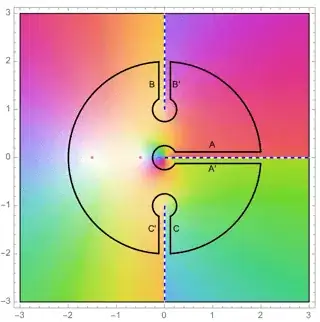
along the positively-oriented triple-keyhole contour $\mathcal C$ (pictured below with the arbitrarily chosen $a=\frac14$, and relocating the poles to make the sketch less cluttered), avoiding branch cuts taken at $[0,\infty)$ and $\pm i [1,\infty)$ so that $\arg z\in(0,2\pi)$ and $\arg\left(\frac{i-z}{i+z}\right)\in(-\pi,\pi)$.
enter image description here

$\mathcal C$ encloses two simple poles at $z=-2\pm\sqrt3$, so by Cauchy's residue theorem,

$$\begin{align*} \oint_{\mathcal C} f(z) \, dz &= i2\pi \sum \operatorname{Res} f(z) \\ &= \frac{i\pi e^{ia\pi}}{\sqrt3} \left[\left(2+\sqrt3\right)^a \arctan\left(2+\sqrt3\right) - \left(2-\sqrt3\right)^a \arctan\left(2-\sqrt3\right)\right] \\ &= \frac{i\pi^2 e^{ia\pi}}{12\sqrt3} \left(5 \left(2+\sqrt3\right)^a - \left(2-\sqrt3\right)^a\right) \end{align*}$$

The integrals along the circular portions of $\mathcal C$ will vanish as $R\to\infty$ (large arc's radius) and $\varepsilon\to0^+$ (small arcs' radius). This leaves us with the integrals to either side of each cut which are summarized below.

$$\begin{align*} \int_A = \int_\varepsilon^R f(x+i\varepsilon) \, dx &\to \int_0^\infty \frac{x^a \arctan x}{x^2 + 4x + 1} \, dx \\ \int_{A'} = \int_R^\varepsilon f(x-i\varepsilon) \, dx &\to -e^{i2a\pi} \int_0^\infty \frac{x^a \arctan x}{x^2+4x+1} \, dx \\ \implies \int_{A\cup A'} &\to \left(1-e^{i2a\pi}\right) J(a) \\[2ex] \int_B = i \int_{1+\varepsilon}^R f(-\varepsilon+ix) \, dx &\to -\frac12 \int_1^\infty \frac{x^a e^{i\tfrac{a\pi}2} \left(\log\frac{x-1}{x+1} - i \pi\right)}{x^2 - 4ix - 1} \, dx \\ \int_{B'} = i \int_R^{1+\varepsilon} f(\varepsilon+ix) \, dx &\to \frac12 \int_1^\infty \frac{x^a e^{i\tfrac{a\pi}2} \left(\log\frac{x-1}{x+1} + i \pi\right)}{x^2 - 4ix - 1} \, dx \\ \implies \int_{B\cup B'} &\to i\pi e^{i\tfrac{a\pi}2} \int_1^\infty \frac{x^a}{x^2 - 4ix - 1} \, dx \\[2ex] \int_C = -i \int_{1+\varepsilon}^R f(\varepsilon-ix) \, dx &\to \frac12 \int_1^\infty \frac{x^a e^{i \tfrac{3a\pi}2} \left(\log\frac{x+1}{x-1} + i \pi\right)}{x^2 + 4ix - 1} \, dx \\ \int_{C'} = -i \int_R^{1+\varepsilon} f(-\varepsilon-ix) \, dx &\to -\frac12 \int_1^\infty \frac{x^a e^{i \tfrac{3a\pi}2} \left(\log\frac{x+1}{x-1} - i \pi\right)}{x^2 + 4ix - 1} \, dx \\ \implies \int_{C\cup C'} &\to i\pi e^{i\tfrac{3a\pi}2} \int_1^\infty \frac{x^a}{x^2+4ix-1} \, dx \end{align*}$$

Totaling up these contributions and solving for $J(a)$ yields

$$\bbox[2pt, #fffde7, border: 2px solid red]{\begin{align*} J(a) &= \frac{\pi^2\csc(a\pi)}{24\sqrt3} \left(\left(2-\sqrt3\right)^a - 5 \left(2+\sqrt3\right)^a\right) \\ & \qquad \qquad + \frac\pi2 \int_1^\infty \frac{\csc\frac{a\pi}2\,x^2 + 4 \sec\frac{a\pi}2\,x - \csc\frac{a\pi}2\,}{x^4+14x^2+1} \, x^a \, dx \end{align*}}$$

and thus

$$\begin{align*} J\left(\frac12\right) &= \frac\pi{\sqrt2} \int_1^\infty \frac{\sqrt x \left(x^2+4x-1\right)}{x^4+14x^2+1} \, dx - \frac{2+\sqrt3}{12\sqrt2} \pi^2 \\ J\left(-\frac12\right) &= -\frac\pi{\sqrt2} \int_1^\infty \frac{x^2-4x-1}{\sqrt x \left(x^4+14x^2+1\right)} \, dx + \frac{2-\sqrt3}{12\sqrt2} \pi^2 \\[2ex] \implies J\left(\frac12\right) - J\left(-\frac12\right) &= \frac\pi{\sqrt2} \int_1^\infty \frac{x^3+5x^2-5x-1}{\sqrt x \left(x^4+14x^2+1\right)} \, dx - \frac{\pi^2}{3\sqrt2} \\ &\!\!\!\!\!\stackrel{y=\frac{\sqrt x-1}{\sqrt x+1}}= 4\sqrt2\,\pi \int_0^1 \frac{y \left(y^4+1\right)}{y^8 + 14y^4 + 1} \, dy - \frac{\pi^2}{3\sqrt2} \\ &= 2\sqrt2\,\pi \int_0^1 \frac{d\left(y^2-\frac1{y^2}\right)}{\left(y^2 - \frac1{y^2}\right)^2 + 16} - \frac{\pi^2}{3\sqrt2} \end{align*}$$

user170231
  • 19,334