7

In order to understand the topic of "presentation of a group", I would like to work out the following example: $\def\Z{\mathbb{Z}} \def\iso{\cong} \def\llg{\langle} \def\rrg{\rangle}$

$\Z\times \Z \iso \langle a,b\,|\, [a,b]=1\rangle$, where $[a,b]:=a^{-1}b^{-1}ab$.

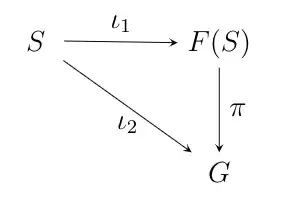
This example appears in Section 6.3 of Dummit and Foote's Abstract Algebra. The definition of generators and relations there is somehow confusing. It begins with a given group $G$ and a subset $S$ of $G$ such that $G=\llg S\rrg$ and then assume a subset $R$ of the free group $F(S)$ has the property that its normal closure in $F(S)$ equals to the kernel of the group homomorphism $\pi$, where $\pi$ is defined by the following commutative diagram:
enter image description here

where $\iota_k$, $k=1,2$, are the inclusion maps. This a priori appearance of the group $G$ in the definition makes statements like the example above difficult to understand. To approach the example above, I will use the following definition instead:

Let $S$ be a set and $F(S)$ the free group on $S$. Let $R$ be a set of words in $F(S)$, i.e. $R\subset F(S)$, and $N$ the normal closure of $R$ in $F(S)$. The group $\llg S|R\rrg$ is defined as $$ \llg S|R\rrg=F(S)/N $$

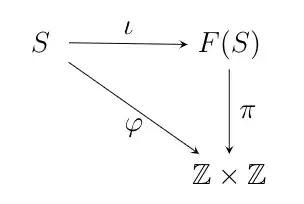
Now let $S=\{a,b\}$, $\varphi(a)=(1,0)$, $\varphi(b)=(0,1)$. By the universal property of $F(S)$, there exists a unique group homomorphism $\pi: F(S)\to \Z\times\Z$ such that the following diagram commutes:
enter image description here

i.e., $\pi\circ\iota=\varphi$. If I can establish the following,

  • $N=\ker\pi$;
  • $\pi$ is surjective, (trivial because $\pi(a^mb^n)=m\pi(a)\oplus n\pi(b)$)

then by the first group isomorphism theorem, the proof is done.

The inclusion $\ker\pi\supset N$ is easy; since $\ker\pi$ is a normal subgroup, it suffices to show that $\ker\pi\supset R$: $$ \pi([a,b])=[\pi(a),\pi(b)]=[(1,0),(0,1)]=(0,0)\;. $$

How can I show the other direction $\ker\pi\subset N$? Or is there anything else I can do to get around this step?

  • 1
    I think it might be easier to prove $F(S)/N$ is abelian (generated by commuting elements), and then show there is an inverse homomorphism $\mathbb Z\times \mathbb Z \to F(X)/N$. To be pendantic, you may want to note $\mathbb Z \times \mathbb Z \cong \mathbb Z \bigoplus \mathbb Z$. – Justin Young Jun 16 '20 at 21:15
  • 1
    Note that there is no such thing as the presentation of a group; there are infinitely many per group. Consider Tietze transformations. – Shaun Jun 16 '20 at 22:39
  • 1
    @Shaun: fair enough; I edited the sentence. Thanks for the "Tietze transformations". I have never seen that before, due to my ignorance:) –  Jun 16 '20 at 22:46
  • You're welcome, @sophia :) – Shaun Jun 16 '20 at 23:14

2 Answers2

3

I think the issue is your approach. I'm sure there is a way to show that $\text{ker}(\pi) \subseteq N$, but as you've noticed, it is quite hard to argue this directly. The combinatorics of words can be extremely complicated and it can be useful to avoid talking about them for "simple" problems like this.

It is for exactly this reason that "abstract nonsense" exists. You are already halfway there by using the universal property of the free group, why not go all the way and use the universal property of quotients?

To show $F(S)/N \cong \mathbb{Z}^2$, let's show that $\mathbb{Z}^2$ satisfies the universal property of the quotient! That is, let's show that

  • for any hom $f : F(S) \to G$
  • if $N \subseteq \text{ker}(f)$
  • then $f$ descends to a unique hom $\tilde{f} : \mathbb{Z}^2 \to G$

So let's fix a map $f : F(S) \to G$, which satisfies $N \subseteq \text{ker}(f)$. That is, $f([a,b]) = [f(a),f(b)] = 1$.

But then we can set $\tilde{f}((1,0)) = f(a)$ and $\tilde{f}((0,1)) = f(b)$. If you know that $\mathbb{Z}^2$ is the free abelian group on two generators, then we're done. If not, then you should check by hand that this is actually a homomorphism which makes the quotient diagram commute. I'm sure you'll find this much easier than trying to show that $\text{ker}(\pi) = N$. If you find yourself wanting another hint, feel free to ask in a comment.


Edit:

To elaborate some, let's start with what the "universal property of the quotient" even means. The naming comes from a branch of math called Category Theory, and the idea is to characterize objects based on what morphisms they allow. You've already seen this in the Free Group, which has a universal property expressing what morphisms from the free group exist.

We can describe lots of different algebraic constructions in this way, including the quotient! The definition is as follows:

If $N \trianglelefteq G$, then a morphism $\pi : G \to K$ satisfies the universal property of the quotient (with respect to $G$ and $N$) if and only if: For every $f : G \to H$ with $N \subseteq \text{ker}(f)$, there is a (unique!) homomorphism $\tilde{f} : K \to H$ such that $f = \tilde{f} \circ \pi$.

Now I will leave it to you to show the following few facts, which will culminate in the theorem you want to prove:

  1. Show $\pi : G \to G/N$ the natural quotient map satisfies the universal property of the quotient.

    • This says that the name is well chosen. Indeed, this is where the name comes from!
  2. If two maps $\pi_1 : G \to K_1$ and $\pi_2 : G \to K_2$ both satisfy the universal property, then $\varphi : K_1 \cong K_2$, and moreover $\pi_2 = \pi_1 \circ \varphi$. So not only are $K_1$ and $K_2$ "the same", but so are the quotient maps $\pi_1$ and $\pi_2$.

    • If you haven't seen proofs like this before, this might take some ingenuity. As a hint, notice $\pi_2$ is a map out of $G$ with $N \subseteq \text{ker}(\pi_2)$. So since $K_1$ has the universal property, we must have a map $K_1 \to K_2$. Swapping the roles of $K_1$ and $K_2$, we also have a map $K_2 \to K_1$... Can you prove these maps compose to the identity?
  3. Now can we show that $\mathbb{Z}^2$ satisfies the universal property with respect to $G = F(a,b)$ and $N = \langle [a,b] \rangle$?

    • This is what I outlined in the original part of the answer.
  4. Finally, since $F(a,b)/N$ and $\mathbb{Z}^2$ both satisfy the universal property (by (1.) and (3.) respectively), conclude they must be isomorphic (by (2.)), which is what we're trying to show.


I hope this helps ^_^

HallaSurvivor
  • 38,115
  • 4
  • 46
  • 87
  • 1
    Thank you for your answer. I'm still slowly digesting it. I would appreciate a bit more elaboration. I'm a bit lost in your use of the universal property of quotients. I'm not familiar with the language you use. Would you write it in an explicit way what $\mathbb{Z}^2$ satisfies the universal property of the quotient mean? (I thought you would factor the map $\pi:F(S)\to\mathbb{Z}^2$) through $N$ to get a hom $\Phi:F(S)/N\to \mathbb{Z}^2$ so that $\pi=\Phi\circ \pi'$ where $\pi':F(S)\to F(S)/N$ is the natural projection.) –  Jun 17 '20 at 16:01
  • Sorry it took a while! I've updated my answer. Let me know if it makes sense ^_^ – HallaSurvivor Jun 18 '20 at 00:46
  • Thank you for the elaboration and the references! I'm not familiar with category theory and just tried to catch up with you with a bit of reading. I will summarize briefly the steps as follows to see if I understand you correctly. Please let me know if I make any mistakes. :-) –  Jun 18 '20 at 16:16
  • Step 1. Fix the set-function $\varphi: S\to \mathbb{Z}\times \mathbb{Z}$ defined as $\varphi(a)=(1,0)=:e_1$ and $\varphi(b)=(0,1)=:e_2$. By the "universal property" of the free group $F(S)$, there exists a unique group homomorphism $\Phi:=\tilde{\varphi}:F(S)\to\mathbb{Z}^2$ such that $\Phi(a)=e_1$, $\Phi(b)=e_2$. The symbol $\pi$ will be saved for the natural projection $\pi:F(S)\to F(S)/N$. –  Jun 18 '20 at 16:16
  • Step 2. In order to show that $F(S)/N\cong\mathbb{Z}^2$, we show that the pair $(\Phi, \mathbb{Z}^2)$ satisfies the "universal property" as does $(\pi, F(S)/N)$.

    Now given $(f,G)$ where $f\in \textrm{Hom}_{\textrm{Group}}(F(S),G)$ with $N\subset\ker f$, we want to define a group homomorphism $\tilde{f}:\mathbb{Z}^2\to G$ so that $\tilde{f}(\Phi(w))=f(w)$. But since $\mathbb{Z}^2$ is a free module with basis ${e_1,e_2}$, it suffices to define $\tilde{f}$ on the basis.

    –  Jun 18 '20 at 16:17
  • (Step 2. cont.) On the other hand, we want $$ \tilde{f}(\Phi(a))=f(a),\quad \tilde{f}(\Phi(b))=f(b);. $$ So define $\tilde{f}(e_1):=f(a)$ and $\tilde{f}(e_2)=f(b)$ and extend the definition $\mathbb{Z}$-linearly to $\mathbb{Z}^2$. we can then check that $\tilde{f}$ has the desired properties. –  Jun 18 '20 at 16:17
  • Sidenote: "universal properties" are formally defined using the language of "functors". The mentioned universal properties (one with free groups, one with quotient groups) can be viewed as "working definitions". The reason why Step 2 works for showing $(\Phi,\mathbb{Z}^2)=(\pi,F(S)/N)$ is that loosely speaking, terminal objects are unique (up to isomorphism) within a category. –  Jun 18 '20 at 16:18
  • 1
    Your answer really motivates me to learn more. Thanks again! –  Jun 18 '20 at 16:18
  • You've got it! ^_^ – HallaSurvivor Jun 18 '20 at 16:19
  • 1
    And yeah, universal properties are formalized using functors, and category theory gives you lots of ways to think about them. Category Theory is ubiquitous in algebra for exactly this reason: it takes dramatically simplifies arguments like this. Plus, it lets you formalize intuitions about some isomorphisms being "canonical" while others are not. – HallaSurvivor Jun 18 '20 at 16:22
  • Good luck learning more!! Enjoy the journey ^_^ – HallaSurvivor Jun 18 '20 at 16:22
  • @HallaSurvivor Do you have a reference for this kind of categorical algebra? – J. De Ro Jun 25 '20 at 11:40
  • @ε-δ this is what Category Theory is for, really. So any book on category theory should do. The problem is a lot of them focus on the concepts rather than how to use the concepts. I didn't use any complex machinery, I just used it in a way you might not have seen before. It's not exactly what you want, but Aluffi's "Algebra: Chapter 0" does a good job using category theory freely in algebraic arguments from the beginning. Good luck ^_^ – HallaSurvivor Jun 25 '20 at 15:18
  • Thanks for the suggestion! – J. De Ro Jun 25 '20 at 15:34
1

In general, this kind of question is tricky. However, this specific example can be simplified if you are willing to use the fact that $\mathbb{Z\times Z}$ is the free abelian group on two generators.

We shall start with a "squishing" argument: the group defined by $\langle a, b\mid [a, b]=1\rangle$ maps onto $\mathbb{Z\times Z}$, and vice-versa.

Firstly, by the universal property of free groups, note that $\mathbb{Z\times Z}$ admits some presentation on two generators $\langle a, b\mid R\rangle$. As $\mathbb{Z\times Z}$ is abelian we have that $[a, b]=1$, and so $[a, b]\in N(R)$. This means that $\mathbb{Z\times Z}$ is a homomorphic image of the group with presentation $\langle a, b\mid [a, b]=1\rangle$.

On the other hand, the group with presentation $\langle a, b\mid [a, b]=1\rangle$ is abelian, and so, by the universal property of free abelian groups, it is mapped onto by $\mathbb{Z\times Z}$.

Hence, our "squishing" is complete, and (abusing notation by writing the presentation for the group defined by it) we have surjections $\phi_1$ and $\phi_2$ as follows: $$\mathbb{Z\times Z}\xrightarrow{\phi_1}\langle a, b\mid [a, b]=1\rangle\xrightarrow{\phi_2}\mathbb{Z\times Z}$$ Now, every proper quotient of $\mathbb{Z\times Z}$ contains elements of finite order (why?), and so either $\phi_2\phi_1$ is not surjective or has trivial kernel. As both maps are surjective their composition is surjective, and so $\phi_2\phi_1$ has trivial kernel. Therefore, $\phi_1$ is surjective and has trivial kernel, as required.


A similar argument can be used to define presentations of, for example, free nilpotent groups. However, the argument used the fact that the groups are Hopfian, which is not always the case. ("Hopficity" is what made the final paragraph tick - in general we can "squish" groups like above but not obtain an isomorphism.)

user1729
  • 31,015
  • Thank you for your answer. I have just digested another answer and tried my best to understand this one. The "squishing" argument seems very interesting, and efficient. Would you mind saying a bit more on how universal property of free groups implies that $\mathbb{Z}^2$ admits some presentation $\langle a,b|R\rangle$? –  Jun 18 '20 at 16:28
  • @sophia We know that $\mathbb{Z}^2$ is two-generated. Therefore, the universal property of free groups means that there exists a surjection $F(a, b)\rightarrow \mathbb{Z}^2$. Therefore, $\mathbb{Z}^2\cong F(a, b)/N$ for some normal subgroup $N$ of $F(a, b)$. As you observed in the question, presentations correspond to quotients $F(a, b)/N$ of free groups, so the fact that we have this quotient implies that we have a presentation. – user1729 Jun 18 '20 at 16:45