7

A finite group cannot be union of conjugates of a proper subgroup.

Is this a theorem of "Camille-Jordan"? If not, who proved this statement first? I couldn't find any historical information about this theorem in well known group theory texts/references or on Wikipedia. In group theory books, the only theorem of Jordan appears is the "Jordan-Holder Theorem", but I didn't find, the theorem mentioned above, anywhere with name of Jordan.

Mike Pierce
  • 18,938
Rucha
  • 263

1 Answers1

8

You might want to look at the following paper (1872) by Jordan:

C. Jordan, Recherches sur les substitutions, J. Liouville 17 (1872), 351–367. PDF link

In this paper, he proves that if a finite group $G$ acts transitively on a set $X$ of size $\geq 2$, then there exists an element $g \in G$ that does not fix any point in $X$.
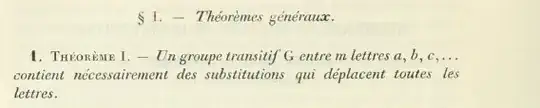
jordan

The theorem you mention is a corollary of Théorème I. If $H$ is a proper subgroup, then $G$ acts transitively on the left cosets of $H$ by multiplication. Now $[G:H] \geq 2$ since $H$ is a proper subgroup, so there exists a $g \in G$ such that $gaH \neq aH$ for all $a \in G$. Hence $a^{-1}ga \not\in H$ and $g \not\in aHa^{-1}$ for all $a \in G$. In other words, $g$ is an element of $G$ that is not contained in $\bigcup_{a \in G} aHa^{-1}$.

In fact, we can use the theorem to prove Théorème I. If $G$ acts transitively on $X$, then the point stabilizers of $X$ are conjugate. Thus if every point fixes some point of $X$, then $G = \bigcup_{g \in G} aHa^{-1}$ for any $H = \operatorname{Stab}(x)$. If $|X| \geq 2$, then $H$ is a proper subgroup since $G$ is transitive.

I don't know a lot of French, but I don't think I see him actually mentioning in the paper that "a finite group cannot be the union of conjugates of a proper subgroup" (someone might want to check this). But I guess it is still safe to attribute that to Jordan, since it is an easy corollary of Théorème I, and the two results are equivalent anyway.

  • 1
    Could you translate the enunciation of the theorem? – Pedro Apr 27 '13 at 20:19
  • @PeterTamaroff: Something like "A transitive group $G$ on $m$ letters $a, b, c, \ldots$ contains necessarily a permutation that moves every letter" – Mikko Korhonen Apr 27 '13 at 20:20
  • Now $[G : H] \ge 2$, so there exists a $g \in G$ such that $gaH \neq aH$ for all $a \in G$ --- could you please provide more details here? – hengxin Mar 30 '14 at 13:47
  • 1
    @hengxin: Theoreme I says that if $G$ acts transitively on a set $X$ (assume $|X| \geq 2$), then some element acts without fixed points. The part you mention is an application of the theorem to the case where $G$ acts on the left cosets of $H$ by left multiplication. – Mikko Korhonen Mar 30 '14 at 14:54
  • I see. Thanks. BTW, where can I find a proof of Theorem I in English? – hengxin Apr 01 '14 at 08:32
  • @hengxin: See this question for two proofs: http://math.stackexchange.com/questions/106158/every-transitive-permutation-group-has-a-fixed-point-free-element – Mikko Korhonen Apr 01 '14 at 08:34
  • Got it. Both theorems are interesting. – hengxin Apr 01 '14 at 08:47