It is similar to the derivation of cos(x) or sin(x) geometrically.
Let $\theta_1 = \arcsin(x)$
$$\sin(\arcsin(x)) = x = P$$
$$\cos(\arcsin(x)) = \sqrt{1 - \sin^2(\arcsin(x))}= \sqrt{1-x^2}= B $$
$$H = 1$$
A very important result used in all the cases,
$$\lim_{x \rightarrow 0} \frac{\sin x}{x} = 1$$
And assume
$$\lim_{x \rightarrow 0} {\sin x} = x$$
You wouldn't even need to use $\sin'(x) = \cos(x)$
Sorry for the bad drawing and not drawing a unit circle:(
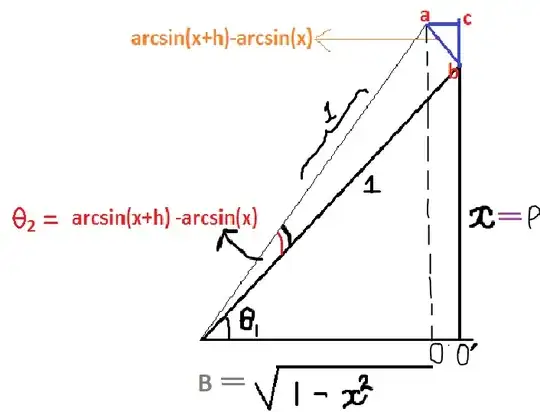
If carefully notice
$$\theta_1 + \theta_2 = \arcsin(x+h)$$
As in other differential equations we will take $h \rightarrow 0$ at the end
$$\theta_2 = \arcsin(x+h)-\arcsin(x)$$
$$AO' = \sin(\theta_1 + \theta_2)$$
$$AO' = \sin(\arcsin(x+h)) = x+h$$
$$CB = AO' - AO = x+h -x = h$$
$$AC = OO'$$
$$AC = \cos(\arcsin(x))-\cos(\arcsin(x+h) )$$
$$AC = \sqrt{1-x^2} - \sqrt{1-(x+h)^2}$$
$$AC = h \lim_{h\rightarrow 0}\frac{\sqrt{1-x^2} - \sqrt{1-(x+h)^2}}{h}$$
$$AC =- h \frac{d}{dx}(\sqrt{1-x^2})$$
Use Chain Rule
$$AC = -h\frac{-x}{\sqrt{1-x^2}}$$
$$AC = h\frac{x}{\sqrt{1-x^2}}$$
Using Pythagoras Theorem for ABC
$$AB^2 = AC^2 + BC^2$$
$$AB^2 = h^2\frac{x^2}{ 1-x^2}+ h^2$$
$$AB = h\sqrt{\frac{x^2 +1-x^2}{1-x^2}}$$
$$AB = h\sqrt{\frac{ 1 }{1-x^2}}$$
$$AB = \sin(\theta_2)$$
$$AB = \lim_{h\rightarrow 0}\sin(\arcsin(x+h)-\arcsin(x) )= \lim_{\theta_2 \rightarrow 0}\sin(\theta_2)$$
$$AB = \theta_2$$
$$\theta_2 = h \frac{ 1 }{\sqrt{1-x^2}}$$
$$\theta_2/h = \frac{ 1 }{\sqrt{1-x^2}}$$
$$\lim_{h \rightarrow 0} \frac{\arcsin(x+h)-\arcsin(x)}{h} = \frac{ 1 }{\sqrt{1-x^2}}$$
Now you can do the same for $\arccos (x)$, but since this proof was done by only using $\sin(x)/x = 1$,
Let $\theta_2 = \arccos(x-h) - \arccos(x)$
You can also assume h to be positive but this is a lot easier
$B = x$
$P = \sqrt{1-x^2}$
$H= 1$
$$BC = \sqrt{1-(x-h)^2}- \sqrt{1-x^2}$$
$$BC^2 = h^2 \frac{x^2}{ {1-x^2}}$$
$$AC^2 = h^2$$
AB remains the same
$$AB = \theta_2 = h \frac{ 1 }{\sqrt{1-x^2}}$$
$$\lim_{h \rightarrow 0} \frac{\arccos(x-h)-\arccos(x)}{h} = \frac{ 1 }{\sqrt{1-x^2}}$$
But....
$$\lim_{h \rightarrow 0} \frac{\arccos(x+h)-\arccos(x)}{h}= \lim_{h \rightarrow 0} \frac{\arccos(x-h)-\arccos(x)}{-h}$$
$$\frac{\mathsf d}{\mathsf {dx}}(\arccos(x)) = -\frac{ 1 }{\sqrt{1-x^2}}$$
I found out that arctan also requires a similar approach
https://en.wikipedia.org/wiki/Inverse_trigonometric_functions


