8

$$\cos^2(\theta) + \sin^2(\theta) = 1$$

I solved this by using right triangle,

$$\sin(\theta) = \frac{a}{c}, \quad \cos(\theta) = \frac{b}{c}$$

$$\cos^2(\theta) + \sin^2(\theta) = 1$$

$$\Bigl(\frac{b}{c}\Bigr)^2 + \Bigl(\frac{a}{c}\Bigr)^2 = 1 $$

$$\frac {a^2 + b^2} {c^2} = 1 $$

now using Pythagorean identity: $a^2 + b^2 = c^2$

$$\frac {c^2} {c^2} = 1, \quad 1 = 1 $$

Sebastiano
  • 7,649
EM4
  • 1,245
  • 2
    Perfect for my humble opinion :-) – Sebastiano Jul 29 '20 at 23:02
  • 2
    Are you allowed to assume that $\theta$ is an acute angle? If not, then you have more work to do. – Blue Jul 29 '20 at 23:13
  • 1
    This is the right idea. But I'm confused as to what you are allowed to assume is true by definition or axiom and what you can prove. How are $\cos,\sin$ defined? do you know the distance formula? – fleablood Jul 29 '20 at 23:21
  • @Blue , really? I will learn about this :) – EM4 Jul 29 '20 at 23:30
  • @fleablood, I see what you are saying, I wrote this proof without thinking deeply. I should have defined my cos and sin more. How will distance formula work for this proof? – EM4 Jul 29 '20 at 23:31
  • 2
    Okay.... I see that you have learned the definition of $\cos \theta$ and $\sin \theta$ in terms of right triangles and not points of the unit circle. The distance formula tells us that that a unit circle is defined as all $(x,y)$ so that $x^2 + y^2 = 1$ and if $\sin, \cos$ are define by being the x,y values of points of a circle $\cos^2 + \sin^2 =1$ is a given. – fleablood Jul 29 '20 at 23:46
  • "Are you allowed to assume that θ is an acute angle": If you define $\cos \theta$ by $\frac {adj}{hyp}$ or a right triangle then $\cos \theta, \sin \theta$ are not defined if $\theta \ge 90^\circ$ so you don't have to worry about this.... but if you define $\cos, \sin$ as the $x,y$ values of a circle then if $(x,y)$ is the point of a unit circle at angle $\theta$ then we know by the formula of a circle that $1 = x^2 + y^2 = \cos^2 \theta + \sin^2 \theta$ and there is nothing to prove. ... but, like all math, everything depends on your definitions. – fleablood Jul 30 '20 at 00:08

9 Answers9

11

You solved this by using some right triangle but there isn't a right triangle in your solution? Remember, things like that have to be explicitly written in your proof.

Also, the proof is not very valid because you started off by asserting that:

$$\sin^2(\theta)+\cos^2(\theta) = 1$$

when really, what you should have started with is just the left-hand side of that. In other words, I can see where you're going with the reasoning but it isn't airtight because of your wording.

Really, what you should have done is to say that:

$$\sin(\theta) = \frac{a}{c}$$

$$\cos(\theta) = \frac{b}{c}$$

where $a,b,c$ are the sides of a particular right triangle whose image you're supposed to include. Then, you have:

$$\sin^2(\theta)+\cos^2(\theta) = \frac{a^2}{c^2} + \frac{b^2}{c^2} = \frac{a^2+b^2}{c^2}$$

By Pythagoras's Theorem relating the sides of the right triangle, it is the case that $a^2+b^2 = c^2$. Hence, we have:

$$\sin^2(\theta) + \cos^2(\theta) = \frac{a^2+b^2}{c^2} = \frac{c^2}{c^2} = 1$$

which proves the desired result.

  • Also worth noting, there is only a right triangle with angle $\theta$ if $\theta$ is greater than 0 and less than 90°. To prove this for all real numbers $\theta$, the approach would depend on how the trig functions have been defined. – Steve Kass Jul 29 '20 at 23:11
  • Yeap, that's true. I'll edit my post later to reflect that since i should've mentioned that. – Abhijeet Vats Jul 29 '20 at 23:25
  • @AbhijeetVats, yes I should have been more explicit on my proof. Ugh more learning. – EM4 Jul 29 '20 at 23:29
  • @SteveKass what you mean? :) – EM4 Jul 29 '20 at 23:29
  • You can't prove this with a right triangle if $\theta$ doesn’t fit into a right triangle. For example, what if $\theta=135º$? There is no right triangle containing $\theta$ as an angle. – Steve Kass Jul 29 '20 at 23:34
  • true true, so how would you solve this? – EM4 Jul 29 '20 at 23:39
  • You would need to define sine and cosine using the unit circle on the Cartesian Plane and prove it by way of other simpler identities. You can find the derivation in Modern Calculus and Analytic Geometry by Richard Silverman – Abhijeet Vats Jul 29 '20 at 23:55
10

My start, for my students is the real circunference $\mathcal C$ of center $O(0,0)$ and radius $r$, $P\equiv(x,y)\in \mathcal C$ $$\mathcal C\colon \quad x^2+y^2=r^2$$ $r>0$ and $x=r\cos\theta, y=r\sin\theta$, $\theta\in[0,2\pi[$, that it gives: $$r^2\cos^2\theta+r^2\sin^2\theta=r^2 \iff r^2(\cos^2\theta+\sin^2\theta)=r^2$$ Hence dividing by $r^2>0$ you have:

$$\cos^2\theta+\sin^2\theta=1$$

Sebastiano
  • 7,649
8

The asker seems to have the basic idea of the argument down. However, this question is tagged , thus I believe that the asker wants feedback on their argument. Other answers have provided alternative proofs of this results, but these seems not to really address the question of critiquing the proof or its presentation.

Definitions

The argument that you give is a little unclear, as you have not unambiguously defined the objects you are working with, nor how they are meant to fit together. In American high schools, the definitions given for trigonometric functions are usually in terms of right triangles, e.g. $\sin(\theta) = \text{opp}/\text{hyp}$, where $\text{opp}$ is the length of the side oppose the angle $\theta$ in a right triangle, and $\text{hyp}$ is the length of the hypotenuse of that triangle.

However, this is not the only way to define trigonometric functions. In other contexts, the trigonometric functions might be defined in terms of points on the unit circle, or as the solutions to certain differential equations, or by their Taylor series, or in terms of the complex exponential function, and so on.

I cannot emphasize this enough: definitions matter! Everything in mathematics comes down to applying arguments to well defined mathematical objects. Often, a single mathematical object can be defined in multiple (equivalent) ways. Proving results about these objects depends on a thorough understanding their definitions.

Logical Structure

The argument you give is also a little unclear as you don't indicate which statements follow from the others. For example, when you write

$\cos^2(\theta) + \sin^2(\theta) = 1$

$(\frac{b}{c})^2 + (\frac{a}{c})^2 = 1 $

what does this mean? Does the first line imply the second? Does the second imply the first? Are the two statements entirely unrelated? You should connect the ideas in some manner, either using English or notation.

Moreover, as I read your argument, you start by assuming the conclusion. This is no good. You need to start with a known true statement, then show how that implies the desired statement. Again, it is helpful to be careful about indicating how one statement relates to the next.

Grammatical Structure

Good mathematical writing should be easy to read, in the sense that you should be able to read it out loud, and it should make sense. For example, you ought to write in complete sentences, mixing in notation only when it makes it easier to understand what is going on.

With the above in mind, here is how I would present your proof:


enter image description here

Definition: Let $\triangle ABC$ be an arbitrary right triangle, where $C$ is the right angle. Let $a$, $b$, and $c$ denote the lengths of the sides opposite the angles $A$, $B$, and $C$, respectively (see the image, above, taken from Wikipedia). Define the sine and cosine of the angle $A$ by $$ \sin(A) = \frac{a}{c} \qquad\text{and}\qquad \cos(A) = \frac{b}{c}. $$

Proposition: If $0 < \theta < 90^{\circ}$, then $ \sin(\theta)^2 + \cos(\theta)^2 = 1$.

Proof: Using the notation in the definition above, set $\theta = A$.[1] Starting on the left-hand side of the desired identity, the definitions of sine and cosine give $$ \sin(\theta)^2 + \cos(\theta)^2 = \left(\frac{a}{c} \right)^2 + \left( \frac{b}{c} \right)^2. $$ Expand this and simplify to get $$ \left(\frac{a}{c} \right)^2 + \left( \frac{b}{c} \right)^2 = \frac{a^2}{c^2} + \frac{b^2}{c^2} = \frac{a^2 + b^2}{c^2}. $$ The Pythagorean theorem[2] implies that $a^2 + b^2 = c^2$, and so $$ \frac{a^2 + b^2}{c^2} = \frac{c^2}{c^2} = 1. $$ Combining these equalities gives $$ \sin(\theta)^2 + \cos(\theta)^2 = 1, $$ as desired.

Addendum: As pointed out by fleablood in the comments, there is a slight hole in the argument: the definition of sine and cosine given above presupposes that the ratios don't depend on the actual triangle. That is, if $\triangle ABC$ and $\triangle A'B'C'$ are right triangles such that $A$ and $A'$ have the same measure, then $$ \frac{a}{c} = \frac{a'}{c'}. $$ This follows immediately from properties of similar triangles, but probably requires some mention in the general development of the theory. Of course, once you make this observation, we could just assume that $c=1$. The Pythagorean theorem implies that $a^2 + b^2 = 1$, and so $$ \sin(\theta)^2 + \cos(\theta)^2 = \left(\frac{a}{1}\right)^2 + \left( \frac{b}{1} \right)^2 = a^2 + b^2 = 1. $$ This argument is basically identical to the one given above, but the computations are slightly more straight-forward.


[1] Note that the assumption that $0 < \theta < 90^{\circ}$ is important here, as we have not defined the sine and cosine functions for other values of $\theta$. This is part of why we eventually define these functions using more sophisticated tools in more advanced settings.

[2] I am going to assume that the Pythagorean theorem has already been established, since the argument in the original question seems to assume this result. If one needs a proof, there are one or two on Cut the Knot.

  • 1
    If the definition of $\cos\theta = \frac {adj}{hyp};\sin\theta=\frac{opp}{hyp}$ assumes that for all similar right triangles with base angles will have these proportions be constant, then as a proof could we not just merely consider the one such triangle with hyp $=1$. Then by defin $adj =\cos \theta$ and $opp = \sin\theta$ and the result is the Pythagorean theorem. – fleablood Jul 30 '20 at 00:55
  • @fleablood Sure. But this is not generally how the arguments are presented in American high schools (which is the point of view I assumed), and the presentation above is neither more (nor less) general than making the additional assumption that the hypotenuse is of unit length. – Xander Henderson Jul 30 '20 at 01:42
  • Very nice also your explanation. +1. – Sebastiano Jul 30 '20 at 08:48
6

Well, the fundamental theorem of trigonometry is an extra useful identity for us, we all know that it's important.

Here's an approach:

It's basic that: $$0=0$$ Wich is the same if we wrote: \begin{align} 0&=0.t\\ &=0.x\bigg\vert_0^t\\ &=0\times\int_0^t\mathrm{d}x\\ &=\int_0^t2\cos(x)\sin(x)-2\cos(x)\sin(x)\mathrm{d}x\\ &=\underbrace{\int_0^t 2\cos(x)\sin(x)\mathrm{d}x}_{I}-\underbrace{\int_0^t2\cos(x)\sin(x)\mathrm{d}x}_{J}\\ \end{align} Now using some substituions in the integral $I$: $$u=\sin(x)\ \ \ \ \ \ \ \ \ \mathrm{d}u=\cos(x)$$ We'll have: $$I=2\int_0^{\sin(t)}u\ \mathrm{d}u$$ For the integral $J$: $$v=\cos(x)\ \ \ \ \ \ \ \ \ \ \ \mathrm{d}v=-\sin(x)$$ So: $$J=2\int_1^{\cos(t)}v\ \mathrm{d}v$$ Note that the minus sign will dissapear due to the substitution: \begin{align} 0&=2\int_0^{\sin(t)}u\ \mathrm{d}u+2\int_1^{\cos(t)}v\ \mathrm{d}v\\ &=u^2\bigg\vert_0^{\sin(t)}+v^2\bigg\vert_1^{\cos(t)}\\ \sin^2(t)+\cos^2(t)-1&=0\end{align} And here's our identity: $${\cos^2(\varphi)+\sin^2(\varphi)=1}$$ I Hope that you've liked it!

euler_med
  • 1,044
4

There are many proofs of this identity. We can utilize another trigonometric identity. $$\cos^2(\theta)+\sin^2(\theta)=1\implies\sqrt{\cos(\theta)\cos(\theta)+\sin(\theta)\sin(\theta)}=1$$ Recognize the trigonometric identity under the radicand. $$\sqrt{\cos(\theta)\cos(\theta)+\sin(\theta)\sin(\theta)}=\sqrt{\cos(\theta-\theta)}=\sqrt{\cos(0)}=\sqrt{1}=1$$ Thus, the identity is true for any $\theta\in\mathbb{R}$.

EDIT: Let us begin by recognizing that $\cos^2(\theta)+\sin^2(\theta)$ may or may not be equal to $1$ for any real number $\theta$. Let us prove that it is indeed equal to $1$. \begin{align} \cos^2(\theta)+\sin^2(\theta)&=\cos^2(\theta)+\sin^2(\theta)\\ \cos^2(\theta)+\sin^2(\theta)&=\cos(\theta)\cos(\theta)+\sin(\theta)\sin(\theta) \end{align} If we are permitted to utilize other trigonometric identities, which is not explicitly prohibited in the question, we can quickly finish the proof. \begin{align} \cos^2(\theta)+\sin^2(\theta)&=\cos(\theta-\theta)\\ &=\cos(0)\\ &=1 \end{align} Thus, the identity $\cos^2(\theta)+\sin^2(\theta)=1$ is true for any $\theta\in\mathbb{R}$.

  • 1
    hmmm, how you got radical? Never seen this before. – EM4 Jul 29 '20 at 23:28
  • @user1981 Take the square root of each side of the equation. – ThunderGod763 Jul 29 '20 at 23:29
  • "Recognize the trigonometric identity under the radicand. " But the only reason we know that trig identity is true is because we know from the begining that $\cos^2 + \sin^2 = 1$. You can't use an advanced result to prove a basic result. This argument is circular and not valid. – fleablood Jul 30 '20 at 00:01
  • 1
    @fleablood The angle addition formulae can be derived without the identity $\sin(x)^2 + \cos(x)^2 = 1$. I have in mind an argument which uses properties of vectors (addition and scaling formula, plus the Pythagorean theorem). Thus the reasoning here needn't necessarily be circular. – Xander Henderson Jul 30 '20 at 00:22
  • @fleablood I believe it is valid because at that rate, we cannot use any trigonometric identities in this proof and must resort to a geometric one or something without trigonometry. Additionally, if the original identity is true, then it implies true statements. The statement $1=1$ is true and implied by the identity, which I proved. – ThunderGod763 Jul 30 '20 at 00:39
  • 3
    " Additionally, if the original identity is true, then it implies true statements. The statement 1=1 is true and implied by the identity, which I proved. " Um....You may want to think about that a little more.... – fleablood Jul 30 '20 at 00:45
  • 1
    $0=2 \implies -1 = 0-1 = 2-1 = 1 \implies (-1)^2 = 1^2 \implies 1=1$. So $0=2$ implies a true statement. – fleablood Jul 30 '20 at 00:47
  • @fleablood I can go from $1=1$ to $\sin^2(\theta)+\cos^2(\theta)=1$ in a correct manner. I cannot, however, go from $1=1$ to $0=2$ in a correct manner. – ThunderGod763 Jul 30 '20 at 00:55
  • 1
    ""I can go from 1=1 to sin2(θ)+cos2(θ)=1 in a correct manner." That is true statement implies identity. That is not what you said. You said identity implies true statement. That is not a valid condition. You said "Additionally, if the original identity is true, then it implies true statements. The statement 1=1 is true and implied by the identity" which is not valid. – fleablood Jul 30 '20 at 01:02
4

This is the right idea. But I'm confused as to what you are allowed to assume is true by definition or axiom and what you can prove. How are $\cos,\sin$ defined? Do you know the distance formula?

Why are you being asked to prove it? Could it not be assume to be true by axiom and definition?

......

The way I always viewed it, which may or may not be in synch with how you learned it and in which order, was:

First we have the Pythagorean Theorem. I won't bother proving it but... we can google and find many proofs.

The we have converting euclidean geometry to the cartesian plane and find how equations of points as ordered pairs dovetails in with algebraic eqations. I won't go into details but it's basically given Euclid's 5th posulate about parallel lines the horizontal and vertical grids of the cartesian plane are parallel and parellel lines will have equal slopes.

Then we have the distance formula: Two points are $(x_1, y_1)$ and $(x_2, y_2)$ if we create a third point $(x_2, y_1)$ then the line $(x_1, y_1)$ to $(x_2, y_1)$ is a horizontal line $x_2 - x_1$ long and the line $(x_2,y_1)$ to $(x_2, y_2)$ is a vertical line $y_2 - y_1$ long. These two lines form the legs of a right triangle. The line $(x_1, y_1)$ to $(x_2, y_2)$ is the hypotenuse of this line. So by the pythagorean theorem the distance between $(x_1, y_1)$ and $(x_2, y_2)$ is the length of the hypotenuse which is the square root of the sum of the squares of the other legs. So the distance $||(x_1, y_1), (x_2,y_2)|| =\sqrt {(x_2-x_1)^2 + (y_2 - y_1)^2}$.

And then you we have the equation for a circle: A circle is defined as all the points that are equidistance from the center. So if a circle is centered at $(a,b)$ and has radius $r$ the the circle is all the points $(x,y)$ where $||(x,y),(a,b)|| = r$ or in other words so that $(x-a)^2 + (y-b)^2 = r^2$.

So if we have a unit circle centered and $(0,0)$ then the circle is described by all the $(x,y)$ so that $x^2 + y^2 =1$.

And then we define $\sin \theta, \cos \theta$. If $\theta$ is an angle and we look at the point $(x,y)$ on a unit circle centered that cooresponds with the angle, the we define $\cos \theta$ as the $x$ value and $\sin \theta$ as the $y$ value.

Which means as $x^2 + y^2 = 1$ then $\cos^2 \theta +\sin^2 \theta = 1$. There's nothing to prove as that was a well known fact about circles.

.....

Or if you defined $\sin \theta, \cos \theta$ and proportions of right triangle. then

$\cos \theta = \frac {adj}{hypotenuse}$ and $\sin \theta = \frac {opp}{hypotenuse}$ and as $hypotenuse^2 = adj^2 + opp^2$ then $\cos^2 \theta + \sin^2 \theta=(\frac {adj}{hyp})^2 + (\frac {opp}{hyp})^2 = (\frac {hyp}{hyp})^2 = 1$.

....

Okay... I apologize for my initial tone.

If that was your definition of $\sin, \cos$ (and that is a very common way of defining $\sin, \cos$ (although I prefer to use the unit circle definition) then I guess $\cos^2 + \sin^2 = 1$ ISN'T a given after all. (Unless your definition was defined for right triangle with hypotenuse equal to $1$ in which case it is. But still, using the Pythagorean Theorem there isn't much to prove.... merely that dividing by the hypotenuse will scale down to $1$.)

So I guess it shouldn't have surprised me to see you trying to prove it as much as it did.

I apologize. Your proof, for the triangle definition of trig, is correct.

fleablood
  • 124,253
  • is okay @fleablood , I am always down to be critic to be good learner and such. Don't be sorry...I should have been more precise on my proof. – EM4 Jul 30 '20 at 00:06
  • 2
    Well, I'm not really apologizing. My point is that whether this needs to be proven or not depends on context and definitions and for the most part this is an immediate property that that motivates the definition of trig. So to prove this doesn't make sense if this was a preliminary to even definining trig in the first place.... But I don't want to make it sound as though I am browbeating a student. ... It's too common for those of us who are experienced to berate students for niavite. Best to acknowledge that as my point is subtle. – fleablood Jul 30 '20 at 00:15
  • Really it is a complete explanation of my explanation in high school class. Unfortunately, I must be concise. Obviously implicitly I have supposed that $0 < \theta < 90^{\circ}$ to have a right triangle. +1 surely. – Sebastiano Jul 30 '20 at 08:47
1

I can solve this using Euler's formula

$e^{i\theta}=\cos(\theta)+i\sin(\theta)$ and $e^{-i\theta}=\cos(\theta)-i\sin(\theta)$.$$\cos^2(\theta)+\sin^2(\theta)=1$$

$$\cos^2(\theta)-i^2\sin^2(\theta)=1$$

$$(\cos(\theta)+i\sin(\theta))(\cos(\theta)-i\sin(\theta))=1\iff (e^{i\theta})(e^{-i\theta}) = 1$$

$$e^0 = 1 \iff 1 = 1$$

$\therefore\theta$ true for any $\mathbb{R}$.

Sebastiano
  • 7,649
EM4
  • 1,245
  • @SteveKass what about this method on this proof on above? – EM4 Jul 29 '20 at 23:45
  • 2
    "I can solve this using Euler's formula" No you can't. Euler's formula requires knowing that $\cos^2 + \sin^2 = 1$ and if you didn't know that you could never know Euler's formula. So this is circular (pun unintended) and you are put de cart before the horse (pun intended). – fleablood Jul 29 '20 at 23:58
-1

since:

$(cos + sin)^2 = cos^2 + sin^2 + 2*cos*sin$

then:

$cos^2 + sin^2 = (cos + sin)^2 - 2*cos*sin$ ...............(eq #1)

Consider the diagram at

https://www.fullpotentialtutor.com/wp-content/uploads/2022/11/Pythagorean-Theorem-Proof.png.webp

(sorry, I am new and not allowed to post images yet)

if we consider area then $(a + b)^2 = c^2 + 4 * \frac{(b * a)}{2}$

Rearranging:

$(a + b)^2 - 2 * (b * a)= c^2$

or:

$\frac{(a + b)^2}{c^2} - 2 * \frac{b * a}{c^2} = 1$

or:

$(\frac{a}{c} + \frac{b}{c})^2 - 2 * \frac{b}{c} * \frac{a}{c} = 1$

we can substitute $cos = \frac{b}{c}$

and $sin = \frac{a}{c}$

and we get:

$(sin + cos)^2 - 2*cos*sin = 1$

Substituting eq #1:

$sin^2 + cos^2 = 1$

dfdies
  • 1
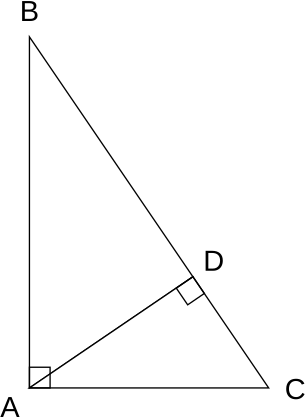
-1

I have thought of a simpler approach

I am new to this site and am not yet allowed to post images, so please consider the triangle at:

Wiki Triangle

We know that $\angle ABD = \angle ADC$ and shall focus on those two angles

$\cos = \frac{BD}{BA} = \frac{AD}{AC}$

$\sin = \frac{AD}{BA} = \frac{DC}{AC}$

So substituting into $\cos^2 + \sin^2 = 1$

$\frac{BD * AD}{BA * AC} + \frac{AD * DC}{BA *AC} = 1$

As $BD + DC = BDC$

$\frac{(BDC - DC) * AD}{BA * AC} + \frac{AD * DC}{BA *AC} = 1$

$\frac{BDC*AD}{BA*AC} - \frac{DC* AD}{BA * AC} + \frac{AD * DC}{BA *AC} = 1$

$\frac{BDC*AD}{BA*AC} = 1$

Since, $\cos = \frac{AD}{AC}$ and

$\frac{BDC}{BA} = \frac{1}{\cos}$ then

$\frac{\cos}{\cos} = 1$

HeroZhang001
  • 2,201
dfdies
  • 1
  • Welcome to stackexchange. That said, you have just posted two different somewhat flawed answers to an old question that already has several good answers. That's a waste of your time and mine and others on this site. If you want to help, answer new questions - but only those where the OP shows some genuine effort of their own. – Ethan Bolker Mar 13 '23 at 14:54