4

I read https://matheducators.stackexchange.com/q/7837, but it doesn't answer my question because the Multiplicand is a whole integer there. The trick is to rationalize the denominator, to enable me to compare the numerator. I'm just using $\dfrac{4}{6} \div \dfrac{1}{2} \equiv \dfrac{4}{6} \div \color{red}{\dfrac{3}{6}}$. I can see that $4/6 = \color{red}{1}$ of the top row (each row representing $3/6$) + $\color{green}{1/3}$ of the bottom row = 4/3.
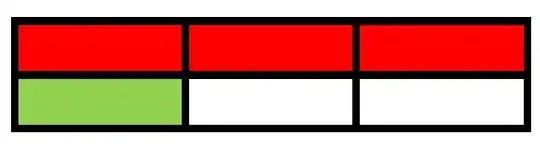
enter image description here

Now $a \neq b \neq c \neq d \neq 0, 1$. I rationalize the denominator. $\dfrac{\dfrac{a}{b}}{\dfrac{c}{d}} \equiv \dfrac{\dfrac{ad}{bd}}{\dfrac{cb}{db}} $. Now what do I do? How can I compare $ad$ with $cb$?

  • Maybe it is easier if you simplify and concretise a bit. For instance, you could philosophise over why $3\div 5$ is the same as $3\cdot \frac15$. Then expand one thing at a time from there, until you have the full general intuition. – Arthur Nov 20 '20 at 09:39
  • @Peter This isn't my example. It's from the Reddit post. But I removed $a,c$ from that inequality now. –  Nov 20 '20 at 09:44
  • If you do not want to apply the rule, you can imagine that we multiply both fractions with a suitable positive integer to make them integers. In your example, such a positive integer is $6$ giving $4$ and $3$. In general, you just have to take $b\cdot d$ or better $lcm(b,d)$. – Peter Nov 20 '20 at 09:47

1 Answers1

0

Imagine you have the fraction $\frac{a}{b}$. This can be readily made by a set of segments b long, a coloured.

Beside it is a second set of coloured rods. The length of $a$ is made identical to $c$ new segments, the total length of the rod is $d$ segments.

The lengths of the two rulers then stand in the ratio of $\frac{b}{d}$ of these two rulers, since we have made $a=c$.

The other way is to resort to a graph.
In the first part, we make a line $b$ long and divide it to $a$:
o-------a---b.
In the second part, we make a line o------c---d.
Geometric division is performed by drawing a line between the divisor and $1$. Here, $1$ means $b$ and the line is drawn from $c$ to $b$.
Continue $oab$ outwards and draw a second line from $d$ parallel to $cb$, to intersect with $ab$. You will see that it is on the other side of $a$.