Look at the trigonometric circle and approximate the chord $s$ with the angle $\theta$.
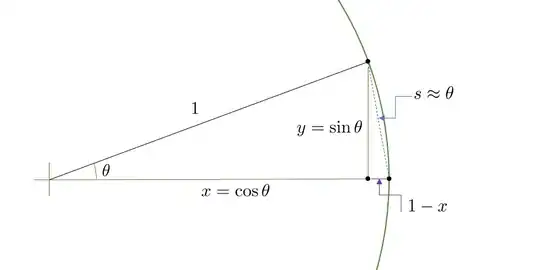
Here $x=\cos \theta$ and $y=\sin \theta$.
From the big triangle, you have $x^2+y^2=1$ which is obvious, and from the small circle, you have $s^2 = y^2 + (1-x)^2$. But with approximation $s \approx \theta$ the above is
$$\theta^2 \approx y^2 + (1-x)^2 \tag{1}$$
Now sub $y=\sqrt{1-x^2}$ to get the well-known approximation
$$ \theta^2 \approx 1-x^2 + (1-x)^2 = 2 (1-x) $$
or
$$ x = \cos \theta \approx 1 - \tfrac{1}{2} \theta^2 \tag{2}$$
Now use (2) in (1) to get $\theta^2 \approx y^2 + \tfrac{1}{4} \theta^4$, but since we are keeping this a second order approximation $\theta^4 \approx 0$ and
$$ y = \sin \theta \approx \theta \tag{3} $$
Finally, $\tan \theta = \tfrac{y}{x} \approx \tfrac{\theta}{1-\tfrac{1}{2} \theta^2}$. But use the property $\tfrac{1}{1-z} = 1 + \frac{1}{1-z} z \approx 1 + z$ with $z=\tfrac{1}{2} \theta^2$ to get the final approximation.
$$ \tfrac{y}{x} = \tan \theta \approx \theta \left( 1 + \tfrac{1}{2} \theta^2 \right) \tag{4a} $$
But note that the last one is based on two approximations.
Another approach with $\tan$ would be to approximate once $\tan \theta = \tfrac{y}{x} = \theta \frac{\sqrt{1-\tfrac{1}{2}z}}{1-z}$ with $z=\tfrac{1}{2}\theta^2$ and the approximation $ \tan \theta \approx \theta \left( 1 + \tfrac{3}{4} z \right)$
$$ \tfrac{y}{x} = \tan \theta \approx \theta \left( 1 + \tfrac{3}{8} \theta^2 \right) \tag{4b} $$
For example with $\theta=0.6$ you have $\tan(0.6) = 0.68413681$, $0.6 \left( 1 + \tfrac{1}{2} 0.6^2 \right)=0.708$ an 3.5% error, and $0.6 \left( 1 + \tfrac{3}{8} 0.6^2 \right)=0.681$ an 0.45% error.
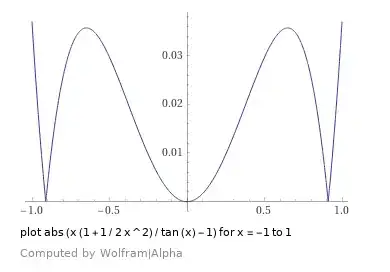
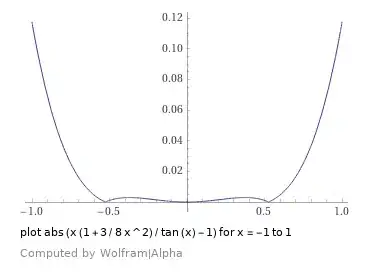
So (4b) is at least an order of magnitude better at approximating $\tan \theta$ than (4a). A graphical comparison of the error $f(x)/\tan x-1$ is shown below: