42

Problem: Let $x > 0$. Prove that $$x^{x^{x^{x^{x^x}}}} \ge \frac12 x^2 + \frac12.$$

Remark 1: The problem was posted on MSE (now closed).

Remark 2: I have a proof (see below). My proof is not nice. For example, we need to prove that $\frac{3x^2 - 3}{x^2 + 4x + 1} + \frac{12}{7} - \frac{24x^{17/12}}{7x^2 + 7} \le 0$ for all $0 < x < 1$ for which my proof is not nice.

I want to know if there are some nice proofs. Also, I want my proof reviewed for its correctness.

Any comments and solutions are welcome and appreciated.

My proof (sketch):

We split into cases:

i) $x \ge 1$:

Clearly, $x^{x^{x^{x^{x^x}}}}\ge x^x$. By Bernoulli's inequality, we have $x^x = (1 + (x - 1))^x \ge 1 + (x - 1)x = x^2 - x + 1 \ge \frac12 x^2 + \frac12$. The inequality is true.

ii) $0 < x < 1$:

It suffices to prove that $$x^{x^{x^{x^x}}}\ln x \ge \ln \frac{x^2 + 1}{2}$$ or $$x^{x^{x^{x^x}}} \le \frac{\ln \frac{x^2 + 1}{2}}{\ln x}$$ or $$x^{x^{x^x}}\ln x \le \ln \frac{\ln \frac{x^2 + 1}{2}}{\ln x}$$ or $$x^{x^{x^x}}\ge \frac{1}{\ln x}\ln \frac{\ln \frac{x^2 + 1}{2}}{\ln x}.$$

It suffices to prove that $$x^{x^{x^x}}\ge \frac{7}{12} \ge \frac{1}{\ln x}\ln \frac{\ln \frac{x^2 + 1}{2}}{\ln x}. \tag{1}$$

First, it is easy to prove that $$x^x \ge \mathrm{e}^{-1/\mathrm{e}} \ge \frac{1}{\ln x}\ln\frac{\ln\frac{7}{12}}{\ln x}.$$ Thus, the left inequality in (1) is true.

Second, let $f(x) = x^{7/12}\ln x - \ln \frac{x^2 + 1}{2}$. We have \begin{align*} f'(x) &= \frac{7}{12x^{5/12}} \left(\ln x + \frac{12}{7} - \frac{24x^{17/12}}{7x^2 + 7}\right)\\ &\le \frac{7}{12x^{5/12}} \left(\frac{3x^2 - 3}{x^2 + 4x + 1} + \frac{12}{7} - \frac{24x^{17/12}}{7x^2 + 7}\right)\\ &\le 0 \tag{2} \end{align*} where we have used $\ln x \le \frac{3x^2 - 3}{x^2 + 4x + 1}$ for all $x$ in $(0, 1]$. Also, $f(1) = 0$. Thus, $f(x) \ge 0$ for all $x$ in $(0, 1)$. Thus, the right inequality in (1) is true.
Note: For the inequality $\frac{3x^2 - 3}{x^2 + 4x + 1} + \frac{12}{7} - \frac{24x^{17/12}}{7x^2 + 7} \le 0$ for all $0 < x < 1$, we let $x = y^{12}$ and it suffices to prove that $11y^{47} + \cdots + 3 \ge 0$ (a polynomial of degree $47$, a long expression) for all $0 < y < 1$.

We are done.

SBF
  • 36,041
River Li
  • 37,323
  • 5
    Just mentioning that this can not be generalized further. Plots with WolframAlpha show that ${^{n}x} \ge (x^2+1)/2$ for $n=2, 4, 6$, but not for $n=8$. – Martin R Jun 07 '21 at 07:18
  • 3
    This is what I see for $n=8$: https://www.wolframalpha.com/input/?i=plot+x%5E%28x%5E%28x%5E%28x%5E%28x%5E%28x%5E%28x%5Ex%29%29%29%29%29%29+%2C+%28x%5E2%2B1%29%2F2+from+0+to+1 and the inequality does not hold near $x=0.2$. – Martin R Jun 07 '21 at 08:11
  • 1
    @RiverLi see https://math.stackexchange.com/questions/3784218/nested-logarithm-and-an-inequality .Perhaps it could be inspire you...? – Miss and Mister cassoulet char Jun 07 '21 at 08:25
  • 1
    @MartinR Yes, you are right. – River Li Jun 07 '21 at 08:32
  • 1
    @ErikSatie Thanks. – River Li Jun 07 '21 at 08:33
  • @MartinR Thanks for comment. It seems $^{8}x \ge (x^3 + 1)/2$ for $0 < x < 1$. – River Li Jun 07 '21 at 10:05
  • How do you prove that the polynomial of 47 degree is always positive? And the last fractional bound on ln(x), how did you get it or had the idea of using exactly that bound? Sounds like black magic to me – Thomas Jun 09 '21 at 18:30
  • @Thomas For the fractional bound on $\ln x$, it is the Pade $(2, 2)$ approximation of $\ln x$ at $x = 1$. You may find it by hand (see e.g. my answer for https://math.stackexchange.com/questions/3713384/which-is-greater-frac1332-or-ln-left-frac32-right/3714060#3714060). Or you may find it using wolframalpha.com (just input: Pade approximation ln(x) order 2,2 x=1). – River Li Jun 09 '21 at 23:42
  • 2
    @Thomas For degree $47$: First let $y = \frac{1}{1 + z}$ for $z \ge 0$, and we need to prove that $F(z) \ge 0$ for all $z \ge 0$ where $F(z)$ is a polynomial of degree $47$ (also long expression). Then we split into two cases: (1) If $z \ge 1/10$, by letting $z = 1/10 + u$ for $u \ge 0$, we have $F(1/10 + u)$ is a polynomial in $u$ with non-negative coefficients. True. (2) If $0 < z < 1/10$, by letting $z = \frac{1}{10}\cdot \frac{1}{1 + v}$ for $v > 0$, we have $(1 + v)^{47}F(\frac{1}{10}\cdot \frac{1}{1 + v})$ is a polynomial in $v$ with non-negative coefficients. True. We are done. – River Li Jun 10 '21 at 00:33
  • Thank you nice it is becoming clearer to me :) two more questions: (1) I guess Pade approximant give an approximation and is a question of luck the range of validity of the inequality that one has to check case by case ? (2) I guess you did not handle by hand all those coefficients for the polynomial of degree 47. Did you use some software ? And the choice of 1/10 was trial and error ? – Thomas Jun 10 '21 at 07:02
  • @Thomas Thanks for comment. (1) Yes, we hope to use small order of Pade approximant such as $(1, 1)$ but sometimes it is not enough we have to use high order. (2) I use Maple or Mathematica or Matlab or Wolframalpha.com. (3) Plot the function to see that the global minimum occurs in $(0, 1/10)$. So I try something like $1/10$. (4) Perhaps there are nice proof for $\ln x + \frac{12}{7} - \frac{24x^{17/12}}{7x^2 + 7}$ or the OP by hand. – River Li Jun 10 '21 at 08:46
  • I think your proof is as clever and simple as it gets for the $0<x<1$ case, considering the nature of the problem is ugly. – dezdichado Jun 10 '21 at 20:44
  • 1
    @dezdichado Thanks. The interesting thing is (1), i.e. $x^{x^{x^x}}\ge \frac{7}{12} \ge \frac{1}{\ln x}\ln \frac{\ln \frac{x^2 + 1}{2}}{\ln x}$. In other words, after some manipulations, the original inequality becomes "Constant Separable" (I mean $f(x) \ge g(x)$ becomes $f_1(x) \ge c \ge g_1(x)$ for a constant $c$). – River Li Jun 11 '21 at 02:51
  • @MartinR We just need a minor adjustment. For every positive integer $n$, the inequality $^{2n}x\ge(x^2+x+1)/3$ holds for all positive $x$. – ə̷̶̸͇̘̜́̍͗̂̄︣͟ Nov 14 '23 at 00:02

6 Answers6

13

Here, I give a full solution to the ineq given by RiverLi.
This solution has the advantage of being purely analytic. By "analytic", I mean, it is not based on any "approximate", "graphic" argument (except numeric calculations). I do try to be as clear as possible, however I do omit some explantions for some points because they're not complicated, just lengthy; in those cases, I add graphs to "justify".


Solution

Before going into details, I restate three simple facts we were able to easily verify by hand, and a lemma that is difficult to show.
$$x^x \ge e^{-1/e} \qquad x^{x^{x^x}}>\left(e^{-1/e}\right)^{e^{1/e}} > \underbrace{0.5877}_{=:a} \text{ and } \quad x^{x^{x^{x^{x^x}}}}> (e^{-1/e})^{1/0.587}>0.5343 $$

Lemma 1: $y \mapsto \frac{ \ln( (y+1)/2)}{\ln(y)}$ is a concave function on $(0.2,1)$.
Graph: Here
Demonstration: At the end.

Now we consider four different possible intervals of values of $x$, namely $[0,0.25)$ , $[0.25, 0.5)$, $[0.5 , 1)$ and $[1, +\infty)$ and prove the ineq in each case.


Case 1: When $x \ge 1$.
As @RiverLi has proven previously, $$x^{x^{x^{x^{x^x}}}} \ge x^x \ge x^2-x+1 \ge \frac{1}{2}(x^2+1)$$ Hence the inequality is true.


Case 2: When $x \in [0, 0.25)$, we have $$^6x> 0.534 >1/2( 0.25^2 +1) \ge \frac{1}{2}(x^2+1)$$ So this case holds.


Case 3: When $x \in [0.5,1)$

Consider the function $f(y)=\ln( e^y+1)$ on $(-\infty,0)$. Because its third derivative $f^{(3)}(y)=\frac{e^y(1-e^y)}{ (1+e^y)^3} $ is positive, we have the following usual inequality $$\frac{f(y)-f(z)}{y-z} \ge f'\left( \frac{y+z}{2}\right)$$ Choose $y=\ln(x^2),z=0$, we imply that: $$\frac{ \ln( (x^2+1)/2)}{\ln(x^2)} \ge \frac{x}{x+1}$$ or (note that $0<x<1$) $$\frac{x^2+1}{2} \le x^{ \frac{2x}{x+1}}$$ Besides $$^6x > x^{x^{0.5877}}= x^{ x^{0.5877}}$$ which implies the sufficiency to show $x^{0.5877} \le \frac{2x}{x+1}$, or $$2 \ge x^{0.5877} +x^{-0.4123}$$ Where the maximum of RHS on $(0.5,1)$ is easy to be analysed, which is in fact achieved at $x=1$, thus the ineq holds. See the graph here


Case 4 $x \in [0.25,0.5]$
As argued in the part 3, $^6x > x^{x^{0.5876}}$( I take $0.5876$ instead of $0.5877$ because it's nicer for later), it suffices to show $$\frac{\ln(x^2+1)-\ln(2)}{\ln(x)} \ge x^{0.5876}$$ on $[0.25, 0.5]$ or $$2\frac{\ln(y+1)-\ln(2)}{\ln(y)} - y^{0.2938} \ge 0$$

on $[0.5 ,\sqrt{0.5} ]\subset [0.5, 0.71]$ Indeed, we will prove the following stronger ineq after using Bernoulli's ineq,

$$2\frac{\ln(y+1)-\ln(2)}{\ln(y)}-\left( 0.6^{p} +p0.6^{p-1}(y-0.6) \right)\ge 0$$ where $p=0.2938$
Now, according to our lemma, the left fraction is concave function, which makes LHS is a summ of a concave and a linear function. Hence $LHS$ is concave. That means LHS attains minium at bord, thus $$LHS \ge \min( LHS_{|y=0.5},LHS_{|y=0.71})=0.007\dots>0$$ Graph here Hence the intial ineq holds for the interval $[0.25,0.5]$. Hence the conclusion. $\square$


Side note: We may not use lemma 1 for the demonstration in case 4 ( just mutiplying both side by $\ln(y)$ then analyze). However, I find this messy and tiresome to check.

----- End of solution -----------------------


Appendix:
Demonstration of lemma 1 I start by demonstrating another lemma
Lemma 2 $f,g$ be differentiable functions on $[a,b]$ such that $g(b)=f(b)=0$, $g(x)> 0,g'(x) < 0$ for all $a<x<b$, then if $x \mapsto \frac{f'(x)}{g'(x)}$ is an decreasing function, so is $\frac{f(x)}{g(x)}$.

Demonstration of lemma 2 Noting $h(x)= \frac{f(x)}{g(x)}$, by Cauchy's MVT, there is a number $c$ lying between $(x,b)$ such that: \begin{align}h'(x)&= \frac{f'(x)g(x)-g'(x)f(x)}{g(x)^2}\\ &=\frac{g'(x)}{g(x)}\left( \frac{f'(x)}{g'(x)}- \frac{f(x)-f(b)}{g(x)-g(b)}\right)=\underbrace{\frac{g'(x)}{g(x)}}_{<0}\underbrace{\left( \frac{f'(x)}{g'(x)}-\frac{f'(c)}{g'(c)}\right) }_{\ge 0} \le 0\end{align} Hence the conclusion.

Back to the demonstration of lemma 1
Note $h(x)=\frac{ \ln(x+1)-\ln(2)}{\ln(x)}$,it suffices to prove $h'(x)$ is decreasing. Now let's study $h$, we have: $$h'(x)= \underbrace{\left( x\ln(x)-(x+1)\ln( \frac{x+1}{2})\right)}_{=:f(x)} \frac{1}{\underbrace{x(x+1)\ln(x)^2}_{=g}}$$ (Check the formula's correctness here)
We see that $f(1)=0$, $f'(x)= \ln(x)-\ln\left( (x+1)/2\right) \le 0$. Hence we have first conclusions that $f(x) \ge 0$, $h$ increasing, and $h\le \lim_{x\rightarrow 1}h(x)=1/2$
The we have $g(1)=0$ and $$g'(x)=\ln(x)(\underbrace{2 + 2 x + \ln(x) + 2 x \ln(x)}_{ >0\text{ if } x>0.2}) \le 0$$ Besides, $$\frac{f'(x)}{g'(x)}=\frac{1-\frac{\ln(x+1)/2}{\ln(x)}}{2 + 2 x + \ln(x) + 2 x \ln(x)} =\frac{1-h(x)}{2 + 2 x + \ln(x) + 2 x \ln(x)}$$ is decreasing because the nominator is decreasing and positive ($h$ is increasing) and the denominator is increasing (by simple calculations or check graph here) Thus based on lemma 2, $h'(x)$ is decreasing. Thus conclusion $\square$

P/s: We can even prove that $y \mapsto \frac{\ln( (y+1)/2)}{\ln(y)}$ is concave on $(0,1)$, not just $( 0.2,1)$, but it is not necessary for our goal.

  • 2
    Nice.(+1) The idea is that for each appropriate interval, use the bound of the form $^6 x \ge x^{x^a}$. The remaining is whether we can prove $x^{x^a} \ge \frac{x^2 + 1}{2}$ easily. For example, for Case 3, it is easy to prove that $h(x) = 2 - x^{0.5877} - x^{-0.4123}$ is concave, so we only need to check $h(1/2)\ge 0$ and $h(1)\ge 0$. – River Li Jun 13 '21 at 04:16
  • Thank you. I agree the hard part of this question is how to find a checkable way to prove $x^{x^a}\ge \frac{x^2+1}{2}$ as the constant $a=0.5877$ is kinda tight. Indeed, we all see that if $a=0.57$ the ineq is no longer true. – Paresseux Nguyen Jun 13 '21 at 04:26
  • 1
    Your idea of using Pade's approximation is something I've never heard of. It's great to know such tool. I did learn many things from your proof. Thank you. – Paresseux Nguyen Jun 13 '21 at 04:27
  • 1
    Thank you for your solution. Your solution is addressed clearly using e.g. ----- End of solution -----------------------. – River Li Jun 13 '21 at 04:31
  • 2
    It seems that $^6 x \ge x^{x^{16/27}} \ge \frac{x^2 + 1}{2}$ for all $0 < x < 1$. The left inequality is equivalent to $^4 x \ge 16/27$. – River Li Jun 13 '21 at 05:15
  • 1
    It would be great if someone can prove that inequality. I'm really curious about it. For now, I think I would have some rest. Your ineq has haunted for some days. You may not believe it, I even saw it in my sleep. – Paresseux Nguyen Jun 13 '21 at 05:38
  • 1
    It is surprising! Thanks. – River Li Jun 13 '21 at 05:42
  • @ParesseuxNguyen anh đang học hay giảng dạy ở đâu vậy ? –  Jun 13 '21 at 06:18
  • @RiverLi following my second proof we have on $(0,1)$ :$$6^x\geq x^{x^{x^{\left(2.288x\left(1+x^{0.65}\left(x^{1.35}-1\right)\right)\right)}}}\geq x^{x^{\frac{16}{27}}}\geq 0.5x^2+0.5$$.Can you confirm ? – Miss and Mister cassoulet char Jun 20 '21 at 13:03
  • @ErikSatie If your purpose is to prove the OP, $^6 x \geq x^{x^{\frac{16}{27}}}\geq 0.5x^2+0.5$ is enough. If you want to prove the stronger inequality, sorry, I am not interested in the complicated thing like $x^{x^{x^{\left(2.288x\left(1+x^{0.65}\left(x^{1.35}-1\right)\right)\right)}}}$. – River Li Jun 20 '21 at 14:54
  • @RiverLi Can I propose it following you ? – Miss and Mister cassoulet char Jun 20 '21 at 16:26
  • @ErikSatie You may post it as a question. Some people may be interested in it. – River Li Jun 21 '21 at 01:24
5

Alternative solution:

Case $0 < x < 1$:

It is easy to prove that $x^x \ge \mathrm{e}^{-1/\mathrm{e}}$. Thus, we have $$x^{x^{x^x}} \ge x^{x^{\mathrm{e}^{-1/\mathrm{e}}}}. \tag{1}$$

Also, it is easy to prove that $$\ln y - y\mathrm{e}^{-1/\mathrm{e}}\le \ln \ln \frac{12}{7}, \ \forall y > 0.$$ By letting $y = -\ln x$, we have $$x^{x^{\mathrm{e}^{-1/\mathrm{e}}}} \ge \frac{7}{12}. \tag{2}$$

From (1) and (2), we have $$x^{x^{x^x}} \ge \frac{7}{12}$$ and thus $$x^{x^{x^{x^{x^x}}}} \ge x^{x^{7/12}}.$$

It suffices to prove that $$x^{x^{7/12}} \ge \frac12 x^2 + \frac12$$ or $$x^{7/12}\ln x \ge \ln \frac{x^2 + 1}{2}.$$ Let $f(x) = x^{7/12}\ln x - \ln \frac{x^2 + 1}{2}$. We have \begin{align*} f'(x) &= \frac{7}{12x^{5/12}} \left(\ln x + \frac{12}{7} - \frac{24x^{17/12}}{7x^2 + 7}\right)\\ &\le \frac{7}{12x^{5/12}} \left(\frac{3x^2 - 3}{x^2 + 4x + 1} + \frac{12}{7} - \frac{24}{7x^2 + 7}\cdot {\frac {1189\,{x}^{2}+574\,x-35}{-35\,{x}^{2}+574\,x+1189}}\right)\\ &= {\frac { 7\left( 1-x \right) \left( 1155\,{x}^{5}-16107\,{x}^{4}-53520 \,{x}^{3}+5232\,{x}^{2}+31629\,x-9861 \right) }{12x^{5/12} \left( {x}^{2}+4\,x+1 \right) \left( 7\,{x}^{2}+7 \right) \left( -35\,{x}^{2}+574\,x+1189 \right) }}\\ &\le 0 \end{align*} where we have used $\ln x \le \frac{3x^2 - 3}{x^2 + 4x + 1}$ for all $x$ in $(0, 1]$, and $x^{17/12} \ge {\frac {1189\,{x}^{2}+574\,x-35}{-35\,{x}^{2}+574\,x+1189}}$ for all $x$ in $(0, 1)$. Also, $f(1) = 0$. Thus, we have $f(x) \ge 0$ for all $x$ in $(0, 1)$.
Note: The bounds come from the Pade approximation. For the former, just take derivative. For the latter, we only need to prove the case when ${\frac {1189\,{x}^{2}+574\,x-35}{-35\,{x}^{2}+574\,x+1189}} > 0$. Let $F(x) = \frac{17}{12}\ln x - \ln {\frac {1189\,{x}^{2}+574\,x-35}{-35\,{x}^{2}+574\,x+1189}} $. We have $$F'(x) = -{\frac { 707455\left( x-1 \right) ^{4}}{12 x \left( 1189 \,{x}^{2}+574\,x-35 \right) \left( -35\,{x}^{2}+574\,x+1189 \right) } } < 0. $$ Also, $F(1) = 0$. The desired result follows.

We are done.

River Li
  • 37,323
3

Remarks: @Erik Satie considered $^6 x \ge \lim_{n\to \infty} {^n}x = -\frac{W(-\ln x)}{\ln x}$ for $(38/100, 1)$. I gave alternative proof of $-\frac{W(-\ln x)}{\ln x} \ge \frac12 x^2 + \frac12$ for all $x$ in $(38/100, 1)$.


Case $x \in (38/100, 1)$:

According to Theorem in [1] (Page 240), we have $\lim_{n\to \infty} {^n}x = -\frac{W(-\ln x)}{\ln x}$ where $W(\cdot)$ is the principal branch of the Lambert W function. Also, we have $^6 x \ge {^8}x \ge {^{10}}x \ge \cdots$ which results in $^6 x \ge \lim_{n\to \infty} {^n}x = -\frac{W(-\ln x)}{\ln x}$.

Let us prove that $-\frac{W(-\ln x)}{\ln x} \ge \frac12 x^2 + \frac12$ for all $x$ in $(38/100, 1)$.

To this end, with the substitution $x = \mathrm{e}^{-y}$ for $y\in (0, -\ln\frac{38}{100})$, we need to prove that $$\frac{W(y)}{y} \ge \frac12 \mathrm{e}^{-2y} + \frac12$$ or $$W(y) \ge \frac12 y\mathrm{e}^{-2y} + \frac12 y.$$ Since $u \mapsto u\mathrm{e}^u$ is strictly increasing on $(0, \infty)$, it suffices to prove that $$W(y)\mathrm{e}^{W(y)} \ge \left(\frac12 y\mathrm{e}^{-2y} + \frac12 y\right) \mathrm{exp}\left({\frac12 y\mathrm{e}^{-2y} + \frac12 y}\right)$$ that is $$y \ge \left(\frac12 y\mathrm{e}^{-2y} + \frac12 y\right) \mathrm{exp}\left({\frac12 y\mathrm{e}^{-2y} + \frac12 y}\right)$$ where we have used the fact $W(y)\mathrm{e}^{W(y)} = y$ for all $y > 0$.

With the substitution $z = \mathrm{e}^{-2y}$, it suffices to prove that, for all $z$ in $(38^2/100^2, 1)$, $$0 \ge \ln \frac{1 + z}{2} - \frac{1 + z}{4}\ln z.$$ The remaining is smooth.


Reference

[1] R. Arthur Knoebel, “Exponentials Reiterated,” The American Mathematical Monthly, No. 4, Vol. 88 (1981), pp. 235-252, Apr. 1981. https://www.maa.org/programs/maa-awards/writing-awards/exponentials-reiterated-0

River Li
  • 37,323
3

A partial answer


First Fact :

For $x\in(0,1)$ we have :

$$x^{x^{x^{x^{x^{x}}}}}\geq x^{x^{x}}$$

Proof: see the Reference in my other answer .


Second Fact

For $x\in(0,1)$ we have :

$$ x^{x^{x}}\geq x^{\left(1+\left(x-1\right)x\right)}$$

Hint :use Bernoulli's inequality.


Third Fact

For $x\in[0.65,1]$ we have :

$$x^{\left(1+\left(x-1\right)x\right)}\geq b(x)=\left(x\left(1+\left(x-1\right)\cdot\left(\left(x-1\right)x\right)+0.5\left(x-1\right)^{2}\cdot\left(\left(x-1\right)x\right)\cdot\left(\left(\left(x-1\right)x\right)-1\right)\right)\right)$$

Rewrite $x^{\left(1+\left(x-1\right)x\right)}=xx^{\left(\left(x-1\right)x\right)}$ and use the binomial theorem for $p(x)=x^a$ at $x=1$ .We stop the power series at the second order .

Remains to show :

$$0.5 (x - 1)^2 (x^5 - 2 x^4 + 3 x^2 - 1)=b(x)-0.5x^2-0.5\geq0$$

Or

$$(x^5 - 2 x^4 + 3 x^2 - 1)\geq 0$$

Wich is left to the reader and easy using derivatives .


A lemma :

We have for $a,x\in(0,1)$:

$$x^{a^{a^{1.86a\left(1+a\left(a-1\right)\right)}}}\leq x^{a^{a^{a^{a^{a}}}}}\quad\quad(I)$$

Wich is a refinement if $x=a$

The inequality $(I)$ is equivalent to :

$$a^{a^{a}}\leq 1.86a\left(1+a\left(a-1\right)\right)$$

It seems that we have for $a\in(0.03,1)$

$$a^{a^{a}}\leq a^{0.86\left(1+\left(a-1\right)a\right)} \leq 1.87a\left(1+a\left(a-1\right)\right)$$

We start from :

$$a^{a^{a}}\leq a^{0.86\left(1+\left(a-1\right)a\right)}$$

Wich is equivalent to :

$$a^{a}\geq 0.86\left(1+\left(a-1\right)a\right)$$

The function $f(a)=a^{a}$ is convex so we have :

$$f(x)\geq f'(b)(x-b)+f(b)$$

Remains to choose judicious points wich is not hard using a graphic so I let it to the reader . Also see the reference .

Now we start from :

$$a^{0.86\left(1+\left(a-1\right)a\right)} \leq 1.87a\left(1+a\left(a-1\right)\right)$$


A trick is : put $a$ in exponent on both side and the inequality have the form :

$$(1.87u)^v\geq v^{0.86u}$$

The inequality in $u,v$ reminds me the inequality :

Let $a,b>0$ and $k\in(0,1)$ then we have :

$$a(1-k)+bk\geq a^{1-k}b^{k}$$

Using this we have :

$$\left(1.87u\left(x\right)\right)^{-1}\left(v\left(x\right)^{\left(\frac{x}{\left(0.86u\left(x\right)\right)}\right)^{-1}}\left(x\right)+u\left(x\right)\cdot1.87\cdot\left(1-x\right)\right)\geq \left(\left(1.87u\left(x\right)\right)^{-x}\right)x^{\left(0.86u\left(x\right)\right)}$$

Where :

$$u(x)=x\left(1+\left(x-1\right)x\right)$$ and : $$v(x)=x$$ and $x\in(0.03,1)$


The rest is smooth using the lemma 7.1 (p.136 see the first reference for that) .

End lemma


Second lemma

Let $a,x\in(0,1)$ then we have :

$$x^{a^{\frac{7}{12}}}\leq x^{a^{a^{1.87a\left(1+\left(a-1\right)a\right)}}}$$

Proof :

It's equivalent to :

$$a^{1.87a\left(1+\left(a-1\right)a\right)}\geq \frac{7}{12}$$

The function :

$$n(a)=a^{1.87a\left(1+\left(a-1\right)a\right)}$$

Is convex on $(0,1)$ so admits a global minimum on $(0,1)$. The rest is smooth again !


End Second lemma

Remains to show for $x,a\in(0,1)$ and $x\geq a$:

$$0.5a^{2}+0.5\leq x^{a^{\frac{7}{12}}}$$

I pursue it later thanks for advices or comments !

Reference :

Vasile Cirtoaje, "Proofs of three open inequalities with power-exponential functions", The Journal of Nonlinear Sciences and its Applications (2011), Volume: 4, Issue: 2, page 130-137. https://eudml.org/doc/223938

https://www.planetmath.org/convexfunctionslieabovetheirsupportinglines

2

Denote $$f(x,y)= x^{x^{\large y}},\quad p(x)=x^x,\quad \varphi(x)=f(x,p(x)),\quad g(x)=f(x,\varphi(x)),\tag1$$ then $$\tau_3(x)=x^{p(x)} = f(x,x),\quad\tau_4(x)=x^{\tau_3(x)} =\varphi(x),\quad \tau_5(x)=x^{\tau_4(x)}=f(x,f(x,x)),$$ and the given inequality can be reformulated as $$\tau_6(x)=g(x)\ge\dfrac{1+x^2}2.\qquad (x\in\mathbb R_+)\tag2$$

The derivatives of power towers are: $$\begin{cases} &p'(x) = p(x)(x\ln x)' = p(x)(1+\ln x) = p(x)\ln(ex),\\[4pt] &\tau'_3(x)=\tau_3(x)(p(x)\ln x)' = \dfrac1x\,\tau_3(x)p(x)(1+x\ln x\ln(ex)) = \dfrac1x\,\tau_3(x)p(x) q_3(x),\\[4pt] &\varphi'(x)=\tau'_4(x) = \tau_4(x)(\tau_3(x) \ln x)' =\dfrac1x\,\tau_4(x)\tau_3(x)(1+\ln \tau_3(x) q_3(x)),\\[4pt] &\tau'_5(x)=\dfrac1x\,\tau_5(x)\tau_4(x)(1+\ln\tau_4(x)(1+\ln\tau_3(x)q_3(x))),\\[4pt] &g'(x)=\tau'_6(x) = \dfrac1x\,\tau_6(x)\tau_5(x)(1+\tau_5(x)(1+\ln\tau_4(x)(1+\ln\tau_3(x)q_3(x)))).\\[4pt] \end{cases}\tag3$$

Also, \begin{cases} f'_y(x,y) = f(x,y) (x^y \ln x)'_y = f(x,y)x^y\ln^2x\\[4pt] f'_x(x,y) = f(x,y)(y x^{y-1}\ln x+x^{y-1})=f(x,y)x^{y-1}\ln(ex^y). \tag4\end{cases} From $(3)$ should

  • $\;x_2=\operatorname{argmin} p(x)=e^{-1}\approx 0.367879,\quad \min p(x) = e^{-e^{-1}}>0.692200.\qquad\qquad(5)$

  • $\;q'_3(x)=(1+x\ln x\ln(ex))' = \ln^2 x + 3\ln x +1,\;$ \begin{cases} x_{31}=\operatorname{argmax} q_3(x)= \exp \dfrac{-3-\sqrt5}2 \approx 0.072946\\ x_{32}=\operatorname{argmin} q_3(x) = \exp \dfrac{-3+\sqrt5}2 \approx 0.682518\\ q_3(x_{31})=1+(2+\sqrt5) \exp \dfrac{-3-\sqrt5}2 \approx1.309005\\ q_3(x_{32})=1+(2-\sqrt5) \exp \dfrac{-3-\sqrt5}2 \approx0.838879. \tag6\end{cases} Therefore, $\;q_3(x)\ge q_3(x_{32})\;$ and $\;\tau'_3(x)>0,\;$ wherein $\;q_3(x)\;$ increases when $\;x\in(0,x_{31})\vee(x_{32},\infty)\;$ and decreases when $\;x\in(x_{31},x_{32}).\;$
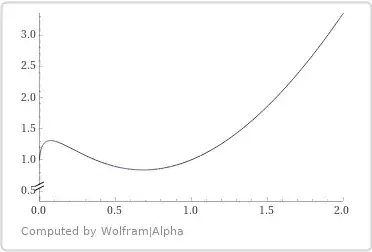
q3(x)

Denote \begin{cases} q_4(x)=1+q_3(x)\ln\tau_3(x),\\ q_5(x)=1+q_4(x)\ln\tau_4(x),\\ q_6(x)=1+q_5(x)\ln\tau_5(x).\tag7 \end{cases}

If $\;\underline{x\in(0,x_{31}]},\;$ then $\;q_4(x)\le 1+\ln \tau_3(x)\le\ln(ex_{31})<0,\;$
i.e. $\;\varphi(x)\;$ decreases, wherein from $(4)$ should $$g(x)=f(x,\varphi(x))\ge f(x,\varphi(x_{31})) \ge g(x_{31}) > 0.685790 > \dfrac{1+x^2}2,$$ and inequality $(2)$ holds.

If $\;x\in(x_{31},x_{2}),\;$ then both $\;q_3(x)\;$ and $\;|\ln\tau_3(x)|\;$ decrease, and $\;q_4(x)\;$ increases.

Taking in account the numerical root $\;x_4\approx 0.274689\!\dots\;$ of $\;q_4(x),\;$ easily to get $$\varphi(0.274)>0.593237,\quad \varphi'(0.274)>-0.003,$$ $$\varphi(0.275)>0.593236,\quad \varphi'(0.275)<0.0014,$$ $$x_4=\operatorname{argmin} \varphi(x) \in(0.274, 0.275),\tag8$$ $$\beta = \min \varphi(x) > \min(0.5930237-0.001\cdot 0.003, 0.593236-0.001\cdot 0.0014),$$ $$\beta = \min \varphi(x) > 0.593234.\tag9$$
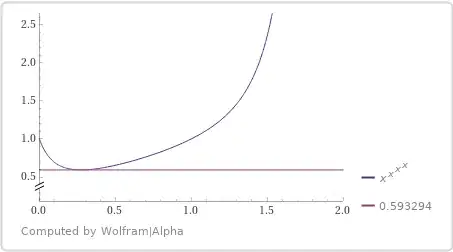
beta>0.593234

If $\;\underline{x\in(x_{31},x_4)},\;$ then

  • $\;q_4(x)\in(-1.83125,0)\;$ increases,
  • $\;\varphi(x)\in(0.593234,0.740040)\;$ decreases,
  • $\;q_5(x)\in(1,1.551300)\;$ decreases,
  • $\;|\ln\tau_5|\in(0.7658,1.9375)\;$ decreases.

Therefore, $\;q_6(x)\in(-2.006,0.235)\;$ increases.

Taking in account the numerical root $\;x_6\approx 0.225627\;$ of $\;q_6(x),\;$ easily to get

$$g(0.225)>0.5428243,\quad g'(0.225)>-0.0037,$$ $$g(0.226)>0.5428235,\quad g'(0.226)<0.0022,$$ $$x_6=\operatorname{argmin} g(x) \in(0.225, 0.226),\tag{10}$$ $$g(x) > \min(0.5428243-0.001\cdot 0.0037, 0.5428235-0.001\cdot 0.0022)>0.542820,$$ $$g(x) > \dfrac{1+0.275^2}2>\dfrac{1+x_4^2}2,$$ i.e. the inequality $(2)$ holds.
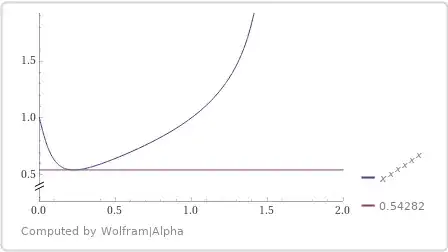
g(x)>0.54282

Note that $\;ex_6^\beta >1,\;$ then from $(4)$ follows increasing of $\;f(x,y)\;$ by $x$ and by $y\;$ in $\;(x_6,\infty).\;$ Since $\;\varphi(x)\;$ increases in $(x_4,x_2)$, then $\;g(x)\;$ also increases in $\;(x_4,x_2).\;$

In this way, $$g(x_4)> g(0.226) > \dfrac{1+0.291^2}2,$$ $$g(0.291) > 0.5525 > \dfrac{1+0.324^2}2,$$ $$g(0.324) > 0.5625 > \dfrac{1+0.35^2}2.$$ Therefore, inequality $(2)$ holds when $\;\underline{x\in(x_4,0.35)}.\;$

Since $\;\varphi(0.35)>0.6,\;$ then it suffices to prove the inequality $$h(x)=x^{0.6}\ln x - \ln\dfrac{1+x^2}2 \ge 0.\qquad (\underline{x\in(0.35,\infty)}).\tag{11}$$

Taking in account that $\;h(1)=0\;$ and $$h'(x)=x^{-0.4}(1+0.6 \ln x)-\dfrac{2x}{x^2+1},$$ it suffices to prove that the function $$\psi(y) = (y^5+y^{-5})(1+3\ln y)-2y^2$$ is negative when $\;y\in(0.81,1)\;$ and positive when $y>1.$

$$\textbf{Case}\;y\in(0.81,1).$$
$\;\ln y= \ln(1+y-1)=y-1-\frac12(y-1)^2+\frac13(y-1)^3-\dots\le \frac12(y-1)(3-y),\;$ $$\psi(y) \le 2+3(y-1)(3-y)-2y^2=(y-1)(7-5y) < 0.$$ Proved.

$$\textbf{Case}\;y\in(1,\infty).$$ Let $\;z=\ln y > 0,\;$ then $$\dfrac12\psi\left(e^z\right) = (3z+1)\cosh 5z - e^{2z} = \cosh 5z - \cosh 2z +3z\cosh 5z - \sinh 2z,$$ $$\dfrac12\psi\left(e^z\right) > z\sum\limits_{n=0}^\infty \left(\dfrac{3\cdot25^n}{(2n)!}-\dfrac{2\cdot 4^n}{(2n+1)!}\right)z^{2n} > 0.$$ Proved.

Therefore, inequality $(11)$ holds, and $(2)$ holds too.

  • Thanks for the answer. Do you mean: If $x\in (0, \mathrm{e}^{-1})$, then $f(x, f(x, 1))$ and $g(x)$ both decrease? Please check it. – River Li Jul 15 '21 at 05:53
  • By the way, I think it is not good to make $;\mathbf{x\in\left(0,e^{-1}\right)}$ bold, since $\mathbf{x}$ and $x$ are different. $x\in\left(0,e^{-1}\right)$ is fine. Or, you may use color. – River Li Jul 15 '21 at 05:57
  • @RiverLi Thanks for the comments. 1) let $x=0.2$ and $;y;$ decreases, then $;x^y;$ increases and $;f(x,y);$ decreases – Yuri Negometyanov Jul 15 '21 at 06:12
  • For example, $f(x,f(x,1)) = x^{x^{x^x}}$ does not decrease on $(0, \mathrm{e}^{-1})$. I think it is not clear in the sentence: If $;\underline{x\in\left(0,e^{-1}\right)},;$ then $;f(x,1),f(x,f(x,1)),g(x);$ decrease. – River Li Jul 15 '21 at 07:56
  • You can plot $f(x, f(x, 1)) = x^{x^{x^x}}$ in https://www.wolframalpha.com/: plot x^{x^{x^x}} x= 0.2..exp(-1). https://www.wolframalpha.com/input/?i=plot+x%5E%7Bx%5E%7Bx%5Ex%7D%7D+x%3D+0.2..exp%28-1%29 – River Li Jul 15 '21 at 08:20
  • @RiverLi Agree, done. – Yuri Negometyanov Jul 15 '21 at 12:08
  • You need to prove analytically that $f(x, f(x, 1)) = x^{x^{x^x}}$ decreases on $;x\in(0, 0.274689)$. Also, you need to prove analytically that $g(x) = ~ ^{6} x$ decreases on $;\underline{x\in(0,0.225627)}$. Not just give the results. – River Li Jul 15 '21 at 13:14
  • @RiverLi OK, done. – Yuri Negometyanov Jul 16 '21 at 23:18
  • Sorry, for (7), you only provide some plotting for $x^{x^{x^x}}$. It is not a proof. You do not provide a proof for $;\beta = \min \varphi(x,1) = \varphi(0.274689385297!\dots,1)\ge 0.593237$. Also, you do not provide a proof for $\min g(x) = g(0.2256270602226621!\dots)>0.542823$ since you just plot it. You need to prove them analytically. – River Li Jul 17 '21 at 00:07
  • @RiverLi OK, ready – Yuri Negometyanov Jul 19 '21 at 02:29
  • Sorry, in (4), $f'_x(x,y) = f(x,y)(x^{y-1}\ln x+x^{y-1})=f(x,y)x^{y-1}\ln(ex)$ is incorrect. It should be $f'_x(x,y) = f(x,y)(x^{y-1}y\ln x+x^{y-1})=f(x,y)x^{y-1} (y\ln x + 1)$. – River Li Jul 19 '21 at 02:54
  • @RiverLi Thanks, fixed. – Yuri Negometyanov Jul 19 '21 at 03:13
  • OK. Now, you need to prove analytically that $h'(x)=x^{\beta-1}(\beta \ln x+1)-\dfrac{2x}{x^2+1}$ is negative when $x < 1$. Actually, this is the main part of a proof. – River Li Jul 19 '21 at 04:38
  • @RiverLi Ready. – Yuri Negometyanov Jul 20 '21 at 15:07
  • 【Note that $;ex_6^\beta >1,;$ then from $(4)$ follows increasing of $;f(x,y);$ by $x$ and by $y.$ 】It it not clear. Please give more details. Also, $f(x, y)$ increases by $y$ on which interval? Increases by $x$ on which interval ($(x_4, \infty)$ or $(x_4, 0.35)$)? – River Li Jul 20 '21 at 15:24
  • Also, after (11), you split into two cases $(x_4, 0.35)$ and $(0.35, \infty)$. You may separate them obviously, by using
    or Case 1, Case 2 for example.
    – River Li Jul 20 '21 at 15:28
  • @RiverLi Thank you for the work. Looks completed. – Yuri Negometyanov Jul 20 '21 at 16:48
1

First fact

$$ f(x)=\frac{-(W(-\ln(x)))}{(\ln(x))}= x^{x^{·^{·^·}}}$$ for $0.38<x<1$

Second fact

It seems that we have on $x\in(0.38,1)$ :

$$0.5x^{2}+0.5< f(x)< x^{x^{x^{x^{x^x}}}}\quad (I)$$

Proof for the RHS

$$x^{x^{x^{x^{x^x}}}}> ^{8}x >\cdots>f(x)$$

See https://www.maa.org/programs/maa-awards/writing-awards/exponentials-reiterated-0 .theorem p240-241.The solution is convergent for $e^{-e}<x\leq 1$ and since $e^{-e}<0.38$ wich is coherent .

Proof of the LHS

First Case

For the LHS we can substitute $x=e^y$ and multiplying by $y$.

We get:

$$0.5y(e^{2y}+1)\geq -W(-y)$$

Or :

$$-0.5y(e^{2y}+1)\leq W(-y)$$

Or :

$$0.5y(e^{2y}+1)\exp(-0.5y(e^{2y}+1))\geq y$$

Or :

$$u(y)=(\ln(0.5(e^{2y}+1))+(-0.5y(e^{2y}+1)))\leq 0$$

The derivative is :

$$u'(y)= -0.5 (e^{2 y} + 1) - e^{2 y} y + \frac{2 e^{2 y}}{e^{2 y)} + 1}$$

Lemma $x\in(0,1)$:

$$0.5\left(x-\frac{1}{\left(x\right)}\right)\leq\ln(x)$$

the proof is not hard .

Now starting with the substitution $x=e^y$ and by the lemma we have :

$$-0.5 (x^2 + 1) - x^2 \ln(x) + \frac{2 x^2}{x^2+ 1}\leq -0.5(x^{2}+1)-x^{2}\left(\left(x-\frac{1}{x}\right)0.5\right)+\frac{2x^{2}}{x^{2}+1}$$

We get a polynomial with a root in $x=1$ .Remains to evaluate a cubic polynomial wich is not hard .It show the inequality for $0<x<0.54$ or $\ln(0.38)<y<\ln(0.54)$

Second case

We need to show :

$$\ln(0.5(e^{2y}+1))+(-0.5x(e^{2y}+1))\leq0$$

For that we need a lemma :

Let $-1<y<0$ then we have with $\alpha=\frac{1}{\ln(4)}$:

$$k(x)=\ln((e^{2y}+1))-e^{\left(\alpha\right)2y}\cdot\ln\left(2\right)<0$$

The proof is not hard .

Using this lemma we need to show for $y\in(-0.74,0)$:

$$m(y)=\left(e^{\left(\alpha\right)2y}\cdot\ln\left(2\right)+\ln\left(0.5\right)+(-0.5y(e^{2y}+1))\right)\leq 0$$

$m''(y)$ have only one root expressible in terms of the Lambert's function .We deduce that $m'(y)$ have two roots on $(-0.73,0]$ .Remains to evaluate the function $m(y)$ at $y=-0.73$.

All of this show the first inequality on $(0.38,1)$ wich is a hard part .

Third Case

For the other part and in the spirit of Riverli'proof we have $x\in(0,0.38]$ :

$$x^{x^{x^{x^{x^{x}}}}}> x^{x^{x^{x^{0.69}}}}> x^{x^{\frac{1}{\sqrt{\left(3\right)}}}}> \left(x^{2}+1\right)0.5$$

The LHS is equivalent to $x^x\geq e^{-e^{-1}}>0.69$ The middle inequality is equivalent to :

$$x^{x^{0.69}}\geq \frac{1}{\sqrt{3}}$$

Or :

$$\ln(y)y\geq \frac{0.69}{\sqrt{3}}$$ Where $x^{0.69}=y$

Wich is easy using the Lambert's function .

The Rhs is :

$$x^{x^{\frac{1}{\sqrt{\left(3\right)}}}}> \left(x^{2}+1\right)0.5$$

We have for $x\in(0,0.31)$:

$$x^{x^{\frac{1}{\sqrt{\left(3\right)}}}}>e^{x^2-\ln(2)}> \left(x^{2}+1\right)0.5$$

And for $x\in[0.31,0.38]$:

$$x^{x^{\frac{1}{\sqrt{\left(3\right)}}}}> 2.6^{\left(x^{2}-\frac{\ln\left(2\right)}{\ln\left(2.6\right)}\right)}> \left(x^{2}+1\right)0.5$$

Thes two last inequality are not hard using derivatives .

Bonus inequality :Let $x>0$ then we have :

$$x^{x^{x^{x^{x^{x}}}}}\geq e^{\left(\frac{\ln^{2}\left(x+1\right)}{\ln\left(2\right)}-\ln\left(2\right)\right)}\geq \left(x^{2}+1\right)0.5$$

Hope it helps !

Reference :

R. Arthur Knoebel, “Exponentials Reiterated,” The American Mathematical Monthly, No. 4, Vol. 88 (1981), pp. 235-252, Apr. 1981

  • 1
    But the difference $f(x) - (x^2+1)/2$ (which we want to show to be non-negative) is not convex, therefore I wonder how this helps. – Martin R Jun 07 '21 at 08:43
  • 1
    What I am asking is how this helps to show that $f(x) - (x^2+1)/2 \ge 0$. – Martin R Jun 07 '21 at 09:00
  • 2
    Can you prove those refinements, or are that conjectures? – Martin R Jun 07 '21 at 09:55
  • @ErikSatie First of all, is it easy to prove that $f(x)$ is convex? – River Li Jun 07 '21 at 10:08
  • @RiverLi Firstly yes and now really not .Anyway the last refinement seems to be easy no ? – Miss and Mister cassoulet char Jun 07 '21 at 12:07
  • @ErikSatie Not me who downvoted you. Can you show how to prove that $f(x)=, ^{6} x$ is convex? – River Li Jun 07 '21 at 12:20
  • No sorry I cannot dear River . – Miss and Mister cassoulet char Jun 07 '21 at 12:32
  • 5
    I downvoted the answer because it is a collection of claims, without any proof. – Martin R Jun 07 '21 at 12:41
  • @MartinR I'm not free to propose my ideas ? – Miss and Mister cassoulet char Jun 07 '21 at 12:43
  • 9
    This is a Q&A site. Answers should answer the question. And if you say “$f$ is convex”, “We have the refinement ...”, “We can also use ...”, “And we have ...” then I would expect that you can prove those claims. Otherwise say “$f$ seems to be convex”, “I assume that ...”, etc. – Martin R Jun 07 '21 at 12:47
  • @MartinR Agree, and it is nice to say something like "it seems", "conjecture", "guess", if no rigorous proof is currently available. – River Li Jun 07 '21 at 13:53
  • @ErikSatie I agree with your saying "It seems to be harder than the OP's problem". – River Li Jun 07 '21 at 14:01
  • “... we can substitute $x=e^y$ the rest is smooth“ – is that also a conjecture, or something that you actually proved? – Martin R Jun 07 '21 at 14:08
  • @MartinR Can you pursue it ? – Miss and Mister cassoulet char Jun 07 '21 at 14:47
  • Hello @ErikSatie I just want to make sure whether your claim that Empress Elisabeth being a mathematician was a good "mathematical" joke or is it a fact. – SPARSE Jun 09 '21 at 10:33
  • 1
    @Readmybiopls It's a joke :-). – Miss and Mister cassoulet char Jun 09 '21 at 11:23
  • @ErikSatie Thanks for your effort. For a rigorous and complete proof, you may add explanation or references for $^{6} x \ge \lim_{n\to \infty} ^n x = \frac{-(W(-\ln(x)))}{(\ln(x))}$ for $0 < x < 1$. – River Li Jun 11 '21 at 10:16
  • @RiverLi So let my the time to find it .Thanks :-) – Miss and Mister cassoulet char Jun 11 '21 at 11:57
  • @RiverLi Is https://math.stackexchange.com/questions/800862/convergence-of-power-towers sufficient ? The main argument is https://en.wikipedia.org/wiki/Fixed-point_iteration . – Miss and Mister cassoulet char Jun 11 '21 at 12:03
  • @ErikSatie You should put something on your proof. – River Li Jun 11 '21 at 12:11
  • @ErikSatie Wiki does not give the result, right? In the main text of the question https://math.stackexchange.com/questions/800862/convergence-of-power-towers the result is given but is lack of proof. You need to give a detailed proof for $ \lim_{n\to \infty} {^n} x = \frac{-(W(-\ln(x)))}{(\ln(x))} $ and $^{6} x \ge \lim_{n\to \infty} {^n} x $. – River Li Jun 11 '21 at 14:44
  • @RiverLi If I omit this link https://math.stackexchange.com/questions/108288/infinite-tetration-convergence-radius i found nothing else on the web . So can I post a question ? – Miss and Mister cassoulet char Jun 11 '21 at 15:49
  • @ErikSatie It is a known result. I think you can find something. That link is helpful. – River Li Jun 11 '21 at 16:43
  • @RiverLi now it's OK ! What do you think about my bonus inequality?( a gift for you) .Good night in Europe. – Miss and Mister cassoulet char Jun 11 '21 at 19:05
  • @ErikSatie You may rewrite your proof compactly. For example, in the beginning, you may write something like: For $x \in (38/100, 1)$, according to Theorem in [1] (Page 240), we have $\lim_{n\to \infty} {^n}x = -\frac{W(-\ln x)}{\ln x}$ where $W(\cdot)$ is the principal branch of the Lambert W function. Also, for $x \in (38/100, 1)$, we have $^6 x \ge {^8}x \ge {^{10}}x \ge \cdots$ which results in $^6 x \ge \lim_{n\to \infty} {^n}x = -\frac{W(-\ln x)}{\ln x}$. Let us prove that $-\frac{W(-\ln x)}{\ln x} \ge \frac12 x^2 + \frac12$ for all $x$ in $(38/100, 1)$. – River Li Jun 12 '21 at 04:15
  • @ErikSatie (Cont'd) Reference

    [1] R. Arthur Knoebel, “Exponentials Reiterated,” The American Mathematical Monthly, No. 4, Vol. 88 (1981), pp. 235-252, Apr. 1981. https://www.maa.org/programs/maa-awards/writing-awards/exponentials-reiterated-0

    – River Li Jun 12 '21 at 04:16
  • @RiverLi it's already proved . – Miss and Mister cassoulet char Jun 12 '21 at 08:44
  • @ErikSatie I think you need to improve your text. For example, you said "It's true because it equivalent to $x \le 1$", actually, $x^{x^{·^{·^·}}}$ is not convergent if $0 < x < \mathrm{e}^{-\mathrm{e}}$. You need to clearly address something like $38/100 < x < 1$. – River Li Jun 12 '21 at 09:16
  • @ErikSatie You may say in the beginning "We split into three cases. $38/100 < x < 1$ etc." – River Li Jun 12 '21 at 09:17
  • @ErikSatie $x^{x^{x^{x^{x^x}}}}> ^{2k}x >\cdots>f(x)$ is not clear (Here if you mean $f(x) = x^{x^{·^{·^·}}}$, it requires $\mathrm{e}^{-\mathrm{e}} < x$. But you only say "It's true because it equivalent to x≤1"). You may write something like: For $38/100 < x < 1$, $^6 x \ge {^8}x \ge {^{10}}x \ge \cdots$ and $x^{x^{·^{·^·}}}$ has a limit, thus, $^6 x \ge x^{x^{·^{·^·}}}$. Also, $x^{x^{·^{·^·}}} = -\frac{W(-\ln x)}{\ln x}$. So, $^6 x \ge -\frac{W(-\ln x)}{\ln x}$. – River Li Jun 12 '21 at 09:39
  • @ErikSatie You said "for $k\ge 3$, $x^{x^{x^{x^{x^x}}}}> ^{2k}x$, do you mean $x^{x^{x^{x^{x^x}}}}> {^{6}}x$ and $x^{x^{x^{x^{x^x}}}}> {^8} x$ and $x^{x^{x^{x^{x^x}}}}> {^{10}} x$ etc. rather than $^6 x \ge {^8}x \ge {^{10}}x \ge \cdots$? – River Li Jun 12 '21 at 09:45
  • @ErikSatie By the way, although I criticized your proof, I did not downvoted you. – River Li Jun 12 '21 at 09:57
  • @RiverLi Is it clearer now ? – Miss and Mister cassoulet char Jun 16 '21 at 08:45
  • @ErikSatie Yes, it is easier to read. However, the structure seems not clear. For example, First Fact and Second Fact are for $0.38 < x < 1$. Then "Proof of the LHS" are divided into first case, second case and third case, right? But in third case, you prove $0 < x \le 0.38$. I think you should split into two cases in the beginning. Case 1, $0.38 < x < 1$; Case 2, $0 < x \le 0.38$. In Case 1, you put First Fact and Second Fact. – River Li Jun 16 '21 at 09:09