1

I'm learning to calculate limits in high school and at some point in the class we stumbled upon this exercise:

$$\lim\limits_{x\to 0} \frac{e^{2x}-1}{3x}$$

I know that I could use L'Hôpital's rule to solve it, but I'm curious if there's any other way to solve this limit, since not even my professor could think of a way.

Later
  • 722
  • 2
  • 8
  • 24
  • 1
    Looks like $2/3$ of the derivative of $e^{2x}$ evaluated at $x=0$. – David Mitra Jan 16 '22 at 19:36
  • See https://math.stackexchange.com/q/3848957/42969 for a very similar question. – Martin R Jan 16 '22 at 19:36
  • One may argue my method (and LH) is circular reasoning, depending on how the exponential function was introduced. – David Mitra Jan 16 '22 at 19:38
  • Sorry, just 1/3 above... – David Mitra Jan 16 '22 at 19:43
  • You can use the taylor approximation of $e^x$ at the first order, but it is in someway the same thing as using Hopital's rule. – Lelouch Jan 16 '22 at 19:44
  • Since the numerator equals $(e^x+1)(e^x-1)$, whose first factor isn't a problem, and since the $3$ in the denominator can be applied later, you can focus on evaluating $$\lim_{x\to0}\frac{e^x-1}{x}$$ How you deal with that may depend upon how you have defined the exponential function. – Blue Jan 16 '22 at 19:54
  • 2
    In high school, how do you define the exponential function $e^x$? –  Jan 16 '22 at 19:56

5 Answers5

2

To prove it, I use a Sandwich-type argument by usually first proving (in class) that $$\lim_{x\to 0}\frac{e^x-1}{x}=1.$$ Indeed by Bernoulli's inequality I $$e^x-1\geq (1+x)-1=x.$$ Now since $x^n\leq x^2$ for $-1\leq x\leq 1$ and $n\geq 2$ we have that \begin{align*}e^x=\lim_{n\to\infty}\left(1+\frac{x}{n}\right)^n&=\lim_{n\to\infty}\sum_{k=0}^n{n\choose k}\frac{x^k}{n^k}\\ &=\lim_{n\to\infty}1+x+\sum_{k=2}^n{n\choose k}\frac{x^k}{n^k}\\ &\leq \lim_{n\to\infty}1+x+\sum_{k=2}^n{n\choose k}\frac{x^{\color{red}2}}{n^k}\\ &= \lim_{n\to\infty}1+x+\left(\sum_{k=2}^n{n\choose k}\frac{1}{n^k}\right)\cdot x^2\\ &= \lim_{n\to\infty}1+x+\left(\left(1+\frac{1}{n}\right)^n-2\right)\cdot x^2\\ &= 1+x+\left(e-2\right)\cdot x^2 \end{align*} and by plugging these I get the limit.

Once this is taken care of your result is a simple variable change.

b00n heT
  • 16,360
  • 1
  • 36
  • 46
1

$$\lim_{x\rightarrow 0} \frac{e^{2x} - 1}{3x}=\lim_{x\rightarrow 0} \frac{e^{2x} - 1}{2x}\cdot\frac 2 3=\frac 2 3 \cdot \underbrace{\lim_{u\rightarrow 0}\frac{e^u-1}{u}}_{\text{derivative of exp}}=\frac 2 3$$

Stefan Lafon
  • 12,256
  • 11
  • 29
0

You can make use of the series representation of $e^x$ $$ e^x = 1 + x + \frac{x^2}{2!}+ \cdots $$ So $$ \begin{aligned} \lim\limits_{x\to 0} \frac{e^{2x}-1}{3x} &= \lim\limits_{x\to 0} \frac{1+(2x) + \frac{(2x)^2}{2!}+\cdots-1}{3x}\\ &= \lim\limits_{x\to 0} \left( \frac{2}{3}+\frac{4x}{6}+\text{terms in higher powers of x} \right) \\ &= \frac{2}{3} \end{aligned} $$

PM.
  • 5,249
0

I think if you've seen the definition of the derivative, this question usually wants you to recognize the connection between the derivative of $e^x$ at $0$ and the $\lim\limits_{x\to 0} \frac{e^x-1}{x}$, but I believe if you know the definition of the natural logarithm and that the exponential function is it's inverse, there is a geometric argument based simply on the graph of $y=1/x$ below which doesn't actually use calculus. Note that the area of the shaded region is $h$, so

$$ (e^h-1)\cdot 1\ge h\ge (e^h-1)\cdot e^{-h}$$ $$ 1\ge \frac{h}{e^h-1}\ge e^{-h}$$ $$ 1\le \frac{e^h-1}{h}\le e^{h}$$

Now let $h\to 0$. Of course you have to have factored the numerator and taken out the constant factor from your original expression as discussed in the comments.

I guess that really only gets you ${h\to 0^+}$, but it shouldn't be too hard to fix.
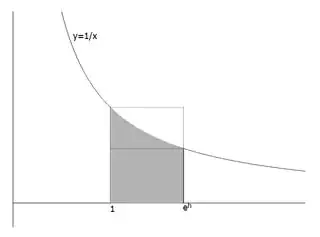
enter image description here

sharding4
  • 4,917
0

Let me add one more answer. $$\lim_{x\to0}(1+x)^{1/x}=e$$ Taking $\log$ on both sides: $$\lim_{x\to0}\frac{\ln(1+x)}x=1$$ Substituting $x$ with $e^t-1$: $$\lim_{t\to0}\frac{t}{e^t-1}=1$$ Finally: $$\lim_{x\to0}\frac{e^{2x}-1}{3x}=\frac23\lim_{x\to0}\frac{e^{2x}-1}{2x}=\frac23\lim_{x\to0}\frac{e^{t}-1}{t}=\frac23$$

Kay K.
  • 9,931