0

I am trying to understand the follwing equation in the proof below:

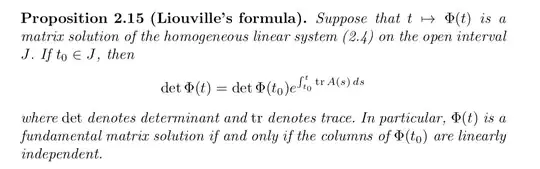
I tried to look at the case $n=2$.

What I get is $$\det(\Phi(I+tA))=\det( (I+tA)\Phi)+\text{very messy terms involving } o(t).$$

My guess/hope is that there are some arithmetic rules for "little-oh" I am not aware of that show that the last part is also $o(t)$.

Is there a book where this formula is shown. I couldn't find anything.

Many thanks in advance!

Hans
  • 902

1 Answers1

1

What exactly is the question? You start from $\dot\Phi(t)=A(t)\Phi(t)$. Then the solution is one order smoother than the function $A$, so at least continuously differentiable. Thus you can use Weierstraß decomposition or the linear Taylor formula $$ \Phi(t+h)=\Phi(t)+\dot\Phi(t)h+o(h)=(I+hA(t))\,\Phi(t)+o(h) $$ The determinant is polynomial in the matrix entries, thus also smooth, so for $w(t)=\det\Phi(t)$ you get $$ w(t+h)=\det\Bigl((I+hA(t))\,\Phi(t)\Bigr)+o(h) =\det\Bigl(I+hA(t)\Bigr)w(t)+o(h) $$ Then use $\det(I+hA)=1+h{\rm Tr}(A)+O(h^2)$, so that $$ \frac{w(t+h)-w(t)}{h}-{\rm Tr}(A(t))\,w(t)=o(h^0) $$ in the limit $h\to 0$ thus $$ \dot w(t)={\rm Tr}(A(t))\,w(t) $$ giving the claimed solution formula, named after Abel.

Lutz Lehmann
  • 126,666
  • My question is why $\det(I+hA(t)),\Phi(t)+o(h))=\det\Bigl((I+hA(t)),\Phi(t)\Bigr)+o(h)$, i.e. why the $o(t^2)$ can be "taken out" of the determinant. – Hans Oct 28 '22 at 12:45
  • 1
    Because the determinant is a differentiable formula as a polynomial in the matrix components. Thus you get, like for every polynomial, $F(M+o(h))=F(M)+F'(M)o(h)+o(h^2)=F(M)+o(h)$. – Lutz Lehmann Oct 28 '22 at 12:58
  • Okay, so $F'(M)o(h)+o(h^2)=o(h)$? But why does the proof in the book use/mentions the definition of the determinant? My guess was that I have to calculate the determinant and then collect terms, which "are" $\det((I+tA)\Phi(t))$ and some terms that are $o(h)$ – Hans Oct 28 '22 at 13:32
  • Yes, that is somehow unfortunate. You need the definition for the trace formula, to get in two steps $\det(I+hA)=\prod(1+ha_{ii})+O(h^2)=1+h\sum a_{ii}+O(h^2)$, as there are no products with only a single non-diagonal term, and the diagonal product obviously has these two leading terms. – Lutz Lehmann Oct 28 '22 at 13:45
  • Unfortunately I am afraid that it is still not clear to me how the proof works, but thank you anyway! Is there a book I could have a look at? – Hans Oct 28 '22 at 14:16