Martin Gardner, somewhere in the book Mathematical Carnival; talks about superellipses and their application in city designs and other areas. Superellipses(thanks for the link anorton) are defined by the points lying on the set of curves:
$$\left|\frac{x}{a} \right|^n + \left|\frac{y}{b} \right|^n = 1$$
After reading the chapter, I was wondering how to calculate the area of these shapes. So I started by the more simplistic version of supercircles' area:
$$\frac{A}{4}=\int_0^1 \sqrt[n]{1-x^n}dx$$
Although, it looks simple, but I wasn't able to evaluate the integral(except some simple cases, i.e. $n=1,2,\frac{1}{2},\frac{1}{3},\cdots$). So I asked Mathematica to see if its result can shed some light on the integration procedure, the result was:
$$\int_0^1\sqrt[n]{1-x^n}dx=\frac{\Gamma \left(1+\frac{1}{n}\right)^2}{\Gamma \left(\frac{n+2}{n}\right)}$$ where $\Re(n)>0$. But I still couldn't figure out the integration steps. So my question is: how should we do this integration?
SideNotes:
It's easy to evaluate the integral in the limit of $n \rightarrow \infty$! One way to do it is using Taylor series expansion, and keeping the relevant terms(only first term in this case).
Some beautiful supercircles are shown in the image bellow:
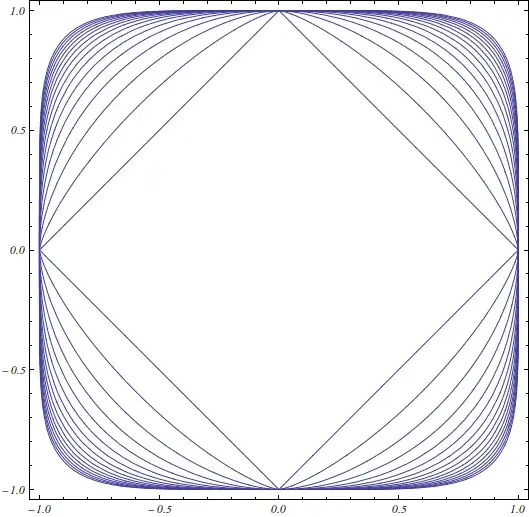
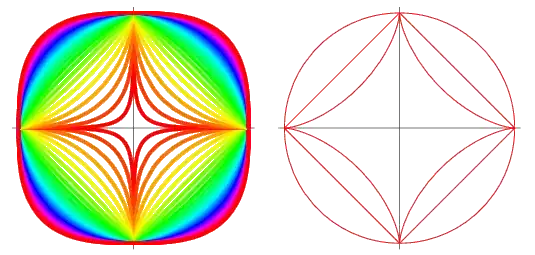
As one can see their limiting case is a square.
Also, it will be really nice, if one can calculate the volume of the natural generalization of the curve to 3(or $k$) dimensions:
$$\left|\frac{x}{a} \right|^n + \left|\frac{y}{b} \right|^n +\left|\frac{z}{c} \right|^n = 1$$


