10

How can I obtain good asymptotics for $$\gamma_n=\displaystyle\int_0^\infty\frac{t^n}{n!}e^{-e^t}dt\text{ ? }$$

[This has been already done] In particular, I would like to obtain asymptotics that show $$\sum_{n\geqslant 0}\gamma_nz^n$$

converges for every $z\in\Bbb C$.

N.B.: The above are the coefficients when expanding $$\Gamma \left( z \right) = \sum\limits_{n \geqslant 0} {\frac{{{{\left( { - 1} \right)}^n}}}{{n!}}\frac{1}{{n + z}}} + \sum\limits_{n \geqslant 0} {{\gamma _n}{z^n}} $$

ADD Write $${c_n} = \int\limits_0^\infty {{t^n}{e^{ - {e^t}}}dt} = \int\limits_0^\infty {{e^{n\log t - {e^t}}}dt} $$

We can use something similar to Laplace's method with the expansion $${p_n}\left( x \right) = g\left( {{\rm W}\left( n \right)} \right) + g''\left( {{\rm W}\left( n \right)} \right)\frac{{{{\left( {x - {\rm W}\left( n \right)} \right)}^2}}}{2}$$

where $g(t)=n\log t-e^t$. That is, let $$\begin{cases} w_n={\rm W}(n)\\ {\alpha _n} = n\log {w_n} - {e^{{w_n}}} \\ {\beta _n} = \frac{n}{{w_n^2}} + {e^{{w_n}}} \end{cases} $$

Then we're looking at something asymptotically equal to $${C_n} = \exp {\alpha _n}\int\limits_0^\infty {\exp \left( { - {\beta _n}\frac{{{{\left( {t - {w_n}} \right)}^2}}}{2}} \right)dt} $$

Pedro
  • 122,002
  • if you write $g(n,t):=t^ne^{-e^{t}}/n!$, then you can swap sum and integral by Fubini-Tonelli. And you know that $\sum g(n,t)z^n$=e^{tz}$. – Alex R. Aug 09 '13 at 01:51
  • If your only goal is to show that the series converges, I think you can circumvent the estimation issue by just noting that an entire function has a power series that converges everywhere. And certainly the Gamma function with its poles removed is entire. – Potato Aug 09 '13 at 02:27
  • @Potato You're assuming what I want to get to! =) – Pedro Aug 09 '13 at 02:30
  • @PeterTamaroff You say you want to show that series converges in the question! – Potato Aug 09 '13 at 02:37
  • @Potato The point is the following. Put $$\Gamma(x)=\int_0^\infty t^{x-1}e^{-t}dt$$ Splitting at $1$, we expand $e^{-t}$ around zero in the first integral to obtain the poles, and use $t^x=e^{x\log t}$ and expand in power series to obtain a series expansion with the coefficients I get. With this, one aims to show that we may extend this to $\Bbb C$. – Pedro Aug 09 '13 at 02:41
  • Right. And the power series you get is precise the Gamma function minus its singular part. And this is an entire function, so the power series converges everywhere. – Potato Aug 09 '13 at 02:44
  • @Potato I give up. – Pedro Aug 09 '13 at 02:44
  • @PeterTamaroff What? Do you know that it is a theorem from complex analysis that an entire function (such as the Gamma function minus its principal part) has a power series that is everywhere convergent? – Potato Aug 09 '13 at 02:45
  • @Potato Sure... but I am not aiming to use complex analysis. – Pedro Aug 09 '13 at 02:46
  • I don't think you need to be that clever when estimating the integral. Even using the bound $e^{-e^t}\le e^{-t}$ on the gives you that the coefficients are bounded above by $1$. – Potato Aug 09 '13 at 02:51
  • @Potato That merely gives convergence for $|z|<1$. – Pedro Aug 09 '13 at 02:52
  • Right. My point is even the crudest of estimates gives you almost what you want. I think $e^{-e^t}\le e^{-t^2}$ should do the trick. – Potato Aug 09 '13 at 02:53

3 Answers3

9

To get an asymptotic estimate we can use a trick similar to one used to find the asymptotics of $n!$.

You wrote

$$ c_n = \int_0^\infty t^n e^{-e^t}\,dt = \int_0^\infty \exp\left(n\log t - e^t\right)\,dt = \int_0^\infty \exp f_n(t)\,dt $$

and saw that $f_n(t)$ has a maximum at $t = W(n)$. We thus scale the integration variable by

$$ t = W(n)(1+s), $$

which yields

$$ \begin{align} c_n &= W(n)^{n+1} \int_{-1}^\infty \exp\left\{n\left[\log(1+s) - W(n)^{-1} e^{W(n)s}\right]\right\}\,ds \\ &= W(n)^{n+1} \int_{-1}^\infty \exp\left\{n g_n(s)\right\}\,ds \end{align} $$

The largest contribution to the integral now comes from a neighborhood of $s=0$, and there we have

$$ g_n(s) = -\frac{1}{W(n)} - \frac{1+W(n)}{2}\,s^2 + \cdots. $$

The details of the Laplace method can be worked out as usual to arrive at the conclusion that

$$ \begin{align} c_n &\sim W(n)^{n+1} \int_{-\infty}^{\infty} \exp\left\{n\left[-\frac{1}{W(n)} - \frac{1+W(n)}{2}\,s^2\right]\right\}\,ds \\ &= W(n)^{n+1} e^{-n/W(n)} \sqrt{\frac{2\pi}{n(1+W(n))}}. \end{align} $$

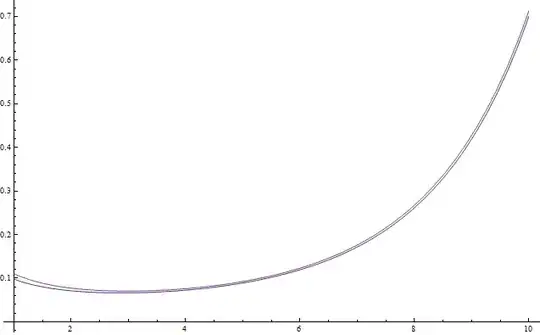
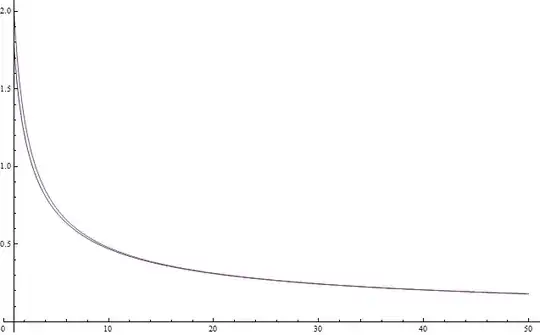
Below is a plot of $c_n$ in blue and this asymptotic in purple for $1 < n < 10$. Below that is a plot of $W(n)^{-n-1} e^{n/W(n)} c_n$ in blue and $\sqrt{\frac{2\pi}{n(1+W(n))}}$ in purple for $1 < n < 50$.

enter image description here

enter image description here

We can then use the estimate

$$ \log n - \log\log n < W(n) < \log n $$

from this answer, true for $n > e$, to find that

$$ c_n < (\log n)^{n+1} e^{-n/\log n} \sqrt{\frac{2\pi}{n(1+\log n - \log\log n)}} $$

for $n$ large enough. Since $n! \geq (n/e)^n \sqrt{2\pi n}$ we obtain the asymptotic bound

$$ \begin{align} \gamma_n &= \frac{c_n}{n!} \\ &< \left(\frac{e \log n}{n}\right)^{n+1} e^{-1-n/\log n} (1+\log n-\log\log n)^{-1/2} \end{align} $$

which clearly decreases faster than exponentially. From this it follows that $\sum \gamma_n z^n$ converges for all $z$.

  • 1
    (+1) This is very similar to the method I showed in chat yesterday. I didn't feel like justifying all the steps of the Laplace method, so I came up with an alternate answer. – robjohn Aug 09 '13 at 04:30
  • (+1) Wasn't expecting any less ;) – Pedro Aug 09 '13 at 04:44
6

For $t>0$, it is true that $e^t>t^2$. Using this bound on the integral gives

$$\int_0^\infty\frac{t^n}{n!}e^{-e^t}dt < \int_0^\infty\frac{t^n}{n!}e^{-t^2}dt.$$

The last integral is just $\frac{1}{2}$ of

$$\frac{\Gamma\left( \frac{n+1}{2} \right)}{n!}.$$

This decays quickly enough to give convergence in the entire complex plane.

Potato
  • 40,171
  • The bounding integral is equal to $\frac1{2n!}\Gamma\left(\frac{n+1}{2}\right)$, but that is not $\frac1{(2n-1)!!}$. It is monotonic, and for odd $n$, it is $\lower{4pt}{\frac{\left(\frac{n-1}{2}\right)!}{n!}}\le\raise{4pt}{\frac1{\left(\frac{n+1}{2}\right)!}}$. This, also, is enough to get convergence for the whole complex plane. – robjohn Aug 09 '13 at 03:57
  • @robjohn I didn't add that part, but thanks for letting me know. – Potato Aug 09 '13 at 03:58
4

$$ \begin{align} \sum_{n=1}^\infty\gamma_nz^n &=\sum_{n=1}^\infty\int_0^\infty\frac{t^nz^n}{n!}e^{-e^t}\,\mathrm{d}t\\ &=\int_0^\infty e^{tz}e^{-e^t}\,\mathrm{d}t\\ &=\int_0^\infty e^{t(z-1)}e^{-e^t}\,\mathrm{d}e^t\\ &=\int_{1}^\infty u^{z-1}e^{-u}\,\mathrm{d}u\\ &=\Gamma(z,1) \end{align} $$ The Upper Incomplete Gamma Function is an entire function. According to this answer, the power series for an entire function has an infinite radius of convergence.


$\color{#C0C0C0}{\text{idea mentioned in chat}}$

$$ \begin{align} \int_0^\infty\frac{x^{n-1}}{(n-1)!}e^{-e^x}\,\mathrm{d}x &=\frac1{(n-1)!}\int_1^\infty\log(t)^{n-1}e^{-t}\frac{\mathrm{d}t}{t}\\ &=\frac1{n!}\int_1^\infty\log(t)^ne^{-t}\,\mathrm{d}t\\ &=\frac1{n!}\int_1^\infty e^{-t+n\log(\log(t))}\,\mathrm{d}t\\ \end{align} $$ Looking at the function $\phi(t)=-t+n\log(\log(t))$, we see that it reaches its maximum when $t\log(t)=n$; i.e. $t_0=e^{\mathrm{W}(n)}=\frac{n}{\mathrm{W}(n)}$.

Using the estimate $$ \mathrm{W}(n)\approx\log(n)-\frac{\log(n)\log(\log(n))}{\log(n)+1} $$ from this answer, at $t_0$, $$ \begin{align} \phi(t_0) &=-n\left(\mathrm{W}(n)+\frac1{\mathrm{W}(n)}-\log(n)\right)\\ &\approx n\log(\log(n)) \end{align} $$ and $$ \begin{align} \phi''(t_0) &=-\frac{\mathrm{W}(n)+1}{n}\\ &\approx-\frac{\log(n)}{n} \end{align} $$ According to the Laplace Method, the integral would be asymptotic to $$ \begin{align} \frac1{n!}\sqrt{\frac{-2\pi}{\phi''(t_0)}}e^{\phi(t_0)} &\approx\frac1{n!}\sqrt{\frac{2\pi n}{\log(n)}}\log(n)^n\\ &\approx\frac1{\sqrt{2\pi n}}\frac{e^n}{n^n}\sqrt{\frac{2\pi n}{\log(n)}}\log(n)^n\\ &=\frac1{\sqrt{\log(n)}}\left(\frac{e\log(n)}{n}\right)^n \end{align} $$ which dies away faster than $r^{-n}$ for any $r$.


Analysis of the Approximation to Lambert W

For $x\ge e$, the approximation $$ \mathrm{W}(x)\approx\log(x)\left(1-\frac{\log(\log(x))}{\log(x)+1}\right) $$ attains a maximum error of about $0.0353865$ at $x$ around $67.9411$.

At least that same precision is maintained for $x\ge\frac53$.

For all $x\gt1$, this approximation is an underestimate.

robjohn
  • 345,667
  • Rob, this is from a course on real analysis, so complex analysis is really out of the question as I told Potato. Also, notice I want to obtain accurate asymptotics. Could you continue with what I wrote using Lambert's $\rm W$? – Pedro Aug 09 '13 at 04:24
  • @PeterTamaroff: okay. I was fooled by all the mention of $\mathbb{C}$ in the question. I will append the stuff I mentioned yesterday in chat, some of which is similar to what Antonio Vargas has posted. – robjohn Aug 09 '13 at 04:34
  • No problem, Rob. If I recall correctly you got estimates in terms of the logarithn and the exponential which make things quite simpler! – Pedro Aug 09 '13 at 04:42