7

I got this question on my HW and am struggling with how to approach it:

Let $g:\mathbb{R}\rightarrow \mathbb{R}$ be a continuous function such that $\int^1_{-1}g(t)dt=3$. Let $f(x,y,z)=g(x+y+z)$, calculate $$\iiint_V f(x,y,z) \, dx \, dy \, dz$$ where $V=\{(x,y,z): |x|+|y|+|z| \leq 1\}$.

I know this domain is comprised of 8 symmetric pyramids, but I'm struggling with how to use this symmetry, and if I should use the Antiderivative $G$ of $g$.

Would appreciate help.

Prem
  • 9,669
lia
  • 141
  • 1
    the 3 should be used as measurement stick unit and then calculate how many such -1..1 ranges there exist in the 3d volume. Then simple multiplication gives you the answer. You need inverse image to solve this problem, need to go backwards the functions. – tp1 May 20 '23 at 11:20
  • Have you learned the Change of Variables Theorem in the lesson for this homework? – Ted Shifrin May 20 '23 at 19:17

2 Answers2

2

There are various ways to try this. My own "non-rigorous" way would be like this :

We have Constant Answer which is not Dependant on $g(x)$ , as long as that Integral is $3$.

(1) Let $g(x)=Constant=3/2$ , then $\int_{-1}^{+1}g(x)dx=3x/2|_{-1}^{+1}=3/2+3/2=3$.

Then we have $f(x,y,z)=g(x+y+z)=3/2$

Then we have $\int\int\int_{V}f(x,y,z)dxdydz=\int\int\int_{V}g(x+y+z)dxdydz=\int\int\int_{V}(3/2)dxdydz=(3/2)|_{V}=3V/2$

The Volume $V$ is a "Diamond" in 3D , where the Diagonals are the 3 Axis , between $-1$ & $+1$ , in other words , Diagonal length is $2$. Hence Cube Side "Diamond" Side is $\sqrt{2}$.

Image :
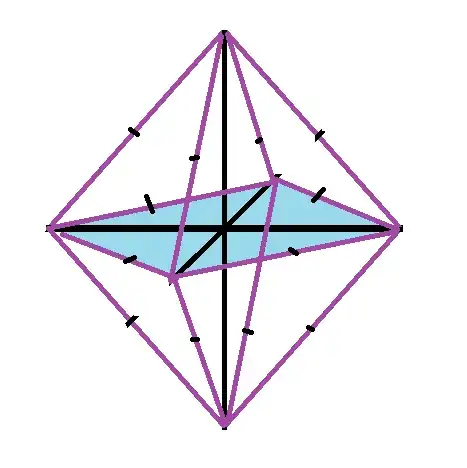
DIAMOND

Purple lines are Equal Sides of the "Diamond" , Black lines are Equal Diagonals.

The "Diamond" is made of 2 Pyramids , each with height $2$ & Square Base with Side $\sqrt{2}$.

Blue Area is the Square Base of the Pyramids.

https://www.varsitytutors.com/hotmath/hotmath_help/topics/volume-of-a-pyramid : "volume of a pyramid = one-third the area of the base times the height" : $\sqrt{2}\times\sqrt{2}\times{2}/3=4/3$

Volume Of Our "Diamond" made of 2 Pyramids is $V=2\times(4/3)=8/3$

Hence the Volume $V$ is $8/3$ which is the Integral Domain we want.

That then gives Integral Value $(3/2)V=(3/2)(8/3)=4$

(2) We can take $g(x)=9x^2/2$ , then $\int_{-1}^{+1}g(x)dx=9x^3/6|_{-1}^{+1}=3/2+3/2=3$.

Integrating $f(x,y,z)=9(x+y+z)^2/2$ thrice & using the limits will be a little Cumber-Some , yet , we know that we have to get the Same Answer $4$.

Prem
  • 9,669
  • 1
    this is very cool, didn't think about deciding what g is. Thanks! – lia May 20 '23 at 17:02
  • Hmm I tried to verify the triple integral and got 18/5 which is not $3sqrt(2)$. I may have done it wrong – dm63 May 20 '23 at 19:58
  • This question indicates that V = 4/3 not 2sqrt2. https://math.stackexchange.com/questions/4354272/solve-iiint-1-dxdydz-for-x-y-z-mid-xyz-leq-1?rq=1 – dm63 May 21 '23 at 02:25
  • Good Catch , @dm63 , while typing Initially , I did realise that it was not a Cube , which I Corrected to "Diamond" in 1 Place , but not in the other Place. Eventually , I calculated based on Cube , which was wrong. Image makes it easier now. – Prem May 21 '23 at 12:54
  • You might want to check whether this Answer "matches" your HW Answer , @lia , which will enable the verification ! – Prem May 23 '23 at 05:44
  • Again, $V=4/3,$ not $8/3.$ Anyway, your claim that the integral does not depend on $g$ is wrong hence so is this full answer. – Anne Bauval Jun 14 '23 at 10:08
  • (A) There are two Pieces , hence Double Volume , @AnneBauval , which will convert $4/3$ to $8/3$. (B) Whether it is correct or not , there were 3 disclaimers : (B1) In Answer , I stated [[ My own "non-rigorous" way would be like this ]] (B2) In Comment , I stated [[ check whether this Answer "matches" your HW Answer ]] though OP has not yet responded (B3) In Answer , I gave Example of Quadratic function [[ $g(x)=9x^2/2$ ]] where OP should have taken the Integral to verify the Answer. I am awaiting OP to respond ! When HW Answer is known , I will have clarity ! – Prem Jun 14 '23 at 10:49
  • A) Please look at the link included in my answer: the whole volume of your "two pieces" is $4/3$, not $8/3.$ Moreover, this is confirmed in the final particular case of my general computation. B1) I saw the disclaimer but that does not allow a wrong answer. B2), B3) are requests to the OP to check your answer, they cannot be considered as (part of) an answer. " OP should have taken the Integral to verify the Answer": so should you have before posting. Actually, the result for $g(x)=9x^2/2$ is not your expected $4$: see my answer. – Anne Bauval Jun 14 '23 at 11:29
  • Wrong answers are not allowed , I was only giving hints on what I would have done , when HW required ticking some Multiple Choice list containing Eg "0 , -10 , 8/3 , 80/3" , hence , I suggested something like "tick 8/3" , which is non-rigorous. That was why I asked OP to compare the HW answer & report back here to either confirm or reject that. I will analyse your Post , @AnneBauval , & maybe Delete my Answer in a Day or two. Ideally , I would expect OP to say "No , HW Answer is given in terms of Single Integral of $f(x)$ or $g(x)$" which will nudge me & others to look for better ways here ! – Prem Jun 14 '23 at 14:35
0

The answer cannot be a mere number. It will obviously depend on $g.$

Let $t=x+y+z.$ Replacing $z$ with $t-x-y$ and using many times the rule $|a|\le b\iff-b\le a\le b,$ we find that $$|x|+|y|+|z|\le1\iff\begin{cases}-1\le t\le 1\\\frac{-1+t}2\le x\le\frac{1+t}2\\\frac{-1+|x|+t-x}2\le y\le\frac{1-|x|+t-x}2.\end{cases}$$ Therefore, $$\begin{align}\iiint_V g(x+y+z)dxdydz&=\int_{-1}^1\left(\int_{(-1+t)/2}^{(1+t)/2}\left(1-|x|\right)dx\right)g(t)dt\\&=\int_{-1}^1\left(1+\left[\frac{x^2}2\right]_{(-1+t)/2}^0-\left[\frac{x^2}2\right]_0^{(1+t)/2}dx\right)g(t)dt\\&=\int_{-1}^1\left(1-\frac{(1-t)^2}8-\frac{(1+t)^2}8\right)g(t)dt\\&=\int_{-1}^1\frac{3-t^2}4g(t)dt \end{align}$$ So, if we only know that $\int^1_{-1}g(t)dt=3,$ the best we can say is $$\iiint_V g(x+y+z)dxdydz=\frac94-\frac14\int_{-1}^1t^2g(t)dt .$$ Note that when $g$ is constant, $g(t)=\frac32,$ knowing that the volume of $V$ is $\frac43,$ we obtain directly $\iiint_V g(x+y+z)dxdydz=\frac32\frac43=2,$ which is consistent with the general case above since $\frac32\int_{-1}^1\frac{3-t^2}4dt=2.$

Anne Bauval
  • 34,650