0

Given the functions $$ p(θ) = \frac{S}{2} × \frac{\cos\bigl(n × (θ - α)\bigr)}{n^2 - 1}\\ \begin{align} X(θ) = \cos(θ) × &\left(p(θ) + \frac{S}{2} + A\right) - \sin(θ) × p'(θ) - p(0)\\ Y(θ) = \sin(θ) × &\left(p(θ) + \frac{S}{2} + A\right) + \cos(θ) × p'(θ) - p\left(\frac{π}{2}\right) \end{align} $$ the curve $\bigl(X(t), Y(t)\bigr), 0° ≤ t < 360°$ is a smooth, regular $n$-sided polygonal Curve of Constant Width (CoCW) where

  • $p'(θ)$ is the derivative of $p(θ)$ with respect to $θ$,
  • $A > 0$ is the radius of the smallest osculating circle on the curve,
  • $S + A > 0$ is the radius of the largest osculating circle on the curve,
  • $S + 2 A$ is the total width of the curve, and
  • $α$ is an angle parameter that rotates the curve about the origin.
  • (If $A = 0$, the curve has sharp corners at the "vertices" and thus loses the property of being everywhere-smooth, but everything else holds. If $S = 0$, the curve becomes a circle with radius $A$.)

We also define $N := n - \sin\left(\frac{π}{2} × n\right)$.

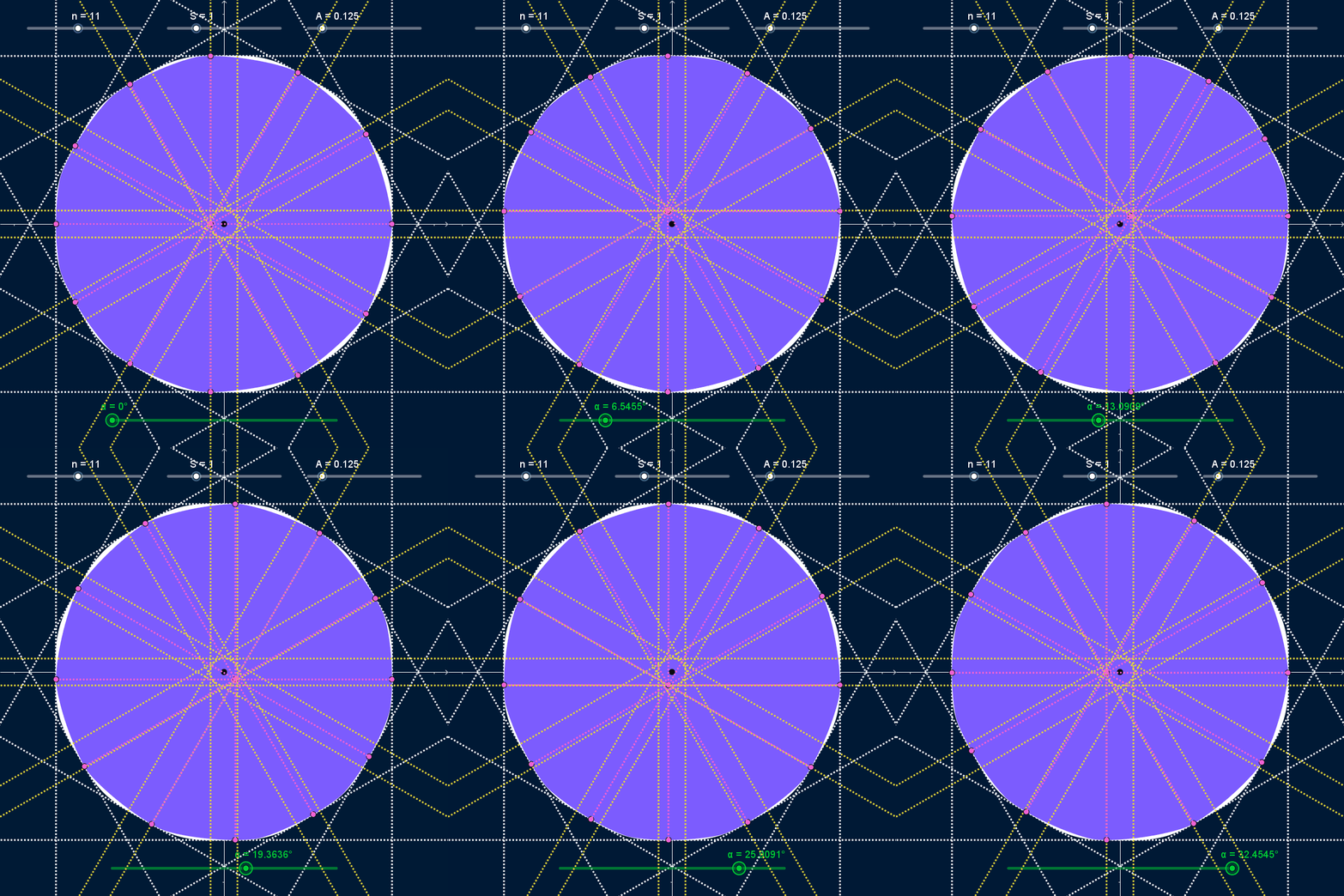
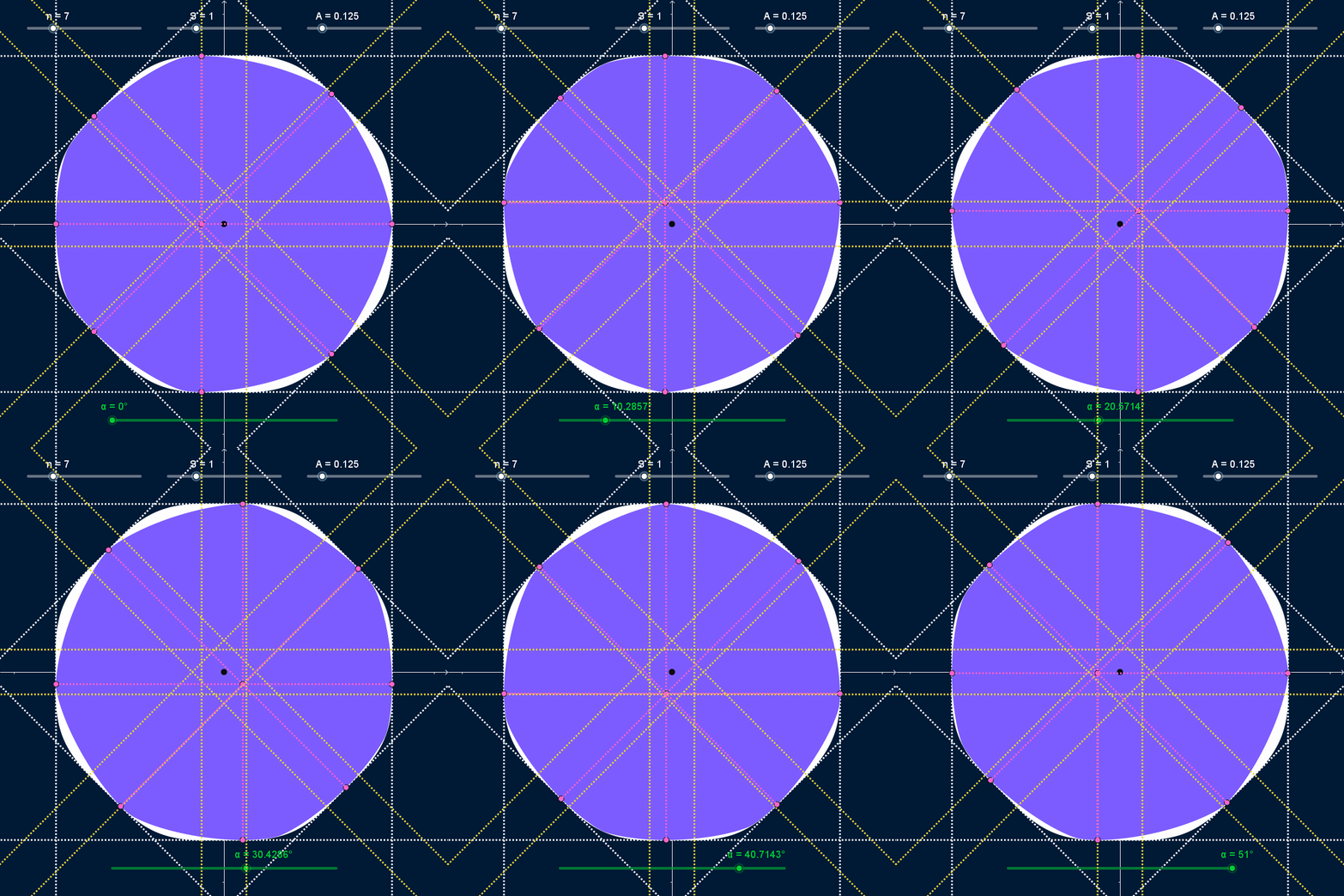
As $α$ varies and the curve rotates, it stays bounded inside a regular polygon with $N$ sides centered on the origin with width and height equal to $S + 2 A$ (dashed white lines in the GIFs below). At all times, the curve touches every side of the bounding polygon at exactly one point (pink points in the GIFs below). However, the rotating curve doesn't completely cover the square; the covered area (solid white in the GIFs below) has rounded corners. I want to find the precise shape of those corners.
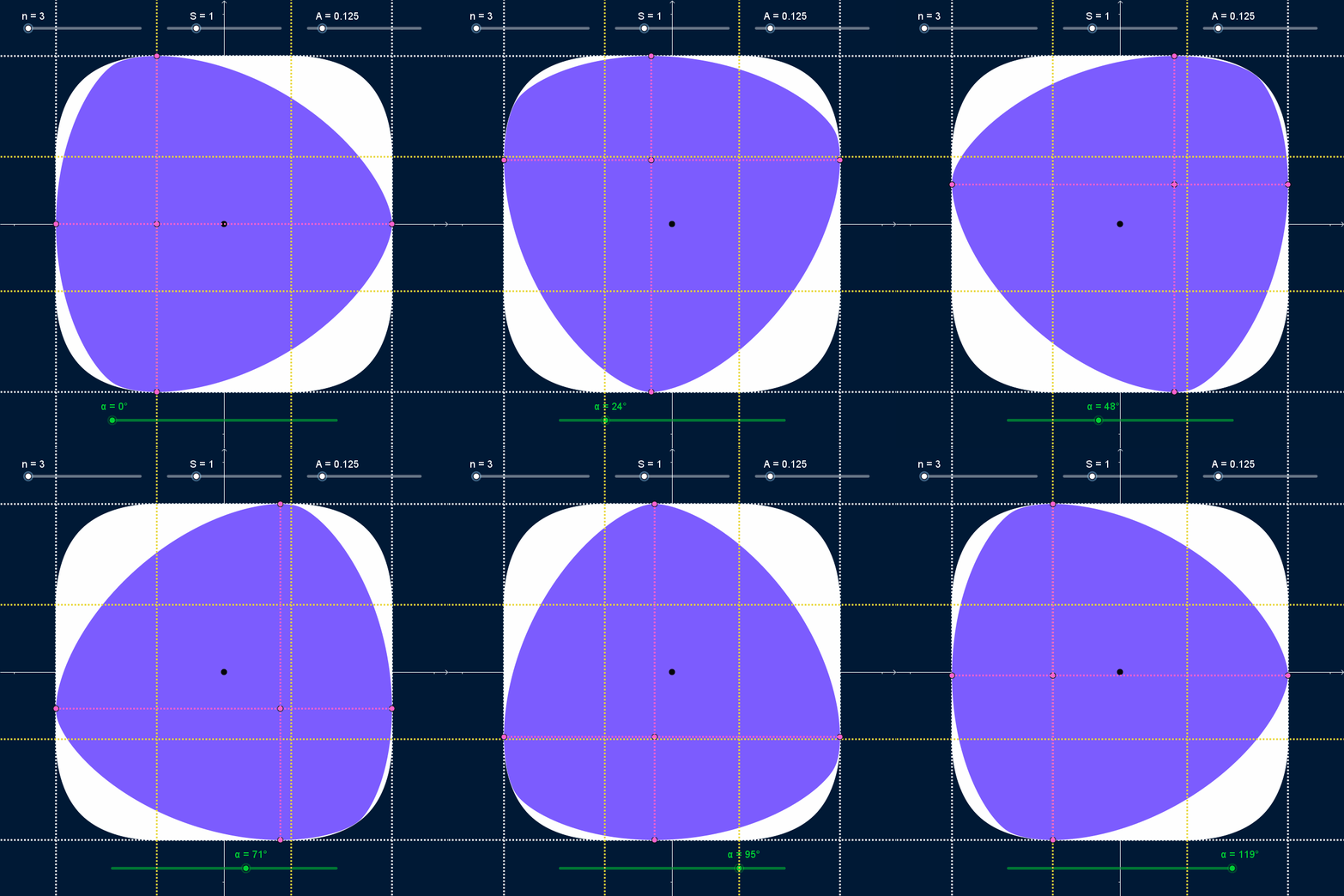
Three-sided curve rotating inside a square.

Seven-sided curve rotating inside an octagon.

Eleven-sided curve rotating inside a dodecagon.

The bounding-box isn't completely rounded. It has a straight line-segment as the center of all four sides, with length $\frac{S × N}{n^2 - 1}$ (bounded by yellow lines in the GIFs above). However, I'm not sure how to find mathematical descriptions of the curves that join those straight segments together.

A Note on Osculating Circles

Given a point on a curve, an osculating circle shares a tangent with the curve at that point and has curvature (inverse of radius) equal to the curvature of the curve at that point. With the CoCW in this question being defined by the functions $X(t)$, $Y(t)$, we can draw two points on the curve $P_{1} = \bigl(X(β), Y(β)\bigr)$ and $P_{2} = \bigl(X(β + π), Y(β + π)\bigr)$. Because we are dealing with a CoCW, the tangents of the curve at these two points are parallel for any $β$ and the center-points of the osculating circles at both points are the same, located at $P_{0} = \bigl(X(β) - Y'(β), Y(β) + X'(β)\bigr)$. As we let $β$ vary, the smallest radius of the osculating circles on this curve will be $A$, and the largest radius will be $S + A$.
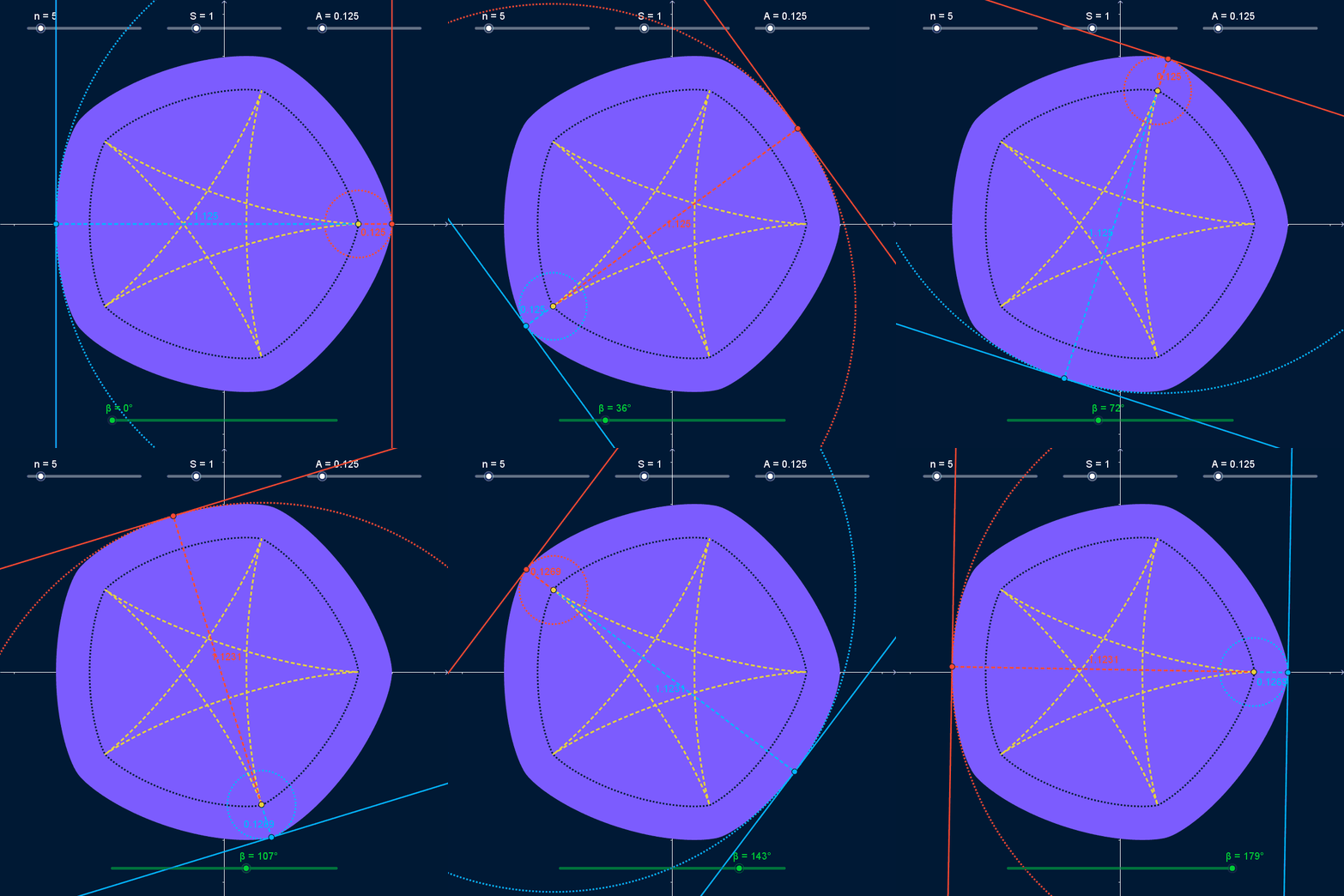
Animation of osculating circles of a five-sided curve.

Lawton
  • 1,759
  • 7
  • 18
  • Is $p'(\theta)$ the derivative of $p(\theta)$? If not, then what does $p'$ mean? And if so, then what in the H*** are you doing mixing angles measured in degrees with derivatives? Are you insane?? – Paul Sinclair Mar 22 '24 at 19:47
  • I'm sorry, but I've plotted this for $n=5, S=10, A=5, \alpha=0$ and I don't see anything but a pudgy pentagon. I had the impression that was to see something like an annulus, Can you please add a sample calculation and figure. – Cye Waldman Mar 22 '24 at 23:08
  • @CyeWaldman I added a GIF of the curve (white) rotating inside its bounding box (purple). Note that $α$ is not static. – Lawton Mar 23 '24 at 01:47
  • Very nice, that will help anyone who is looking at this question. – Cye Waldman Mar 23 '24 at 14:28
  • @PaulSinclair $p'(θ)$ is the derivative of $p(θ)$, yes. And the degrees work perfectly well. – Lawton Mar 23 '24 at 14:46
  • If $\theta$ is in degrees and $f(\theta) = \cos \theta$, then $f'(\theta) = -\frac{180}\pi \sin\theta$. – Paul Sinclair Mar 23 '24 at 15:42
  • I've tried duplicating your animation without success. You are doing something funny with the origin. It's different for each frame. If not, how could you have an extremum point riding flat through an arc. So for one thing, could you please check that the equations you published as the same those that you derived/used. Another point, when I plot a single $\alpha$-curve and a circumscribing circle, it does not touch all the extremum points. And if I rotate that and superpose all the solutions I do not see a flat section, but rather, a slight indentation at the waist. – Cye Waldman Mar 23 '24 at 21:18
  • @CyeWaldman I double-checked the equations and don't see any typos or errors. Note that the last $p$ term in the $X$ & $Y$ equations, which doesn't depend on $θ$ but does depend on $α$, serves to translate the curve side-to-side and up-and-down to keep it centered in the bounding box. With those correction terms, the points $\bigl(X(90° × k), Y(90° × k)\bigr)$ for integer $k$ touch all four sides of the bounding box at all times. Also, the circumcenter of the curve is $\bigl(−p(0°), −p(90°)\bigr)$, and the circumradius is $\frac{1}{2} × \left(\frac{S}{n^2 - 1} + S + 2 A\right)$. – Lawton Mar 24 '24 at 15:52
  • @CyeWaldman You can download a GeoGebra file with this curve here: https://www.ztlawton.com/Curve-of-Constant-Width-StackExchange.ggb. The purple bounding-box only appears as a trace as $α$ animates, so you need to let $α$ cover the entire slider range to see the whole shape. – Lawton Mar 24 '24 at 16:53
  • Unfortunately, I don' use GeoGebra. Now, I'm wondering if you haven't reinvented the Reuleaux polygons (see, for example, https://en.wikipedia.org/wiki/Reuleaux_polygon and https://math.stackexchange.com/questions/2279568/formula-to-create-a-reuleaux-polygon/2279641#2279641), You should be aware that these will not rotate in a square for even sided polygons. Perhaps you can do an example with a hexagon? – Cye Waldman Mar 25 '24 at 00:15
  • @CyeWaldman The curve in my question is precisely a smoothed-out version of a regular $n$-sided Reuleaux polygon. Note that I say in my question that $n$ must be odd, just like constant-width Reuleaux polygons; if $n$ is even, the curve has non-constant width. Regular hexagons (or any other polygon with an even number of sides) don't work. Any curve of constant width, Reuleaux or not, will rotate inside a square while maintaining contact with all four sides simultaneously, and you can see in the GIF I added to my question that this curve does have that property. – Lawton Mar 25 '24 at 00:28
  • @CyeWaldman I made it work in a web-browser without you needing to download anything (but it does use JavaScript): https://www.ztlawton.com/curve-of-constant-width-stackexchange.html – Lawton Mar 25 '24 at 01:09
  • Hi Lawton, you asked for an equation for the corners of the bounding shape. I provided that in my Answer, but I don't hear back from you. Do you have a problem with that response. I have since shown that it can be done by a formal iteration procedure on the fly. – Cye Waldman Mar 27 '24 at 21:06

1 Answers1

0

I have looked at this problem, reformulated it a bit, and developed a credible solution to envelope of curves described in the original post (OP). I work in the complex plane, so have reformatted the equations as follows,

$$ p(\theta)=\frac{S}{2}\frac{\cos (n(\theta-\alpha))}{n^2-1}\\ z(\theta)=\bigg(p(\theta)+ \frac{S}{2}+A \bigg)e^{i\theta}+i p’(\theta) e^{i\theta} $$

You’ll notice that I’ve dropped the translation terms $p(1)+ip(\pi/2)$ as they become superfluous when the solutions for various $\alpha$ are aligned in a single square box and the origin is moved to the center. Here, as in the OP, we have taken $S=1.25, A=S/2$.

To delineate the envelope of the solutions, i.e., the purple zone in the OP, I plotted the solution for 360 values of $\alpha$ on a single plot. This is shown in the first figure below. The red circle is shown for reference and comparison. The blue dashed lines indicate the straight sections of the envelope as called out in the OP. Our job is to find an analytic approximation to the outer envelope, The red star shows the pseudo-origin for developing the curve fit of the envelope. It is obvious that the envelope is not circular but must be close to it. Moreover, we see that it must be symmetric about the $45^{\circ}$-line.

This suggested to me to look at the superellipse. (Some readers may be familiar with the squircle, which will do just as well.) The superellipse is a special case of the superconics curves. The simple form for a curve in the first quadrant is

$$ y=(1-x^q)^{1/q},\quad x\in[0,1] $$

We note that $q=2$ is a circle, of course. And this must be scaled to the actual size of the envelope (details below). I found empirically the for $n=5$ as in the figure below, $q\approx2\cdot1.025641$. The envelope so calculated is shown in magenta in the figure.

Specifically, the pseudo-origin is given by $z_0=d(1+i)$, where, as per the OP,

$$ d=\frac{S}{2}\biggr( \frac{n-\sin(n\pi/2)}{n^2-1}\biggr) $$

The scaling factor is the distance from the origin to the side wall ($w=S/2+A$) less the distance to the pseudo-origin, thus giving the scaling factor $s=w-d$.

Similar calculations were carried out for the case $n=3$. Everything up to the empirical calculation of $q$ is identical, except for $n$, of course. Here we found that $q\approx2\cdot1.086957$. These results are shown in the second figure below.

We also looked at $n=7$ and $n=9$. Here we found that there are eight flat sections rather than four and did not go any further for the time being.

ConstWidthCurves: n=5 ConstWidthCurves: n=3

Cye Waldman
  • 7,524
  • While the superellipse curve comes close to the shape of the envelope for $n = 3$ and $n = 5$, it isn't perfect. I'd like to find the exact shape, not just an approximation, and I'd like it to apply for higher values of $n$ where the envelope isn't square. – Lawton Mar 28 '24 at 14:31
  • @Lawton Personally, I think that what you seek is not possible. However, as a first step, I suggest that find a numerical description of the envelope, which you need for verification of any analytical solution. I tied to characterize the envelope by tracing the outermost point of the curve, but that does not define envelope. In fact, it's almost immediately run over by the subsequent $\alpha$ solutions. In fact, it doesn't seem to be good anywhere except the flat regions. So, I'll suggest that you try to define that envelope before you seek any kind of analytical solution. And good luck. – Cye Waldman Mar 28 '24 at 16:53