13

Can you guys give me a hint on how to proceed with proving this trigonometric equality? I have a feeling I need to use the half angle identity for $\tan \frac{\theta}{2}$. The stuff I have tried so far(multiplying numerator and denominator by $1 + \sin A - \cos A$) has lead to a dead end.

Prove that, $$ \dfrac{1 + \sin A - \cos A}{1 + \sin A + \cos A} = \tan \dfrac{A}{2} $$

Aryabhata
  • 82,206
mathguy80
  • 1,321
  • 1
    The fact that you need to use half angle (or equivalently double angle) identities is built into the shape of the problem. The simple formulas express $\sin(2x)$, $\cos(2x)$, $\tan(2x)$ in terms of trigonometric functions of $x$, so the mechanical way to proceed is to let $x=A/2$. Then $A=2x$. Now work on the left-hand side. – André Nicolas Jul 07 '11 at 13:49

8 Answers8

18

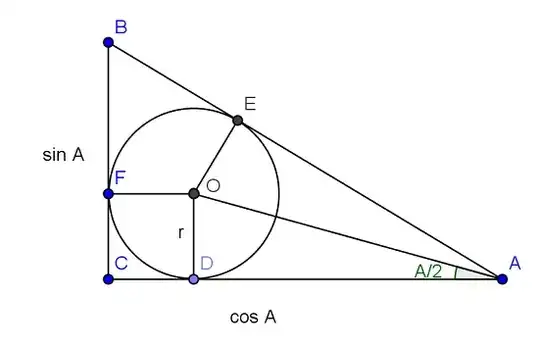
Now that OP has understood how to prove this, here is a geometric proof for certain angles, just for fun :-)

Consider the figure:
enter image description here

$\displaystyle \triangle ABC$ is a right angled triangle with the right angle being at $\displaystyle C$.

$\displaystyle \angle{CAB} = A$ and $\displaystyle AB = 1$ and thus $\displaystyle BC = \sin A$ and $\displaystyle AC = \cos A$.

Now $\displaystyle AO$ is the angular bisector of $\displaystyle \angle{CAB}$. We select $\displaystyle O$ so that $\displaystyle O$ is the in-center (point of intersection of angular bisectors of a triangle). Let the in-radius $\displaystyle OD$ be $\displaystyle r$.

Now $\displaystyle BE = BF$ and $\displaystyle AE = AD$ and adding gives us $\displaystyle BF + AD = AB = 1$

Now $\displaystyle BF = BC - FC =BC - OD$ (as $\displaystyle ODCF$ is a square).

Thus $\displaystyle BF = \sin A - r$. Similarly $\displaystyle AD = \cos A - r$.

Thus $\displaystyle \sin A + \cos A - 2r = 1$.

Using $\displaystyle \triangle ADO$, $\displaystyle \tan \frac{A}{2} = \frac{OD}{AD} = \frac{r}{\cos A - r}$

Since $\displaystyle 2r = \sin A + \cos A -1 $ we get

$$\tan \frac{A}{2} = \frac{2r}{2\cos A - 2r} = \frac{\sin A + \cos A - 1}{\cos A - \sin A + 1}$$

It is easy to verify that

$$ \frac{\sin A + \cos A - 1}{\cos A - \sin A + 1} = \frac{\sin A - \cos A + 1}{\cos A + \sin A + 1}$$


Incidently, the fact that in a right triangle (hypotenuse $c$), the in-radius is given by $ a + b -c = 2r$ and also by $r = \frac{\triangle}{s}$ ($\triangle$ is the area, $s$ is the semi-perimeter) can be used to prove the pythagoras theorem ($a^2 + b^2 = c^2$)!

Aryabhata
  • 82,206
16

$\textbf{Method 1.}$ You have

\begin{align*} \frac{1+ \sin{A} - \cos{A}}{1+\sin{A} + \cos{A}} &= \frac{ \cos^{2}\frac{A}{2} + \sin^{2}\frac{A}{2} + 2\cdot \sin\frac{A}{2}\cdot\cos\frac{A}{2} - \Bigl(\cos^{2}\frac{A}{2} - \sin^{2}\frac{A}{2}\Bigr)}{\cos^{2}\frac{A}{2} + \sin^{2}\frac{A}{2} + 2\cdot \sin\frac{A}{2}\cdot\cos\frac{A}{2} + \Bigl(\cos^{2}\frac{A}{2} -\sin^{2}\frac{A}{2}\Bigr)} \\ &=\frac{ \Bigl(\cos\frac{A}{2} + \sin\frac{A}{2}\Bigr)^{2} - \Bigl(\cos\frac{A}{2}+\sin\frac{A}{2}\Bigr) \cdot \Bigl(\cos\frac{A}{2} - \sin\frac{A}{2}\Bigr)}{\Bigl(\cos\frac{A}{2} + \sin\frac{A}{2}\Bigr)^{2} + \Bigl(\cos\frac{A}{2}+\sin\frac{A}{2}\Bigr) \cdot \Bigl(\cos\frac{A}{2} - \sin\frac{A}{2}\Bigr)} \\ &= \frac{ \cos\frac{A}{2} + \sin\frac{A}{2} - \cos\frac{A}{2} + \sin\frac{A}{2}}{\cos\frac{A}{2} + \sin\frac{A}{2} + \cos\frac{A}{2} -\sin\frac{A}{2}} \qquad \Bigl[ \text{cancelling}\ \Bigl(\small\cos\frac{A}{2} +\sin\frac{A}{2}\Bigr) \ \Bigr] \\ &= \tan\frac{A}{2} \end{align*}

$\textbf{Method 2.}$ Here is another way of seeing this. By using something called Componendo and Dividendo.

Let $$\frac{1+\sin{A} -\cos{A}}{1+\sin{A} + \cos{A}} = \frac{k}{1}$$ Now applying componendo and dividendo we get $$\frac{1+ \sin{A}}{-\cos{A}} = \frac{k+1}{k-1} \Longrightarrow \frac{\cos\frac{A}{2}+\sin\frac{A}{2}}{-\cos\frac{A}{2}+\sin\frac{A}{2}} = \frac{k+1}{k-1} \qquad (1)$$

Again using componendo dividendo on $(1)$ we get $$\frac{\cos\frac{A}{2}+\sin\frac{A}{2} -\cos\frac{A}{2}+\sin\frac{A}{2}}{\cos\frac{A}{2}+\sin\frac{A}{2} +\cos\frac{A}{2}-\sin\frac{A}{2}} = \frac{k+1 +k-1}{k+1-k+1} \Longrightarrow k=\frac{\sin\frac{A}{2}}{\cos\frac{A}{2}}=\tan\frac{A}{2}$$

$\textbf{Method 3.}$ Another way of looking into this would be, \begin{align*} \frac{1+\sin{A}-\cos{A}}{1+\sin{A}+\cos{A}} =\frac{(1-\cos{A})+\sin{A}}{(1+\cos{A}) + \sin{A}} &= \frac{ 2\:\sin^{2}\frac{A}{2} + 2\cdot\sin\frac{A}{2}\cdot\cos\frac{A}{2}}{2\:\cos^{2}\frac{A}{2} + 2 \cdot\sin\frac{A}{2}\cdot \cos\frac{A}{2}} \\ &= \frac{2\:\sin\frac{A}{2}}{2\:\cos\frac{A}{2}} \cdot \Biggl(\frac{\cos\frac{A}{2}+\sin\frac{A}{2}}{\cos\frac{A}{2} + \sin\frac{A}{2}}\Biggr) \\ &= \tan\frac{A}{2} \end{align*}

$\textbf{Method 4.}$ My younger brother mentioned about this method. Multiplying numerator and deominator by $(1+\sin{A}-\cos{A})$ we get \begin{align*} \frac{1+\sin{A}-\cos{A}}{1+\sin{A}+\cos{A}} \times \frac{1+\sin{A}-\cos{A}}{1+\sin{A}-\cos{A}} &= \frac{(1+\sin{A}-\cos{A})^{2}}{(1+\sin{A})^{2}-\cos^{2}{A}} \\ &= \frac{2 + 2\: \sin{A} -2\cdot\sin{A}\cdot \cos{A} -2\cos{A}}{2\: \sin{A} + 2\sin^{2}{A}} \\ &= \frac{(2-2\cos{A}) \cdot (1+\sin{A})}{2\:\sin{A} \cdot (1+\sin{A})} \\ &=\frac{1-\cos{A}}{\sin{A}} = \frac{2\: \sin^{2}\frac{A}{2}}{2\cdot \sin\frac{A}{2} \cdot \cos\frac{A}{2}} \\ &=\tan\frac{A}{2} \end{align*}

Oh once again when I looked at the question I realize that you attempted this method. Hopefully now it's clear.

7

An alternative solution:

Substituting

$$\tan\left(\frac{A}{2}\right)=\frac{\sin(A)}{1+\cos(A)}$$

and multiplying through to clear the fractions quickly reduces the statement to one which is trivially true. Then working backwards through the simplifications you have made gives the proof.

Edit (providing requested clarification):

When you make the above substitution, you have

$$\frac{1+\sin A - \cos A}{1+\sin A + \cos A} = \frac{\sin A }{1+\cos A}$$

So

$$ (1+\sin A - \cos A)(1+\cos A) = \sin A (1+\sin A + \cos A)$$

And cancelling terms gives

$$1-\cos^2 A = \sin^2 A$$

So, using that as the starting point for your proof, "uncancelling" terms, and dividing gives the required identity.

Ben Derrett
  • 4,592
  • That's good, and it supports mathguy's feeling that the half-angle identity for tangent would be useful. My solution is for those of us who have forgotten that half-angle identity. – Gerry Myerson Jul 07 '11 at 13:38
  • I tried that but ended up going in circles, ending up with the other identity $\frac{1 - \cos A}{\sin A}$ Can you clarify what you mean by clearing fractions? – mathguy80 Jul 07 '11 at 13:40
  • Amazingly, a Canadian province I shall not name had for a long time the following final exam grading policy. In proving a trigonometric identity, a student could not "mix" the sides. Any computation step had to deal with one side or the other! – André Nicolas Jul 07 '11 at 20:06
7

There is a theorem$^1$ that is worth knowing (I used it in this answer to this question) that states:

All direct trigonometric functions of $A$ ($2\alpha$) can be expressed rationally in terms of the tangent of $\frac{A}{2}$ ($\alpha$).

Combining $\sin A=2\sin \frac{A}{2}\cdot \cos \frac{A}{2}$ and $\cos ^{2} \frac{A}{2}+\sin ^{2}\frac{A}{2}=1$, we get (for $\cos \frac{A}{2}\neq 0$)

$$\sin A=\frac{2\sin \frac{A}{2}\cdot \cos \frac{A}{2}}{\cos ^{2}\frac{A}{2} +\sin ^{2}\frac{A}{2}}=\frac{2\tan \frac{A}{2}}{1+\tan ^{2}\frac{A}{2}}; \qquad (1)$$

and from $\cos A=\cos ^{2}\frac{A}{2}-\sin ^{2}\frac{A}{2}$, for $\cos \frac{A}{2}\neq 0$,

$$\cos A=\frac{\cos ^{2}\frac{A}{2}-\sin ^{2}\frac{A}{2}}{\cos ^{2}\frac{A}{2} +\sin ^{2}\frac{A}{2}}=\frac{1-\tan ^{2}\frac{A}{2}}{1+\tan ^{2}\frac{A}{2}}. \qquad (2)$$

To prove the identity multiply the LHS numerator and denominator by $1+\tan ^{2}\frac{A}{2}$ and use $(1)$ and $(2)$:

$$\begin{eqnarray*} \frac{1+\sin A-\cos A}{1+\sin A+\cos A} &=&\frac{1+2\tan \frac{A}{2}-1+\tan ^{2}\frac{A}{2}}{1+2\tan \frac{A}{2}+1+\tan ^{2}\frac{A}{2}} \\ &=&\frac{2\tan ^{2}\frac{A}{2}+2\tan \frac{A}{2}}{2+2\tan \frac{A}{2}}=\tan \frac{A}{2}. \end{eqnarray*}$$

--

$^1$ J. Calado, Compêndio de Trigonometria, 1967.

4

First write $A=2b$. Then make appropriate use of $\tan b=\sin b/\cos b$, $\sin2b=2\sin b\cos b$, and $\cos2b=2\cos^2b-1=1-2\sin^2b$.

Gerry Myerson
  • 179,216
  • Thanks. That's a neat substitution. It's a simple double angle identity from there. This also lead me backwards to, $\sin x = 2\sin \frac{x}{2} \cos \frac{x}{2}$ and $\cos x = \cos^2 \frac{x}{2} - \sin^2 \frac{x}{2}$ – mathguy80 Jul 07 '11 at 13:38
3

The following is a method that in general I would not advocate as an approach to proving the usual trigonometric identities by hand. However, the idea has nice connections with other parts of mathematics, so it is worth mentioning.

There is a standard rational parametrization of (most of) the unit circle. Let $t=\tan(\theta/2)$. Then $$\cos \theta=\frac{1-t^2}{1+t^2} \qquad \text{and} \qquad \sin\theta=\frac{2t}{1+t^2}.$$ This parametrization gives a general method for integrating rational functions of $\sin\theta$ and $\cos\theta$. Parametrizations of the same general character are useful in number theory and elsewhere.

In our problem, the left-hand side is $$ \frac{1+\frac{2t}{1+t^2}-\frac{1-t^2}{1+t^2}}{1+\frac{2t}{1+t^2}+\frac{1-t^2}{1+t^2}}.$$ Bring top and bottom to the common denominator $1+t^2$. Things collapse, we get $t$. (As in the trigonometric proofs, we close our eyes to division by $0$.)

André Nicolas
  • 507,029
  • Another excellent answer. I had seen this substitution approach in some examples, but was unaware of what it was called. Thank you! – mathguy80 Jul 07 '11 at 15:44
1

This can also be done (mechanically) with complex numbers.

GEdgar
  • 111,679
0

Using the identities$$1+\cos A=2 \cos ^{2} \frac{A}{2}, 1-\sin A=2 \sin ^{2} \frac{1}{2} , \sin A=2 \sin\frac{\theta}{2} \cos\frac{\theta}{2}, $$ We have $$ \begin{aligned} \frac{1+\sin A-\cos A}{1+\sin A+\cos A} &=\frac{2 \sin ^{2} \frac{A}{2}+2 \sin \frac{A}{2} \cos \frac{A}{2}}{2 \cos ^{2} \frac{A}{2}+2 \sin \frac{A}{2} \cos \frac{A}{2}} \\ &=\frac{\sin \frac{A}{2}\left(\sin \frac{A}{2}+\cos \frac{A}{2}\right)}{\cot \frac{A}{2}\left(\cos \frac{A}{2}+\sin \frac{A}{2}\right)} \\ &=\tan \frac{A}{2} \end{aligned} $$

Lai
  • 20,421