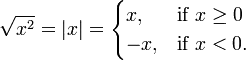
As far as I see, $\sqrt{x^2}$ is not $x$, but $|x|$, meaning the "absolute". I totally get this, because $x^2$ is positive, if $x$ is negative, so $\sqrt{y}$, whether $y = 10^2$ or $y = -10^2$: $y$ is positive.
But then I remember that $\sqrt{x}$ is the same as $x^{1/2}$ and thus, $\sqrt{x^2}$ is the same as $x^{1}$.
So, as far as I get it, $\sqrt{x^2} = x^{2/2}$.
But then, I can cancel $\frac{2}{2}$ to $1$. So: $\sqrt{x^2} = x^1 = x$.
Where does the absolute value in this derivation of the calculation come from?
I get it why its there: Because $(-x)^2 = x^2$, so the radicand is always positive. But from $\sqrt{x^n} = x^{n/2}$ I dont understand how it gets there.