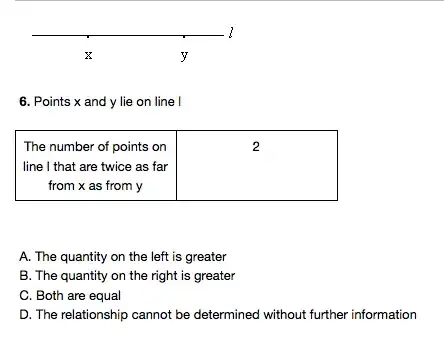
It doesn't matter if the scale isn't specified all you need to know is that there is some distance between $x$ and $y$ and there are other points on the lines with various distances to $x$ and $y$. Just because you can't assume you know the distance between them does not mean that you need to throw out all your intution.
I recommend this. Place your finger on the far left of the number line. Are points in that region twice as far from $x$ as they are from $y$? To my eyes it looks like they are closer to $x$ than $y$ and therefore do not count.
Move your finger to the right till the points start looking like they are closer to $y$ than $x$. This should be between $x$ and $y$ a bit closer to $y$ than $x$. Can you see that even though you aren't sure exactly where it is there has to be a point in that middle region which is twice as far from $x$ as it is from $y$? In other words that there is a point whose distance to $y$ is half its distance to $x$? I think it should be clear there is one point in the middle that does this.
Now keep moving your finger to the right passing through $y$. Notice that while going from the middle region to the right hand region your distance to $y$ goes to zero and then starts getting bigger again. Can you see that we are about to hit another point where $x$ is twice as far from your finger as $y$ is and that there is only one point on the right which does this? This point is the one that is as far from $y$ as $y$ is from $x$.
Hope that helps.