Regarding this problem, I conjectured that
$$ I(r, s) = \int_{-1}^{1} \frac{1}{x}\sqrt{\frac{1+x}{1-x}} \log \left( \frac{(r-1)x^{2} + sx + 1}{(r-1)x^{2} - sx + 1} \right) \, \mathrm dx = 4 \pi \operatorname{arccot} \sqrt{ \frac{2r + 2\sqrt{r^{2} - s^{2}}}{s^{2}} - 1}. $$
Though we may try the same technique as in the previous problem, now I'm curious if this generality leads us to a different (and possible a more elegant) proof.
Indeed, I observed that $I(r, 0) = 0$ and
$$\frac{\partial I}{\partial s}(r, s) = \int_{0}^{\infty} \left\{ \frac{2\sqrt{y}}{(r-s)y^{2} + 2(2-r)y + (r+s)}+\frac{2\sqrt{y}}{(r+s)y^{2}+ 2(2-r)y + (r-s)} \right\} \,\mathrm dy, $$
which can be evaluated using standard contour integration technique. But simplifying the residue and integrating them seems still daunting.
EDIT. By applying a series of change of variables, I noticed that the problem is equivalent to prove that
$$ \tilde{I}(\alpha, s) := \int_{-1}^{1} \frac{1}{x}\sqrt{\frac{1+x}{1-x}} \log \left( \frac{ 1 + 2sx \sin\alpha + (s^{2} - \cos^{2}\alpha) x^{2}}{ 1 - 2sx \sin\alpha + (s^{2} - \cos^{2}\alpha) x^{2}} \right) \, \mathrm dx = 4\pi \alpha $$
for $-\frac{\pi}{2} < \alpha < \frac{\pi}{2}$ and $s > 1$. (This is equivalent to the condition that the expression inside the logarithm is positive for all $x \in \Bbb{R}$.)
Another simple observation. once you prove that $\tilde{I}(\alpha, s)$ does not depend on the variable $s$ for $s > 1$, then by suitable limiting process it follows that
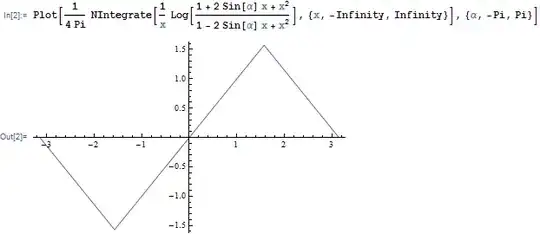
$$ \tilde{I}(\alpha, s) = \int_{-\infty}^{\infty} \log \left( \frac{ 1 + 2x \sin\alpha + x^{2}}{ 1 - 2x \sin\alpha + x^{2}} \right) \, \frac{\mathrm dx}{x}, $$
which (I guess) can be calculated by hand. The following graph may also help us understand the behavior of this integral.