Consider the recursively defined hyperoperation sequence $\circ_i$
$$\begin{array}{rcrclclcl} x& \small{+}&(y\ {\small+}1)&:=&x& &&{\small+}&1\\ x& \boldsymbol{+}&(y\ {\small+}1)&:=&(x& \boldsymbol{+} &y)&{\small+}&x\\ x& \cdot &(y\ {\small+}1)&:=&(x& \cdot& y)&\boldsymbol{+}&x\\ x&\uparrow &(y\ {\small+}1)&:=&(x&\uparrow& y)&\cdot&x\\ x& \uparrow\uparrow &(y\ {\small+}1)&:=&(x&\uparrow\uparrow& y)&\uparrow&x\\ &&&\vdots\\ x& \uparrow^{n+1} &(y\ {\small+}1)&:=&(x&\uparrow^{n+1}& y)&\uparrow^{n}&x\\ &&&\vdots\\ \end{array}$$
with $x \circ_0 y = x {\small+} 1$ (the successor function), $x \circ_1 y = x + y$, $x \circ_2 y = x \cdot y$, $x \circ_3 y = x \uparrow y = x^y$, and so on. This sequence can be used to define a sequence of successor functions for ordinals:
$$\begin{array}{rcrclclcl} \mathsf{S}_0(x) &:=& x \circ_0 \omega&=&x&\small{+}& \omega& = &x& \small{+}& 1\\ \mathsf{S}_1(x) &:=& x \circ_1 \omega&=&x&\boldsymbol{+}& \omega\\ \mathsf{S}_2(x) &:=& x \circ_2 \omega&=&x&\cdot& \omega\\ \mathsf{S}_3(x) &:=& x \circ_3 \omega&=&x&\uparrow& \omega\\ &\vdots\\ \end{array}$$
With these successor functions and their respective limits one gets the following picture of the countable ordinals (at least the smaller ones):
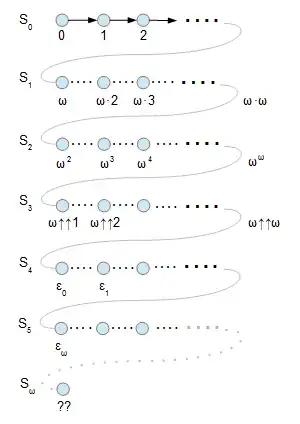
Note that the small dots on every level correspond to the big dots on the level before.
Is this picture essentially correct and maybe helpful?
Can the limit ordinal labelled ?? (which seems to be countable) be characterized rigorously (not just by dots) and does it have a name or notation, eventually?
[Added] Thanks to Miha's suggestion I learned a little bit about fundamental sequences. So the question is about the limit of the fundamental sequence $\lbrace \omega \uparrow^n \omega\rbrace_{n \in \mathbb{N}}$. Maybe it's enough to characterize this ordinal just like this. But it would be interesting how it could be characterized otherwise.
[Added] Maybe it's trivial, but I had to learn (from here) that the limit ordinal under consideration must be a countable ordinal, because the first uncountable ordinal does'nt have a countable fundamental sequence.

