2

I am trying to create a graphic that shows the golden spiral created using a pentagram and the golden triangles contained therein.

I have drawn out the pentagram and golden triangles and the subsequent smaller triangles and pentagrams that are needed to construct the golden spiral, but when I try to fit the golden spiral onto it, I can't seem to get it to fit.

Is there a difference between the golden spiral created using the golden rectangle method (which is where the formula I used to plot the spiral came from) and the golden spiral created using the golden triangle method? It seems that they should be the same, considering they have both been called a "Golden Spiral"

The equation I am using to plot the spiral (in red on the graphic) is $$r=\phi^{\left(\dfrac{2\theta}{\pi}\right)}$$
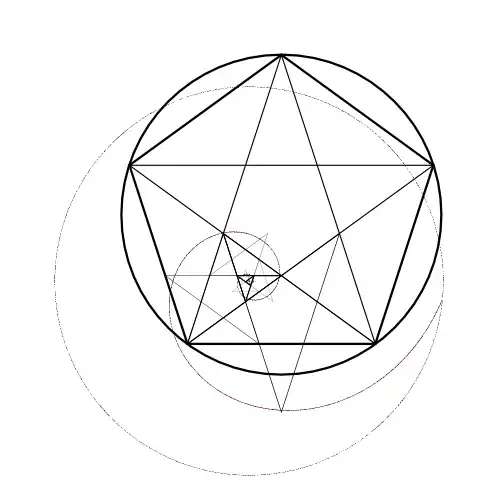
example of spiral not fitting to the pentagrams

As you can see, the spiral I plotted in Maple does not fit the vertices of the golden triangles as seen on the Golden Triangle Wikipedia page. At points near to the origin of the spiral, the spiral seems to be too tight, but further out, it seems to be too loose.

Any suggestions on the proper formula to use to get a logarithmic spiral that fits?

Is this indeed a golden spiral? Or am I mistaken in believing that the spiral created this way is a golden spiral?

UPDATE: for Ross Millikan

The way I reached the formula I have is through an alternate form for the equation of a logarithmic spiral: $r=ac^{\theta}$ where $c=e^{b}$ and when calculating for the Golden Spiral gives a $c$ value of $c=\phi^{\left(\dfrac{2}{\pi}\right)}$. Substituting this into the original equation and simplifying, gives my original equation for the Golden Spiral.

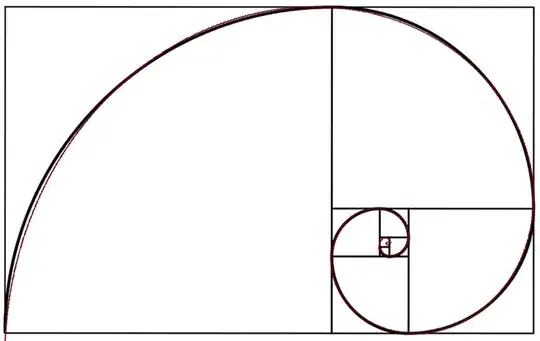
I have compared the spiral graph generated this way with a Fibonacci Spiral and it matches extremely closely, whereas the spiral generated by the equation in your solution does not match at all, as it is much too wide.

Black is the Fibonacci Spiral, red is my Golden Spiral graph: fibonacci graph comparison
Benjam
  • 123
  • 7
  • I think the reason your golden spiral does not fit the pentagons is that the reduction factor of the pentagons does not match the angle of the golden spiral. I'll work on a calculation to get the details. If you want to, compare the size of the largest pentagram with the next smaller. That ratio will not correspond to any number of fifths of a circle of the golden spiral (else it would fit). – Ross Millikan Feb 25 '14 at 04:09
  • It seems that because of the relationship between $\phi$ and pentagons/pentacles, the ratio of the largest pentagon to the next size smaller is $\phi$. i.e.- if the distance between opposing corners of the smaller pentagon is 1, the distance between the respective corners of the larger is $\phi$ http://mathworld.wolfram.com/Pentagon.html – Benjam Feb 25 '14 at 04:27
  • That seems reasonable-there are lots of $\phi$'s in a regular pentagon. Your red spiral passes through the top point of the next to largest pentagram, then through the rightmost point of the next smaller one. A bunch of algebra (I think you need to find the convergence point) will find the radius ratio of the geometric spiral. The evidence suggests that it doesn't match your equation, which claims that the radius reduces by a factor $\phi$ for each turn. – Ross Millikan Feb 25 '14 at 04:39

2 Answers2

2

The red spiral is not a golden spiral. The golden spiral is a logarithmic spiral with equation $r=a\exp(\frac {2\phi}\pi \theta)$

Ross Millikan
  • 374,822
  • Please see my update. – Benjam Feb 22 '14 at 18:40
  • $r$ has to grow exponentially with $\theta$, not linearly – Ross Millikan Feb 22 '14 at 20:59
  • Maybe I'm confused then... why does the red spiral fit so well with the Fibonacci Spiral (which the Golden Spiral is supposed to do), while the graph of the spiral I get with your equation (which, technically should also be a Golden Spiral according to Wikipedia) does not fit at all? Are there different spirals that can be called Golden Spirals? – Benjam Feb 23 '14 at 23:40
  • Also... I just noticed that my original equation was wrong, it's not $\phi$ times the fraction, but $\phi$ raised to the power of the fraction. I apologize for that. Fixed in the post. – Benjam Feb 23 '14 at 23:43
  • Yes, then it works. – Ross Millikan Feb 24 '14 at 00:33
  • Then my question remains... Why doesn't the red spiral fit with the Golden Triangles as expected? Or is the spiral created via the Golden Triangle method not a Golden Spiral? Thanks again for all your help. I appreciate it. +1 – Benjam Feb 24 '14 at 20:34
  • 1
    The Fibonacci spiral is not (in a sense) a spiral at all. It is a series of linked quarter circles that approximate a golden spiral. Based on your picture, it approximates it very well. – Ross Millikan Feb 25 '14 at 03:54
1

I believe there are two important differences between your pentagon construct and the Fibonacci spiral. First of all, let's understand that the Fibonacci spiral is not a logarithmic spiral, but only approximates one. The golden spiral is one whose radius of curvature increases by a factor of $\phi$ with each quarter turn ($\pi/2$). The Fibonacci spiral, by contrast, has a radius of curvature that increases as the Fibonacci sequence with each quarter turn.

Now, we turn our attention to the pentagram and golden triangles, which can also be viewed as the golden gnomon (https://en.wikipedia.org/wiki/Golden_triangle_(mathematics)). Here, we have a logarithmic spiral with a radius of curvature that increases by a factor of $\phi$ with each turn of $3\pi/5$ (or 108$^{\circ}$). And therein lies the difference; the golden triangle spiral is a golden spiral of another 'color.'

Cye Waldman
  • 7,524
  • So the equation I should use for the logarithmic spiral that fits the pentagon construct should be: $r=\phi^{3\pi\theta/5}$? – Benjam Mar 13 '17 at 16:07
  • Yes! I have an example figure but I don't know how to put it here. – Cye Waldman Mar 15 '17 at 00:20
  • Perfect! Thank you. No need for the figure. – Benjam Mar 16 '17 at 16:50
  • After throwing this in Maple and playing around with it and my original figure, I've determined that the proper function is actually $r=\phi^{5\theta/3\pi}$, with the reverse of that (to fit the image shown in your wiki link) being $r=\phi^{-5\theta/3\pi}$. – Benjam Mar 16 '17 at 18:06