0

If I have multiple statements and have to prove that they are all equivalent, which proof strategy should I use?

E.g. let's say I have statements A, B, C and D and need to show that they are all equivalent.

I know that I can prove equivalence by proving: $A\implies B\implies C\implies D\implies A$.

My question is do I have to use a circular pattern or can I e.g., if $A\implies C$ is easier to prove than $B\implies C$, simply prove $A\implies B$, $A\implies C$, $C\implies D$, $D\implies A$ or any other random pattern?

eager2learn
  • 2,799
  • 1
    That would give you the equivalence of $A, C$ and $D$, and $A\to B$. You would still have to show that $B\to A,C,$ or $D$. My advice is to first write down all implications that follow trivially, and then look which directions are still missing in order to have equivalence of all statements. It is always temting to use a circular pattern like $A\to B\to C\to A$, but if it turns out too difficult to prove $C\to A$ directly, then you may consider splitting it into $C\to B$ and $B\to A$. – Stefan Hamcke Nov 30 '13 at 20:36
  • $$A{\implies} B,B{\implies} C,C{\implies} D,D{\implies} A$$ and $$A{\implies} B,A{\implies} C,C{\implies} D,D{\implies} A$$ aren't logically equivalent: explanation here, complete with counterexamples and a truth-table proof. – ryang Oct 20 '21 at 08:52

4 Answers4

4

It would not be enough to show that $A\to B$, $A\to C$, $C\to D$, and $D\to A$: that would show that $A,C$, and $D$ are equivalent and that any one of them implies $B$, but it would not show that $B$ was equivalent to the other three: it might be a strictly weaker statement.

Proving any collection of implications that gives you a ‘path’ from any statement in the set to any other statement in the set is sufficient. For example, you could prove $A\leftrightarrow B$, $A\leftrightarrow C$, and $A\leftrightarrow D$.

Brian M. Scott
  • 616,228
3

You don't need to use exactly the pattern $A\Rightarrow B \Rightarrow C \Rightarrow D \Rightarrow A$, but you do need to check that you can follow arrows from any of the statements to any other. In the example you gave, you can't get $B\Rightarrow A$ or $B\Rightarrow C$ (for instance), but if you also proved $B\Rightarrow A$ then you would be done.

universalset
  • 8,269
  • 20
  • 33
2

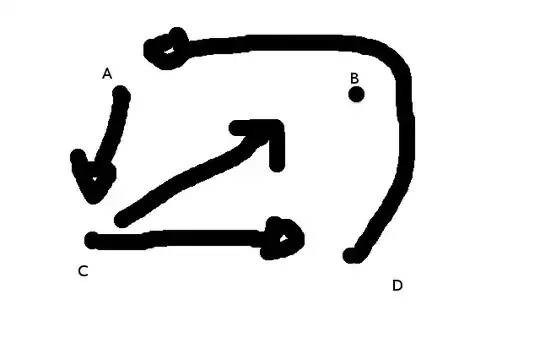
Suppose a,b,c,d are vertices in a directed graph.

and $(x,y)$ is an edge if you have proven $a\rightarrow b$.

Then you have proven equivalence if and only if there is a directed path from x to y for every $x,y\in {a,b,c,d}$

This is a representation of your digraph

enter image description here

However how can you get from point $b$ to another point?


Apparently this already has a name, see implication graph

A digraph that satisfies the desired condition is called a strongly connected digraph

Asinomás
  • 105,651
0

Any pattern that satisfies the condition that you can follow the implication arrow to go from any proposition to any other proposition works.